by Andrea Grunert
The idea to watch Masayuki Suo’s A Terminal Trust (Tsui no shintaku, Japan, 2012) was born out of interest for the subject of medicine and the representation of doctors in Japanese cinema. The presence of distinguished actors such as Tamiyo Kusakari, Kōji Yakusho, Takao Ōsawa and Tadanobu Asano also served to pique my interest in the film. Nevertheless, I was unprepared for the profound effect A Terminal Trust would have on me, leaving me emotionally unsettled and haunted by its content and aesthetical beauty. This impact makes me appreciate the opportunity to share a few thoughts about Suo’s film on the Shomingeki blog.
Medical doctor and patient
A Terminal Trust is based on the short story “Tsui no shintaku” written by Tatsuki Saku. It deals with a case of euthanasia or rather “death with dignity” (1) provided to a terminally ill man. The story refers to cases of euthanasia in Japan, mainly the Kawasaki-Kyodo-Hospital-Case and the Tokai-University-Hospital-Case (2), the latter being mentioned in the film.
The main character of A Terminal Trust is the general practitioner Ayano Orii, played by Kusakari, who starred with Yakusho in Suo’s Shall We Dance? (Sharu wi dansu?, 1996). Orii is portrayed as a competent and sensitive doctor, a truly caring person. One of her patients is Shinzō Egi (Yakusho), a man in his early sixties who has been suffering from asthma for many years and whose deteriorating condition is becoming life threatening. During a conversation with Orii, he tells her that he does not want to be kept alive by tubes and begs her to let him die with dignity. A few months later, he is admitted, in a coma, to the hospital where Orii works. Without regaining consciousness, his breathing has to be assisted by machines. When Orii discovers that her patient has internal bleeding caused by a stomach ulcer, presumably due to stress, she asks Egi’s wife (Kumi Nakamura) for her consent to let her husband die.
Divided into two narratively and aesthetically distinct parts, the film begins three years after Egi’s death, when the judicial authorities started dealing with it. Orii is summoned by the public prosecutor Tsukahara (Ōsawa) who is in charge of the case. The first part, which lasts about an hour and thirty-four minutes, is mainly a long flashback consisting of Orii’s memories of various encounters between her and her patient, Egi, and of her private life. It also includes some sequences showing Orii in the waiting room of the prosecutor’s office and of Tsukahara in his office. The second part, which lasts about fifty minutes, focuses almost exclusively on Orii’s interrogation by the prosecutor.
The first part is mainly about the two protagonists Orii and Egi, and the relationship they develop during Egi’s frequent hospital stays. Egi is a well-educated man who likes European classical music, has been to Italy and speaks a little Italian. He is also a sensitive man who cannot help but notice how much Orii suffers from emotional stress. It is not certain whether he had heard the rumours about Orii that may have circulated in the hospital. She had attempted suicide after a failed love affair with her colleague, Takai (Asano). Egi lends Orii a CD of Giacomo Puccini’s opera Gianni Schicci and draws her attention to the aria “O mio babbino caro” (“Oh my dear papa”). As she listens to the aria, sung by a woman who expresses her wish to die if she is not allowed to marry the man she loves, Orii begins to cry. Later, Egi explains to her that the song is not about pure love, but is mere pretence. The singer mentions suicide only to frighten her father. Orii has to face her true intentions regarding her own suicide attempt. Was it just a show to frighten her unfaithful lover, the young and ambitious Takai? Instead, her suicide scene shows her deep confusion and desperation. Moreover, Takai’s behaviour is obviously that of an egoist, who has abused her feelings for him.
Doctor and patient develop feelings for each other without ever crossing the line into love or even sex. Their true feelings remain unspoken. It is all in the imagination, as the viewer decides whether they love each other. In one scene, Orii takes over the nurse’s job and washes the unconscious Egi, the only moment of physical intimacy, but one that also reveals the doctor’s helplessness and humility in the face of a situation in which she is unable to give the patient anymore medical help. Mutual respect and understanding characterize this very special relationship, which does not require words. In this relationship, in which neither of the two expects anything from the other, both can be free. Egi confides in his doctor about a childhood experience from the last days of the war in Manchuria, when his younger sister died from a bullet in the stomach. Only five years old at the time, he witnessed her long death and his parents’ despair.
The traumatic childhood memories and the reference to an unresolved war past exemplify the death motif that runs through the film. Orii’s suicide attempt is another moment in which death is evoked. Her love affair with her arrogant colleague Takai is a poisonous one. Takai insists on keeping it secret so as not to jeopardize his career. In one scene, they have sex in a hospital storeroom. After her suicide attempt, Takai cruelly dumps her.
Focusing on a handful of protagonists, A Terminal Trust presents highly nuanced human portraits in a mixture of poetic moments and detailed depictions of medical treatment, such as in the scene in which Orii’s stomach is pumped and also when she removes the tubes connecting Egi to the life-prolonging machine.
The memory sketches in which Orii meets Egi in the hospital and their last meeting on the riverbank, Egi’s favourite spot, form the main settings in the first part, during which Egi’s health deteriorates alarmingly. At one dramatic moment, he is struggling desperately to catch a breath. The chronological structure of the flashbacks, showing Egi and Orii, is broken by the scene set in Manchuria in 1945 – a flashback in the flashback – and some short sequences in the prosecutor’s office where Orii is summoned by Tsukahara. Waiting to be questioned, she recalls various moments with Egi, her love affair with Takai, her suicide attempt and Egi’s last moments.
The pace is generally slow, with the exception of the stomach pumping and the few scenes in which Egi is shown having severe breathing problems including his dramatic death scene. These scenes are filmed in long, fragmented segments with numerous close-ups of the procedures. These long painful scenes reveal how close doctor and patient are, both experiencing similar moments of stress and suffering.
The camera lingers on the characters for a long time. There are numerous scenes without dialogue or music. Music is diegetic when Orii listens to the opera CD. In a few scenes, soft piano melodies are used as background music. Long takes and slow movements, frequent shots of empty places – at the river bank, in the hospital or in the prosecutor’s office – and overwhelming silence create moments of great intensity. The employment of music and silence is particularly effective in illustrating Suo’s delicate handling of the relationship between Orii and Egi, making the deep understanding they have for each other emotionally palpable for the viewer.
The restrained acting of both Yakusho and Kusakari underlines the deep humanity of these two characters. Yakusho’s Egi is a friendly and caring man who does not want to be a burden to his family or his employer. This may be in keeping with the usual behaviour expected in Japanese society, of the individual submitting to the collective. Yakucho and Kusakari play their roles with great dignity, perfectly matching the slow rhythm of the film. One could say that the human portraits in this first part are not painted in vivid colours. The reduced palette of delicate blues, greys and beiges is reminiscent of watercolours. They create an atmosphere that evokes the fragility of the human figures and the transience of life.
While waiting for the prosecutor, the sky is leaden grey and the pouring rain that Orii observes as she looks outside adds to the sense of loss and grief that pervades the film. The river landscape that Egi loves so much reminds him of the seemingly endless expanse of the Manchurian steppe of his early childhood. The water flows seamlessly into the horizon, but it is as grey as the sky. In the scene where Orii and Egi meet on the embankment, we also see an industrial landscape, a power station or a huge factory, chimneys and towers on the other side of the river, blocking the view into the distance and signalling hopelessness. It should not be forgotten that the pollution caused by industrialisation has very negative effects on Egi’s health. A feeling of despair, heightened by ugliness, is also evoked by repeated shots of a tangle of pipes under a row of windows at the hospital.
The tubes and wires that connect Egi to various machines, and the tube inserted into Orii’s nose to pump her stomach, also have a menacing quality that seems to contrast with their humanity. There are some ingeniously composed shots, such as the one where Orii is reflected in the I.V. tube on her arm after her suicide attempt. The human being appears as a tiny figure in the infinity of existence, fully revealing Orii’s vulnerability.
The doctor and the prosecutor
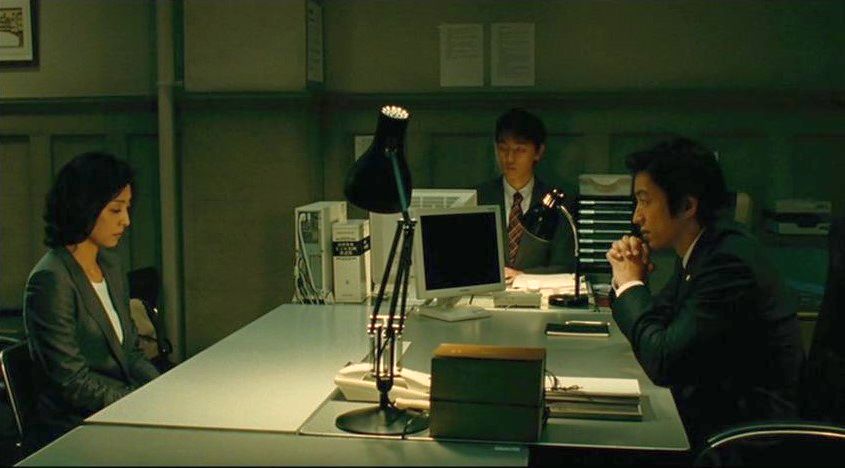
The second part of about fifty minutes takes place almost exclusively in the office of the prosecutor. The spatial unity is broken just once and only for a very short time when Orii goes to the ladies’ room. And the last shots show her arrest after which she is led down a long corridor. At first glance, the mise-en-scène of this second part seems less varied. However, it is not less intense than the first one. On the contrary, the film’s oppressive mood reaches its climax in the interrogation scene. There are long takes of the characters, but Suo makes clever use of the restrained space. Editing, framing and camera movements, including travellings and panorama shots, add enough vivacity to the long scene to make it both appealing and unsettling. There is also the prosecutor’s young male assistant (Yoshihiko Hosoda), recording the interrogation. He observes Tsukahara’s manoeuvres with changing reactions, often taken aback by his superior’s pitiless attitude towards Orii.
The intimate nature of the interrogation scene and the slow pace, perfectly suited to the dramatic situation, create a constant tension, which is heightened by the lightening or rather the darkness that invades the room. At the beginning, the shutters are half-closed, letting in the dim light of a November afternoon. By the time the interview ends, night has already set in. The washed-out colours of the first part contrast with the gloom of the interrogation scene which creates a strong sense of impenetrability and hopelessness.
The interrogation in the dark, closed space, which creates a constant feeling of desperation and instability, is filmed as a duel between the prosecutor and Orii, one fought with unequal weapons. Orii is nothing more than Tsukahara’s prey. In one of the film’s first scenes, the outcome of the interrogation is hinted at the moment a pair of handcuffs, in one of the drawers of Tsukahara’s desk, is framed in a close-up. At the end of the film, Orii leaves the office in handcuffs. The highly allusive image from the beginning finds its conclusion. Tsukahara does everything in his power to have Orii charged with murder. Although she fulfilled Egi’s fervent wish to die with dignity, she has, in fact broken Japanese law. Euthanasia can be carried out when death is imminent and unavoidable or if the patient is in excruciating pain and there are no alternative methods of pain relief. There must also be a written statement of the patient’s wishes regarding the shortening of his life (3). Egi, however, only stated in a conversation with Orii that he did not want life prolonging measures if he was no longer conscious. Nor did any of the other reasons exactly apply to Egi’s case, as Tsukahara makes clear, even though Orii refers to his mental anguish and the stomach ulcer as a symptom of stress. Tsukahara insists on the lack of a written statement and the fact that Egi never expressed his wish to die with dignity to his family. He considers this act of mercy killing to be unacceptable. Katsunori Kai, a professor of law at Waseda University, writes: “This conduct is considered as a homicide in Japan (4).” Tsukahara acts within the law, but his portrayal as an extremely manipulative man who does not stop asking leading questions and constantly tries to intimidate Orii, makes him seen almost like the villain. He has already passed judgment on Orii who is at his mercy. Since he intends to build a murder case from the start – the arrest warrant is already prepared in a drawer of his desk –, all he has to do is wear Orii down so that she falls into his trap. He starts by deliberately making her wait a long time.
Besides Orii and Egi, the prosecutor is the most important character in the film. Instead of the gentle Egi, Orii now has to deal with the aggressive masculinity of an authoritarian personality. Ōsawa plays Tsukahara with fascinating intensity as an ice-cold, calculating man accustomed to power. The film gives him plenty of room for a multifaceted performance which dominates the long interrogation scene. At times he smiles smugly, at others he lords his power over Orii in anger, shouting at her, accusing her of lying, humiliating her and cleverly twisting her words, to the point where she finally breaks down in tears. But he is also an attentive observer, and not completely insensitive. When Orii mentions that she knows the feeling of helplessness that arises when a patient has a tube inserted or is unable to communicate his very feelings to the doctor, he immediately understands that she has attempted suicide. And he too, has thoughtful moments, which are reflected in his wounded expression. But he recovers very quickly and continues with his strategy to corner Orii. In a few moments, Ōsawa manages an almost imperceptible change of mood.
Some concluding thoughts
Tsukahara says dryly: “You confessed to murder“. Under Japanese law, the public prosecutor has considerable power, and Tsukahara is depicted as a man eager to use it. He insists that he is only interested in facts, facts that will allow him to accuse Orii of murder. This portrayal of the prosecutor as a villain makes it easier for the viewer to identity with Orii. However, Suo does not deny that Tsukahara acts according to the law. Moreover, the flashback showing Egi, having regained consciousness and struggling to breathe after Orii has removed the endotracheal tube, is an extremely violent moment that also casts some doubt on her judgment as a doctor who told Egi’s wife that the action would lead to a quick death. Suo’s sympathy for his female protagonist does not avoid the ethical and medical aspects of her decision, and depicts Egi’s death as a moment of great pain.
At the end, a text states that an entry in Egi’s diary was found and presented at Orii’s trial. In it, Egi said that he was entrusting Orii with his life so that he could die with dignity. The court accepted this as an expression of the patient’s refusal to have his life artificially prolonged. Nevertheless, the doctor was sentenced to two years’ imprisonment and four years’ probation for violating the law, because the court did not consider Egi’s condition to be hopeless. However, the portrayal of Egi’s horrific death is also a burden that Orii has to live with and which has not let her unaffected. Without exploring the moral questions raised by euthanasia through dialogue, Suo insists on depicting emotions and his female protagonist’s inner torment. The gloomy atmosphere in Tsukahara’s office is not only related to the negative portrayal of the representative of justice who uses all his power to create a murder case. The darkness is also like a visual symbol of Orii, torn between her desire to fulfil Egi’s last wish and her feelings of guilt.
Notes
(1)Katsunori Kai points to the fact that Japanese law distinguishes between “euthanasia” and “death with dignity”. See Katsunori Kai, “Euthanasia and Death with Dignity in Japanese Law”, Weekly Bulletin of Comparative Law, 27,3 (2009),p.2. https://www.waseda.jp/folaw/icl/assets/uploads/2014/05/A02859211-00-000270001.pdf
(2) See ibid., p. 5-7 for further details.
(3) See op.cit. for further details, p. 2.
(4) See op. cit., p. 2.
 shomingeki - Filmzeitschrift