by Andrea Grunert
A murder is commissioned: that is the starting point of Takashi Miike’s Shield of Straw (Wara no tate, Japan, 2013). The billionaire Ninagawa (Tsutomo Yamazaki), whose 7-year-old granddaughter has been raped and murdered, offers a reward of one billion yen to anyone who kills the suspected murderer Kunihide Kiyomaru (Tatsuya Fujiwara). When Kiyomaru, on the run, narrowly escapes an attempt on his life, he turns himself in to the police. Inspector Kazuki Mekari (Takao Ōsawa) of the Security Police and his subordinate Atsuko Shiraiwa (Nanako Matsushima) are assigned the task of escorting him from Fukuoka on the island of Kyushu to Tokyo. They are joined by two colleagues from the Tokyo Metropolitan Police and a police officer from Fukuoka Prefecture. The journey of 1,200 kilometres becomes a life-threatening undertaking that not all the members of this team will survive. With the whole of Japan eager to get their hands on the bounty, the police officers themselves are in the role of the hunted.
Shield of Straw is the adaptation of the mangaka Kazuhiro Kiuchi’s eponymous first novel, published in 2004 (1). Takashi Miike, one of the most prolific Japanese filmmakers of the last thirty years, has made use of a great variety of topics and genres including jidai geki (13 Assassins/Jūsannin no shikaku, 2010 and Hara-kiri: Death of a Samurai/Ichimei, 2011), fantasy films rooted in Japanese mythology (The Great Yokai War/Yōkai Daisensō, 2005) as well as directing the Western-inspired Sukiyaki Western Django (Sukiyaki Uesutan Jango, 2007), and Ichi, the Killer (Koroshiya Ichi, 2001), a mixture of crime film and comedy. Many of these works include graphic violence and feature a flamboyant style. At first glance, Shield of Straw might appear to be a straightforward thriller, but, both entertaining and thought-provoking, it is an original work on the rule of law and revenge, duty and trauma that also offers reflections on human nature. As in 13 Assassins and Hara-kiri: Death of a Samurai, Miike approaches moral questions that arise in an extreme situation.
The law called into question
Shield of Straw contains numerous action sequences – wild shootings and spectacular mass scenes – and is full of unexpected turns and moments of great suspense. A huge contingent of police escort Kiyomaru and his five guards. However, the first incidents occur on the motorway in the metropolitan area of Fukuoka, where an intimidating battalion of several hundred policemen are massed to manage the transfer and line the route (2).
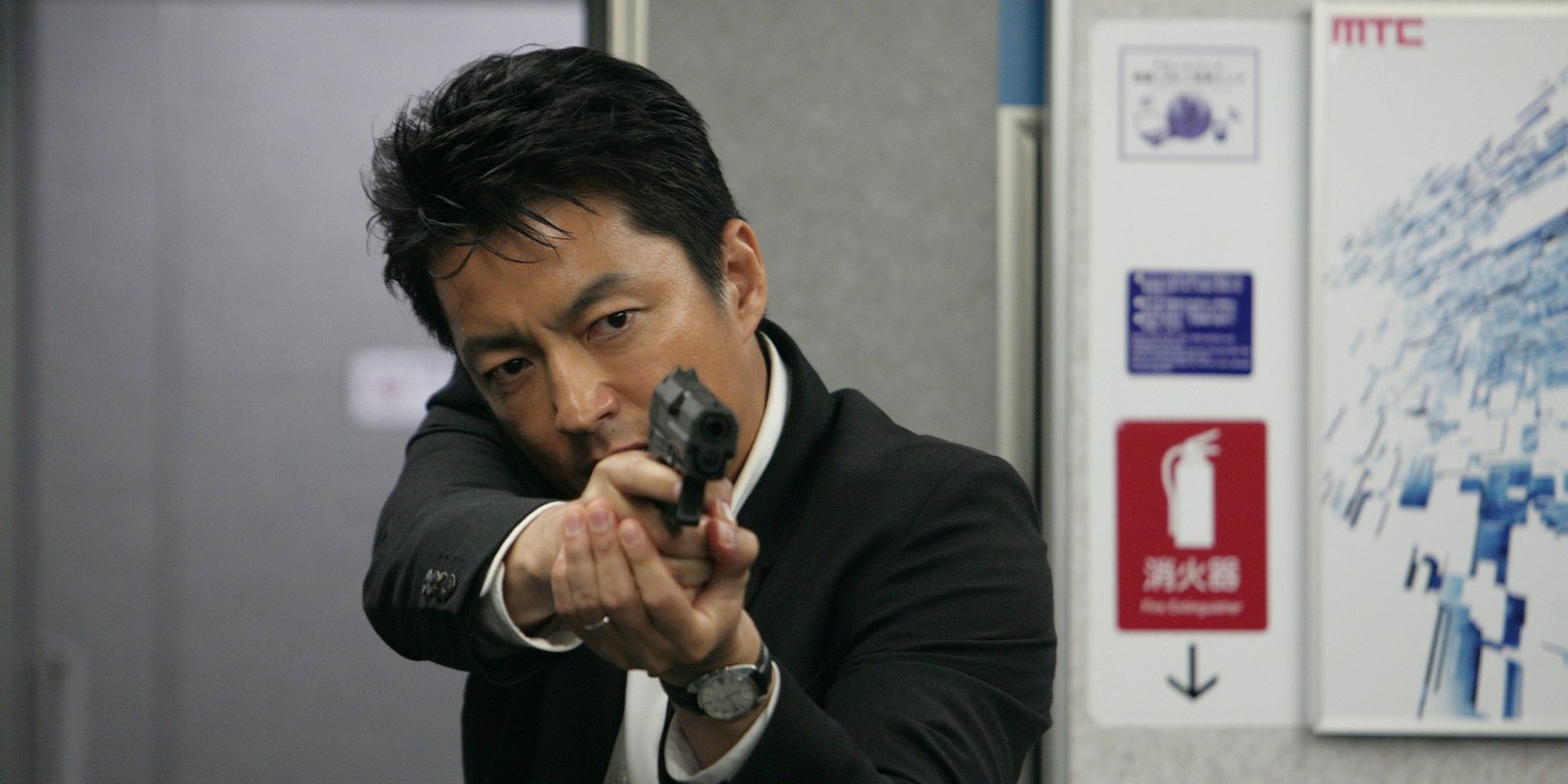
The five police officers whose task is to conduct Kiyomaru safely to Tokyo all have different views on their mission. Kamihashi (Kento Nagayama), the youngest of them, expresses most openly his hatred of the murderer. Shiraiwa says, jokingly, that the team is the closest to the one billion yen. However, she threatens Kiyomaru twice with her pistol and seems eager to kill him. Okumura (Gorō Nagayama) says that he would not mind if someone killed Kiyomaru. Sekiya (Masatō Ibu), the police officer from Fukuoka, is a reserved man and shows less contempt. However, he makes no secret of the fact that he understands Ninagawa’s hatred of Kiyomaru and his desire for revenge. It is Mekari, the main protagonist, who is the one almost obsessively single-minded in his determination to protect Kiyomaru at all costs. His sense of duty sometimes collides with that of the three other men, who are not security officers. Each of the five officers having their own idea of the law and justice, the delicate balance between good and evil is continually threatened (3). Repeatedly challenged by people who want to get their hands on the bounty – fellow policemen, yakuza and civilians – the suspicion that one of the five could be a traitor complicates their mission.
The five police officers are required to risk their lives for a murderer – a situation at the core of the moral dilemma addressed in Shield of Straw. There is no doubt about Kiyomaru’s guilt. Portrayed as a completely detestable little man who revels in violence as long as he is not the target himself, he commits another hideous crime in the course of the action, killing Shiraiwa. He is clearly a psychopath who even enjoys the journey, observing his guards closely and provoking them incessantly. Before the murder of Ninagawa’s granddaughter, Kiyomaru had already been sentenced for the rape and murder of a child, and the film emphasizes his pathological interest in young girls when at one point he escapes from his guards. Trying to hide in a small village, his attention is caught by a little girl sleeping on a veranda and it is only the sudden appearance of Mekari that stops him sexually abusing her. Tatsuya Fujiwara’s performance – his malicious grin and obvious enjoyment when witnessing a man being shot – contribute to the portrayal of a criminal who arouses only revulsion.
That Kiyomaru is guilty of murder and highly dangerous are undisputed facts. However, the legal situation is complicated by Ninagawa’s appeal for his murder. By intriguing against Kiyomaru, he reveals his mistrust of the police and the legal system in general. The novel makes it clear that, according to Japanese law, Kiyomaru will not face the death penalty (4), but in Miike’s film, one of the characters states that the murderer will definitely be sentenced to death. However, Ninagawa has taken the law into his own hands, demanding reciprocal justice. His action is not simply a matter of revenge – if someone kills Kiyomaru, that person will face trial for this offence.
Kamihashi’s feeling of disgust for the murderer leads him to threaten Kiyomaru. The father of Kiyomaru’s first victim tries to kill him, but while he acts out of hatred and desperation, greed seems to be the strongest motive for most of those who seek to take Kiyomaru’s life. The hundreds of police officers securing the route for Kiyomaru in Fukuoka and the police units dispatched to the train stations where the train with Kiyomaru and his five guards stops are particularly well-equipped with firearms. They pose a bigger threat than civilians, and high-ranking police officers in Tokyo are even involved in a plan to sabotage the transfer.
In his novel, Kiuchi includes lengthy descriptions of the Japanese security police force to which Mekari and Shiraiwa belong, emphasizing that even if it was established following the American model, it adheres to a policy of non-aggression (5) and it is Ninagawa’s revenge plot that makes it necessary to equip with firearms the five officers travelling with Kiyomaru and also the other police mobilized for the transfer. Miike does not pursue this aspect, leaving it to the viewer to understand the difference between the situation described in the film and the usual practice of the Japanese police. Whereas in the novel Shiraiwa is male, Mekari’s junior and a rather carefree and slightly naïve character, in the film Shiraiwa is not only a woman but also a single mother. Criticism of the difficult role of women in the Japanese police force is hinted at when it emerges that Shiraiwa as a single mother has no prospect of promotion despite her experience and expertise.
Loyalty and obsession
The question why one should protect a villain and risk one’s life for him is frequently posed, and it is Mekari who tirelessly insists on the security officers’ duty to escort Kiyomaru safely to his destination. Giri, which can be translated as loyalty, duty or obedience, was a cardinal value of the samurai-ruled Tokugawa period (1603-1868). In the era of the Tokugawa shogun, collective honour and the protection of both the lord’s and the clan’s honour became more important than seeking personal reward (6). The culture of the warrior class, based on honour, still lingers in Japan’s postwar entrepreneurial culture as well as in institutions such as the police force. His immediate superior says to Mekari that his first and foremost duty is to safeguard the honour of the police, and Japan’s strongly hierarchical system is reflected in the scene in which Mekari, Shiraiwa and the two police officers from Tokyo have to bow to their superiors. Just how much Mekari has internalized the ideal of honour is revealed in the sequence in which Shiraiwa threatens Kiyomaru with her pistol, prepared to kill him. Mekari prevents her from pulling the trigger, appealing to her sense of honour.
Even if questions of loyalty and duty are deeply embedded in Japanese culture, the principled Mekari is also described as a true professional who recalls American counterparts, familiar from cop films. Mekari is an extremely competent security officer, is intelligent, an excellent shot, an attentive observer and a good strategist. He values professional honour and duty and therefore does everything in his power to ensure that the child murderer has a safe journey to Tokyo. Although showing the least revulsion of the perpetrator and his crime, he too is torn between duty and feelings of revenge. However, unlike Ninagawa, who just wants revenge, Mekari consistently defends the rule of law, expressing his disgust at Ninagawa’s interference, which causes chaos and claims lives. Despite sharing with the elderly billionaire a similar experience of loss, Mekari enjoins him to withdraw the bounty offer and face legal consequences.
Contradictions between the law and the notion of justice as well as the topic of revenge are at the core of numerous cop films produced in Hollywood, Donald Siegel’s Dirty Harry (1971) being one of the most famous examples of the genre. In this first of five films with the San Francisco-based detective Harry Callahan played by Clint Eastwood, the legal system is depicted as inefficient and not trustworthy, and in a final showdown, Harry shoots dead the serial killer Scorpio in a situation set up to make it seem a legitimate act of self-defence. Acting as a police officer in the line of duty, Callahan is portrayed as a modern vigilante who defends a system weakened by bureaucracy in which murderers seem to have more rights than victims. Repeatedly disregarding orders, Callahan is notorious for his independent actions, but unlike him, Mekari does not take the law into his own hands or exceed the limits of his power (7). He only once disobeys his immediate superior Ōki (Hirotarō Honda) by not taking Kiyomaru to the nearest police station but instead stubbornly insisting on delivering the prisoner to the headquarters of the Metropolitan Police in Tokyo. He realizes that obeying Ōki’s order would result in Kiyomaru’s death. This determination is a further character trait that Mekari shares with Callahan and other American loner heroes, a determination that borders on obsession.
Keeping strictly within the law and his duty as a security officer who protects his charge – whether politician, VIP or murderer – Mekari saves Kiyomaru from a beating when Kamihashi, incessantly provoked by Kiyomaru, loses his temper. However, when he says: “No hitting, while we’re here”, Mekari suggests that he is not totally against violence and that, at the bottom of his heart, he hates Kiyomaru as much as Kamihashi does. His remark also hints at a wider social context in which police violence is not out of the ordinary, something that is stated more clearly in the novel.
A highly significant similar experience shared by Mekari and Callahan is that fact that both have lost their wives killed by a drunken driver. Without exploring Callahan’s life story, the mention of his tragic loss partially explains his obsessive dedication to his job. This makes the character part of Hollywood’s standard repertoire, but Callahan’s past experience and unresolved grief give him a greater depth and are also a clue to his aggressiveness. Miike explores this aspect of grief, showing Mekari in his flat where he behaves as if his wife were still alive. Numerous references in the novel reveal how much Mekari still lives in the past, unable to overcome his wife’s death. For him, time has stood still since she was killed. Kiuchi also repeatedly refers to Mekari’s death wish, expressed in inner monologues, but Miike only suggests it, Mekari saying that he has only been able to survive the last three years by focusing on his duty as a security guard. He claims that he is following what his wife once said, namely that his job is to protect others. Later, he states that she never said such a thing and that he invented it to be able to cope with his loss. In the world of his imagination, he has often killed the hit-and-run driver, and he admits to being the one of the five police officers who most wants to see Kiyomaru dead (8).
As a security officer, Mekari acts as a living shield for Kiyomaru, protecting him with his body on a number of occasions. However, the motif of the “shield” has a further meaning in Miike’s film – Mekari’s professionalism and determination to see the job through to the end are a shield for his wounded soul, a shield guarding him against his trauma that also prevents him from seeking revenge and breaking the law (9). Fighting their inner demons, both Callahan and Mekari tread the narrow path between good and evil. Their job alone is a means to shield them from turning into murderers.
Action and reflection
Kiuchi uses inner monologue to reveal Mekari’s psychological condition, his death wish and his inability to come to terms with his wife’s death. Miike contents himself with allusions and references in dialogues to reveal Mekari’s past and inner torment. In one sequence, the father of Kiyomaru’s first victim tries to kill the murderer of his daughter. Mekari hits the hysterical man in the stomach, forcing him to collapse. He then bends down to the man lying on the ground and apologizes to him, speaking in a soft, almost tender voice. The look on his face filled with pain shows his understanding for the man. Ōsawa’s restrained but powerful acting reveals how much Mekari is a multifaceted and even mysterious character who loses control only once when, towards the end of the film, he cannot bear Kiyomaru’s cruelty any longer and batters him with his fists while screaming out his pain and anger.
Acting contributes considerably to the portrayal of the characters in the film and clever mise-en-scène supports both the acting and the settings. Many of the scenes take place in narrow spaces – a room in the hospital, the interior of the carriage in the bullet train. Miike makes superb use of depth, with people in the foreground, middle ground and background. Long dialogue scenes are enlivened by the characters changing position within the frame. They give the actors the opportunity to communicate through their gaze, which is as telling as words. Dialogue scenes with close-ups, looking impressive in the widescreen format, alternate with fast-paced action. And shots of the train speeding through the countryside repeatedly create breaks in the action and serve as time jumps, which are numerous in the film. For example, when Mekari offers an alternative to the vehicle convoy that has turned out to be a fiasco, his strategy is not expressed verbally and instead its implementation is shown. First by a single shot of the convoy starting to move again, and then, after another cut, by a shot of Kiyomaru and the five officers boarding a train in a railway station. These two shots are enough to understand Mekari’s plan – the convoy continuing as a decoy whereas Kiyomaru is taken to Tokyo on a bullet train and accompanied only by Mekari and his four colleagues.
In conclusion
In the course of the action, a situation arises in which killing Kiyomaru becomes legal. A rumour spreads that Mekari and Shiraiwa are Kiyomaru’s hostages and killing him would now be considered a legitimate act. Ninagawa’s plan for revenge now seems to be succeeding, as if he had foreseen such a situation. But Mekari stands firm, demonstrating to Ninagawa, that money cannot buy everything and that his attempt to circumvent and bend the law is wrong. Mekari’s determined pursuit of his duty prevents further transgressions of the law as a result of the elderly billionaire’s interventions..
Shield of Straw does not express criticism of the death penalty and gives a rather stereotypical representation of the child murderer as a monster. However, it is also a film that deals with the fragility of the law and with individual and collective responsibility – a topic important to Miike that is also addressed in 13 Assassins and in Hara-kiri: Death of a Samurai. Concerned with human feelings and human behaviour in an extreme situation, Shield of Straw is about the elusive dividing line between good and evil, about the fragility of this simplistic view and about trauma and revenge. The film’s final shot of Mekari and Shiraiwa’s young son reveals that the main protagonist’s physical and mental recovery from his ordeal has not been achieved by his relentless endeavours but is rather the result of a profound change in his life that embraces the fulfilment of duty but also human concern.
Notes
(1) Kiuchi is best known for his manga Be-Bop High School (Bi Bappu Hai Sukūru, 1983-2003).
(2) In the press conference at the Cannes Film Festival in 2013, where Shield of Straw was presented in competition, Miike explained that the scenes taking place in the bullet train were shot in Taiwan because the Japanese railway did not allow shooting in Japan for security reasons. The fact that Taiwan and Japan have the same high-speed train system was also helpful. The scenes on the motorway, requiring a great number of extras, were also shot in Taiwan because it was not possible to close motorways in Japan and feature such a large number of police vehicles. https://www.festival-cannes.com/f/wara-no-tate/
(3) See also Takao Ōsawa talking about this topic in the film’s press conference at the Cannes Film Festival in 2013. https://www.festival-cannes.com/f/wara-no-tate/
(4) Capital punishment is still a possible sentence in Japan and is still enforced. However, this is often after more than two killings or after a particularly horrendous crime.
(5) In the film, this topic is touched on by Shiraiwa wondering whether security officers will use firearms for the first time in Japan’s history.
(6) As Eiko Ikegami writes, “The collective honor of the samurai class was in fact the symbolic architectural foundation of the Tokugawa bakuhan state.” (The Taming of the Samurai: Honorific Individualism and the Making of Modern Japan, Cambridge, Mass., Harvard University Press, 1995, p. 212)
(7) See Ikegami, ibid., p. 212-213.
(8) In the novel, Mekari’s wife has died of cancer. The film implies a desire for revenge because of the fact that Mekari’s wife was the victim of a hit-and-run accident. Her violent death is, moreover, all the more tragic because she was pregnant.
(9) Unlike Callahan, who has killed in the past and at the end of the film shoots the murderer Scorpio, Mekari, who is practising shooting when he first appears in the film, has never killed, nor does he kill Kiyomaru.
 shomingeki - Filmzeitschrift