by Andrea Grunert
Shinji Araki, whom I interviewed in 2024 (1), has kindly given me access to his new work, the short film The Temptation I Had (Sono yuwaku). His first long feature, The Town of Headcounts (Ninzū no machi, 2020), is set in the future while keeping elements of the contemporary world, and Penalty Loop (Peneruti rupu, 2024 [2]) is a mixture of a variety of genres in which fantasy elements intrude into everyday life situations. As well as being highly gripping, both films offer deep reflections on individual responsibility and humanity.
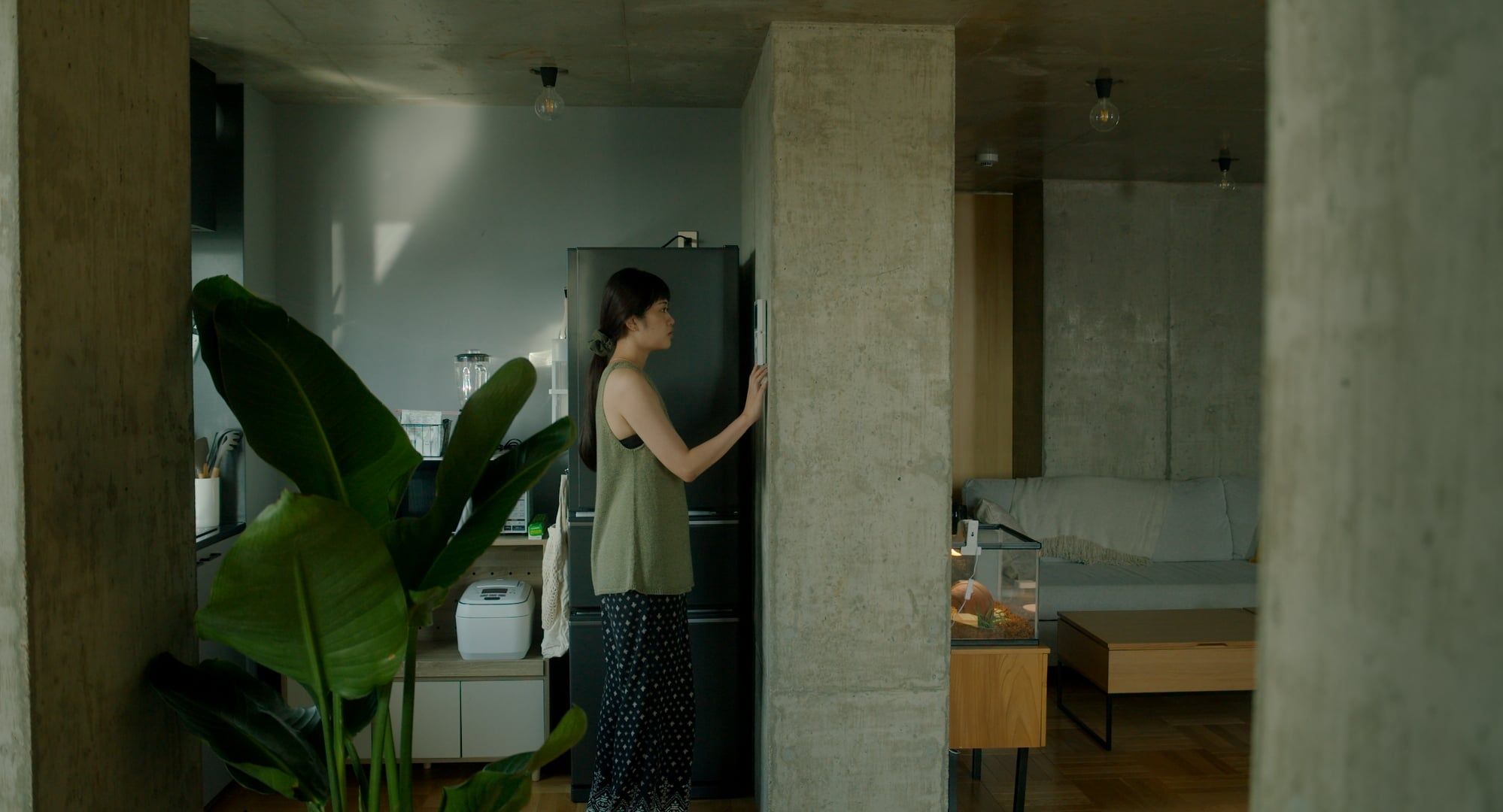
The 30-minutes-long The Temptation I Had also blends present-day reality and fantasy. Most of the action takes place in the apartment in which Kaori (Risa Asanuma) and Takao (Tomomitsu Adachi) live and is anything but futuristic. The outside takes are of ordinary settings: a road intersection filmed from a bird’s eye view, a modern apartment building, an empty plot of land … At first glance, all seems absolutely trivial. However, there is a lingering uneasiness that is created by the voice-over. While the camera captures moments in the couple’s daily life in their private space, Kaori’s voice reveals her concerns about changes in her husband’s behaviour. His habits are not the same as they used to be. The Italian-style noodles he normally prepares so well are suddenly tasteless, whereas the Japanese dishes – usually not his forte – are excellent. The way he uses the vacuum cleaner to clean the floor is also different. And even his physical shape seems to have undergone some strange transformation.
The voice-over reveals the young woman’s inner feelings. She also shares her thoughts with a female friend – Rika (Rio Kanno) – with whom she exchanges text messages. The voice-over and the messages, which are superimposed on images of Kaori, express her misgivings, which are at the core of the narration. Both the voice-over and the text messages add meaning to the images.
The questions Kaori asks herself imbue the film with latent tension, creating moments of suspense. The separation of image and sound together with the text messages, which appear as on the screen of a smartphone, heighten the film’s appeal and create emotional distance. They also contribute to the feeling of mystery that permeates The Temptation I Had. As in Penalty Loop, in which the uncanny pervades the protagonist’s daily life, no special effects are needed to create the realm of fantasy. In Penalty Loop, the futuristic-looking hydroponic plant factory creates an eerie feeling of unfamiliarity. In The Temptation I Had, the bare concrete walls of the apartment or even the bird’s eye’s view of the intersection or the fact that the streets are devoid of cars and pedestrians contribute to the suspense.
Although Rika finds rational answers to her friend’s concerns, the story evolves towards the fantastic. It is in the last part of the film that the uncanny is fully revealed. A dialogue sequence allows the viewers to conclude that despite the overall visual design, which is clearly realistic, they are watching a mystery film.
I will try to avoid spoilers by not providing further clues, but one other key motif, namely desire, can be mentioned without revealing the explanations for Kaori’s worries. In the disguise of the fantastic, Araki deals with questions of sexuality and gender, homosexual desire and sexual identity, and in fact, hidden desires are at the core of his short film. In Penalty Loop, the time-loop narrative is the frame for reflections on guilt and revenge, murder and grief. In The Temptation I Had, the clash between everyday life and fantasy is linked to an unexpected story about desire and hidden feelings.
As in Penalty Loop, there are frequent shots of a tree, its leaves whipped by the wind. Nature is shown as a realm beyond the private space of the apartment in which most of the action takes place. It also alludes to spirituality and inner life and to the magic of nature, so different from the concrete buildings and the tarmac dominating the urban environment. And, as often in Japanese, films, these isolated shots may well not be in any way related to the narration but function instead as a break in the story. Some of the images are beautifully arranged, such as the symmetrical shot of a concrete wall in front of which is a table with a flower in a vase and a glass of wine, evoking a still life. This shot is a clear indication of Araki’s undeniable interest in painting. There is not much music on the sound track except for a few sequences, in particular the one of Kaori and Takao’s passionate lovemaking (3). In general, silence prevails and thereby heightens the feeling of mystery. The slow pace of the narration also invites reflection and at the same time intensifies the latent tension. The atmospheric density that Araki succeeds in creating makes The Temptation I Had a film that is both stimulating and entertaining.
(1) Interview with Filmmaker Shinji Araki
(2) Penalty Loop
(3) The music was written by Ayane Kondō.
 shomingeki - Filmzeitschrift