by Andrea Grunert
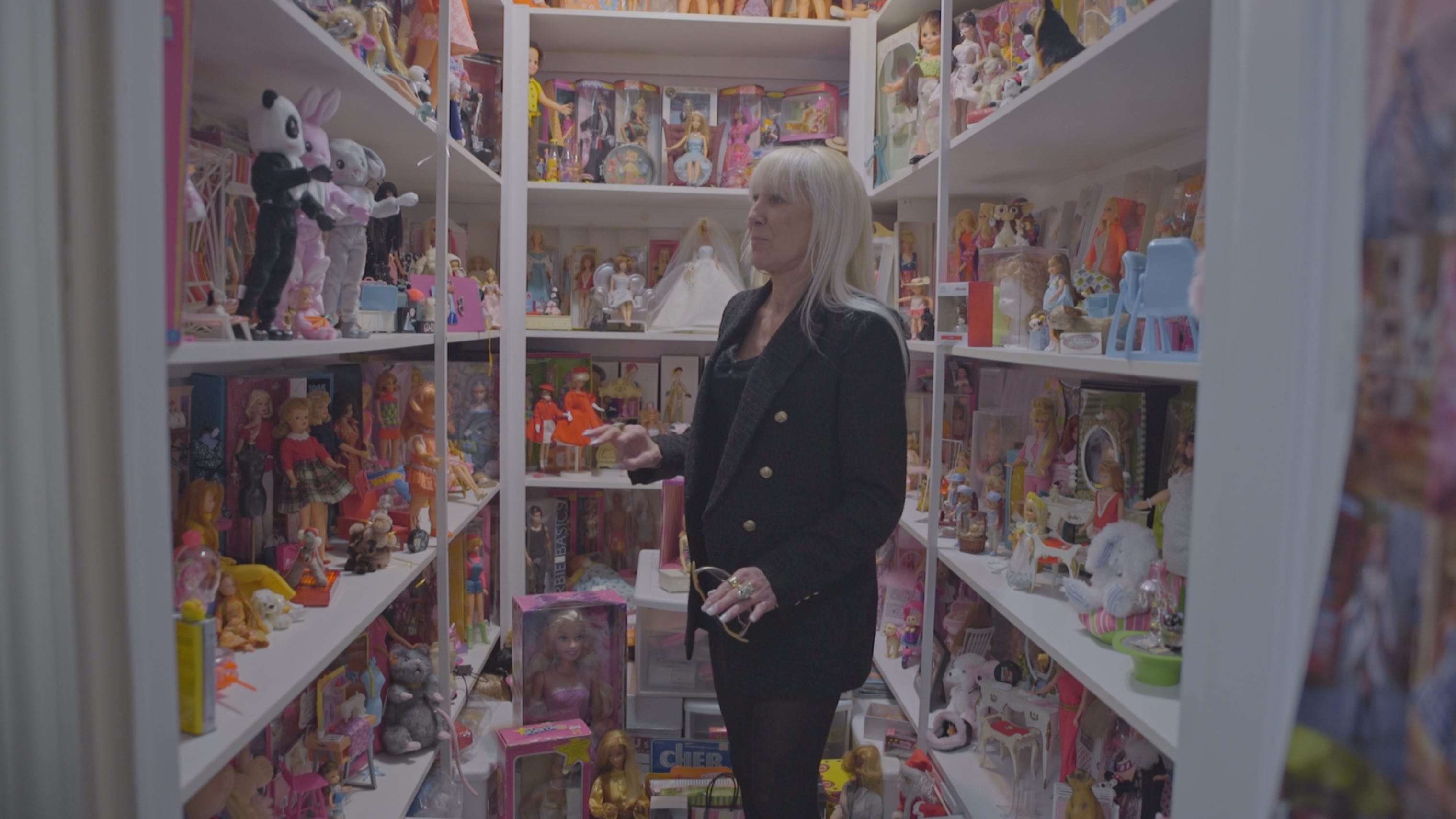
In his documentary on Star Wars fans Que le fan soit avec toi (May The Fan Be With You, Canada, 2022), Marc Joly-Corcoran dealt with an aspect of contemporary popular culture, and the same is true of his documentary film Barbie Boomer. The main protagonist is Sylvie Longpré, a collector of Barbie dolls, and the play on words in the film’s title is a reference to the fact that the protagonist belongs to the generation born in the 1950s. As the title suggests, her story is narrated in a way that combines personal elements with reflections on a wider social context.
The Barbie doll is undeniably part of the history of post-war generations. As Joly-Corcoran recalls in his film, Barbie was created in Germany, first as “Bild-Lilli” in a comic strip that appeared in the tabloid daily newspaper Bild from 1952 on, then three years later as a toy. In 1959, the doll, now named Barbie, became one of the most successful brands of the American toy manufacturer and entertainment company Mattel, which had purchased the rights for commercialization. Barbie, continually adapted to changing images of young women and in accordance with the spirit of the times, is, however, far more than just a toy. She is a symbol of the modern woman who does not define herself purely as a housewife and mother, and she is also a product of the post-war consumer society and, as a sex symbol, a target of male fantasies.
Sylvie Longpré, a second cousin of the director, may not have the biggest and most comprehensive collection of Barbies in the world or even in Canada, but what interests Joly-Corcoran mainly is her way of life. Here Barbie plays an integral part, and the film presents Silvie Longpré as an older woman with a highly complex personality. She speaks about her life and her passion for Barbie, and viewers learn as much about her lifestyle as about her hobby, these two aspects being inextricably intertwined.
Joly-Corcoran films Longpré in a great variety of situations – while arranging her dolls, paying visits to her friend Linda, another Barbie-collector, visiting a toy fair at which Barbie dolls and Barbie merchandise are presented, and meeting the curator of the Musée de la civilisation in Quebec. Her long platinum-blonde dyed hair and fancy clothes are a reference to Barbie fashion. She also drives fast cars and lives in a spacious modern house in the countryside, aspects that suggest the carefree life of the Barbie figure. However, in one scene she is wearing working clothes and fells a tree with a saw, indicating that she cannot be regarded purely as a human version of the Barbie sex-symbol stereotype.
In her monologues and in a variety of dialogue scenes, Longpré reveals her interest in Barbie as a figure opposed to the conventional female role model as housewife and mother. Explanations of Barbie – the doll’s history and social significance – are added by a fictional character, a German speaking female university professor, played by performance artist Jacqueline van de Geer. She appears in a series of shots in which she talks about Barbie in an interview-like manner. Her statements and also Longpré’s thoughts about what Barbie means for her life and for society in general anchor the protagonist’s individual story in a wider sociocultural context. The doll’s significance in this wider context is highlighted by Longpré’s decision to donate some of her collection to the Musée de la civilisation. This museum, aiming to present Quebec’s culture and identity, accepts several of Longpré’s dolls for its archives, and some of them will be on display in June 2026 as part of an exhibition on “Pleasure”.
Longpré’s meetings with the curator and scenes at the event during which the dolls she has donated are shown to the press are part of this exploration of a wider context in which Barbie is seen as an important figure in modern consumerist culture. However, the story leading up to the donation is narrated in a very intimate way, revealing the main protagonist’s inner feelings. For her, parting with her dolls is equivalent to the anxiety parents might feel and express when their children leave home for good. “I have to mourn losing them,“ she says. The feeling of attachment and a fear of loss is all the stronger because Longpré has recently suffered several heart attacks and been close to death. This awareness of her own mortality was a catalyst for the donation, and the fact that her friend Linda has been diagnosed with cancer and is about to undergo surgery is a further aspect that opens up an existential dimension.
Even though Longpré dresses in a stylish way and has sewn some of the Barbie costumes for herself, she is not a cosplayer. Barbie is a natural part of her everyday life, which is reflected not only in her outward appearance but also in her attitude. She is a self-confident woman who has worked as a teacher and tries to live the kind of life she herself wants. The similarity between Barbie and Longpré in their lifestyle is sometimes obvious and sometimes less explicit and even subtle with hints for the viewer that are nevertheless clear enough. She explains that she and her husband have preferred the life of a married couple to that of a family. However, she also states that she cannot live without her Barbies, and she takes care of them as if they were her children. She says that “they are like close relatives”. And adds that Barbie helped her to avoid the worries of an adult’s daily life. For her, Barbie is clearly a source of refuge.
The film’s mise-en-scène emphasizes the interplay between the individual story and the social aspects, and this is underscored by various scenes, including those at the toy fair and in the museum. Joly-Corcoran shows the dolls being catalogued and archived in the museum, and in several shots, Barbie dolls are framed alongside symbols of Christianity such as crosses and figures of saints. In one long shot, the Barbie figures are displayed on a table with the huge statue of an angel next to them, associating Barbie visually with holy relics of the Christian church. This is an image that speaks for itself and supports the statements made by the university professor about the cultural significance of the doll as an icon, in this case, an icon of modernity and consumerism.
By combining an intimate perspective with a journalistic approach that introduces distance, Joly-Corcoran succeeds in creating a strong but discreet human portrait. He avoids clichés and is careful never to ridicule his protagonist’s strong passion for Barbie and her activities as a collector of dolls. At the same time, he does include a critical view of a world that accumulates objects that will inevitably become waste.
*Marc Joly-Corcoran has been teaching editing and scriptwriting at the University of Montreal since 2010. As well as working in the field of documentary film making as director, cameraman and assistant editor, he has also directed a few short fiction films. His first feature film The Mirror was released in 2021 and won several awards, including one at the Montreal Independent Film Festival.
 shomingeki - Filmzeitschrift