chaalchira 1

1.Something like a review

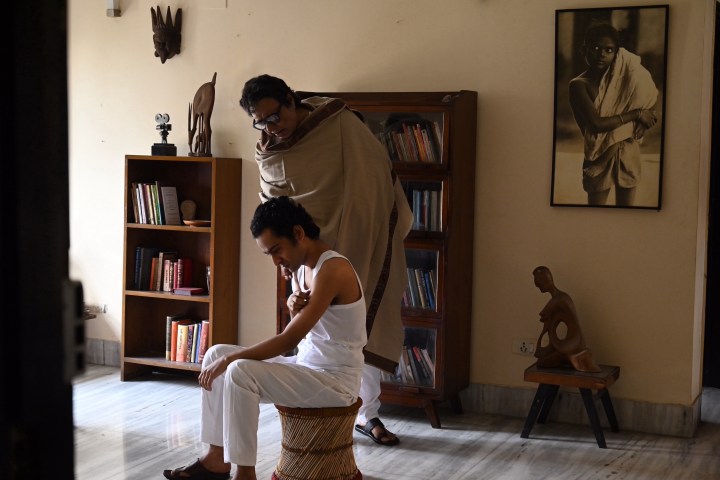
The good thing is – I can still fall for a film, in this case with this strange beautiful beast called Chaalchitra Ekhon. But as I am going old it becomes more and more difficult to translate all this emotions, all this enthusiasm into a coherent prose. The film is very much at the same time. It is a chapter from the biography of one of the most important Bengali film directors Mrinal (called in this film Kunal) Sen, who was a mentor for Anjan Dutt. But it is also a film about the first encounter of these two man. Even though the time is not explicit mentioned, it is 1980 when Sen casts the young Anjan (called in this film Ranjan) for his film Chaalchitra (Kaleidoscope). In this sense it is Dutt´s second autobiographic film which begins where Dutta Vs Dutta ends. But it is as well a film about Kolkata.

We see them while shooting the film and often in long discussions. Beside discuusions about their different ideologies and the work on the film, there are moments when they talk more privately, about their families or for example ho Sen became a filmmaker. These moment are hints that the relationship between the two men goes beyond a relationship between mentor and protege and it seemed to be something like these simple mundane but nevertheless poetic moments one can find in the films by Ozu and Ford. Like I mentioned the other protagonist is the city itself.

Anjan Dutt played in his own films often very difficult, alienated and failed fathers or father-like characters. In this film he plays Kunal (Mrinal) Sen another father-like figure but exactly the positive opposite of the father in Dutta Vs Dutta (also played by himself, an aspect I will return later to. Sawon Chakraborty plays the young Dutt. Both performances moved me in different ways. Dutt´s portrait of Sen seems to happen completely out of his memory in his mentor without mimicking and without hyperbolic make-up. Sawon Chakraborty seems to me very credible as the lanky young man. There is for example the funny habit of Sen to collect match boxes. When I saw this film for the first time I enjoyed the affectionate humor. At the first sight I did not feel the melancholy like in his Dutta Vs Dutta or Aami Ashbo Phirey. But when I saw it for the second time, I realized that the songs had as well subtitles (only one of them is sung in English) which changed my mood and changed my perception of this film.

There are two different alienation effects in this film. The one, often tangible in the shooting programme (which take places on non-designed real streets, in cars , trams and lanes and recorded with handheld cameras). Sometimes freeze frame shots interrupt the flow and suspend for a moment the cinematic illusion of movement, the film is for seconds reset to its primordial state, the photograph. This alienation effect reminds me in some films by Mrinal Sen. But since I watched the film again, I discovered a second and very different alienation effect which I connect rather with Anjan Dutt. The wonderful songs by Anjan and Neel Dutt might be the most popular elements in all films by Anjan Dutt. But the songs were always interwoven with care and very thoughtful in the artificial into the architecture of his films, as coordinates for orientation in Dutta Vs Dutta, more experimental as another level of perception in Aami Ashbo Phirey or Finally Bhalobasha. The lyrics from the songs used in Chaalchitra Ekhon suggest a retrospective perspective, from another time rather our present than the passed time of the film´s narration. During this songs, the film sometimes digresses from the narration into lanes, markets or river banks etc. The narrative flow is interrupted and suspended for a moment. But sometimes they seem as well here the pendant to Anjan Dutt´s voice over narration in Dutta Vs. Dutta. While watching the film again, I laughed a bit less and felt a bit more the melancholic under current. The film becomes more a memory of a time and especially of a person who is already missed. It is rather a personal, poetic epitaph. And those we miss, we sometimes remember with a smile.

There is a great moment which gives an image about the visual imbedding in Kolkata´s urban landscape. Ranjan Dutt and Kunal Sen are discussing on Sen´s balcony. Later we see them on the balcony from the streets in a long shot. The two characters appear now a living part of the city´s architecture. That is almost an Edward Hopper-moment.

  1. My experience with this film

I celebrate myself and sing myself

And what I assume you shall assume

For every atom belonging to me

as good as it belongs to you.”

(Walt Whitman, Song of Myself, published in Leaves of Grass))

While writing my review on this film, I came across of a lot of reactions, most of them share my enthusiasm, few of them are more reluctant reviews. Especially the more reluctant with which I can not agree made me thinking about a general problem of film criticism, the judgmental and often smart-alecky perspective. What is the right language one uses when one loves a film with skin, hair and bones. It is relatively easy for me to articulate from the safe place of a reviewer why Chaalchitra Ekhon is a great film but I still think there is more and I am often too shy to articulate when films goes much deeper than for example satisfying the vain connoisseur in me. The kind this film evokes intense emotions and the kind the film haunts me uncalled for days, sometimes weeks, asks for a more personal perspective. Through the films by Ritwik Ghatak and Terrence Malick (from up to 2011), I got a strange awareness of vulnerability which stands often side by side with what we call great art. I could mention other examples. I know, neither Ghatak, Malick or Dutt do not need my praise or the praise of anyone. Moments in films which let me lose very easily the control over my emotions and which are burnt in my memory are the ending of Dutta Vs Dutta and (I come to that later), Chaalchitra Ekhon, many moments from Malick´s autobiographic inspired The Tree of Life or end of Ghatak´s Subarnarekha. The faces who hunt me have nothing designed anymore (they seem often like modern version of Dreyer´s presentation of human faces in La Passion de Jeanne d´Arc) the emotions these moments evoke hit me with their total nakedness, means vulnerability. Is this great cinematic art? I say damn this question! I experienced these moments as what I want to call cinematic singularities, strong moments of truthfulness in which the critic or the connoisseur in me is suspended for moments. Usually my cinephilia works like that: I watch, some moments evoke emotions in me or memories and I entrust the film with my innermost feeling like in a confesstional box or during a therapy session. But there are also experiences with films where this discreet intermediate area is more variable or even instable. The faces, for example of Anjan Dutt, Sawon Chakrabory, Brad Pitt, jessica Chastain or Madhabi Mukherjee are exposed, last but not least through the non-human but precise and often merciless non-human perspective of the camera. Is the exhaustion we see in these faces the performed exhaustion or do they include signs of exhaustion of the performers themselves or probably both together?

Like I suggested how the songs are integrated in Chaalchitra Ekhon, make this film a kind of very personal obituary on Mrinal Sen. The scene when the young Ranjan hugs Kunal/Mrinal Sen clumsy and cries in his arms is for me one of these strong moments where the awareness of just watching a film disappears for a moment. This images goes far beyond a mark of respect of a protege towards his mentor. It is a gesture of love of a young man for aan elder man he wished to have as a father and who finally enables him to find his own path. Like a phantom image, While seeing this moment I remember the end of Dutta Vs Dutta like a phantom image. Before this scene the voice over of Anjan Dutt resumes that no one from the family he was born in will ever see his films. This moment suspends again the artificial spacetime continuum of the film for a moment. Later we see this other “hug-scene”. Here, Anjan Dutt plays his own father. Now he has lost everything. He is a very sick man, hardly able to move and unable to speak. The relationship the son (Ronno/Anjan) had with his father was difficult, the young man suffered a lot. Now, he can not do anything but forgive this godforsaken lost soul with a last hug, the last gesture of love he can offer.

Shall I praise this work Chaalchitra Ekhon forged with heat of life and art experiences or shal I praise the heat which made such films possible at all? Often , my most intense experiences with a film force me to admit that I don´t know nothing anymore at all. There is no question that personal filmmaking today is a big challenge. Despite the amount of work which is necessary, the sweat and the stress, Chaalchitra Ekhon looks like radical Caméra Stylo, written down and filmed like felt and thought, honest and authentic to the bones..

Rüdiger Tomczak

chaalchitra 2

NC24_cinema_Penalty Loop
(Copyright: „Penalty Loop“ Film Partners)

by Andrea Grunert

The Town of Headcounts (Ninzū no machi, Japan, 2020), Araki Shinji’s (1) directorial debut is a sombre portrait of Japan at an unspecified time in the future. The film is the dystopian tale of a society that manipulates its citizens and tries to eliminate the undesirable such as the poor and the criminals. If space is an important factor in this first film, the focus in Penalty Loop, Araki’s second film, is on time (2). Yui (Yamashita Riō), the girlfriend of the film’s main protagonist Jun (Wakaba Ryūya), has been murdered. The young man is devastated and takes the law into his own hands, killing her murderer, Mizoguchi (Iseya Yūsuke), who works as a maintenance man at the same factory as Jun. When Jun wakes up, the day after having had his revenge, it is still June 6th – the same as the day before – and his victim is still alive. Jun is caught in a spiralling loop of violence during which he kills Mizoguchi again and again.
Araki varies not only the situations in which the killing takes place, but he also shifts from reality to virtual reality. What makes his film original and particularly appealing is its visual design. Jun and Mizoguchi work at a hydroponic plant factory, a highly automatized place and almost devoid of human presence. Jun, clothed from head to toe in a protective suit, is almost unrecognizable as a human figure. The huge room in which vegetables are grown and where his task is to set in motion a conveyor belt with heads of lettuce looks sterile. Just as in his previous film with its futuristic-looking setting, Araki does not need special effects to create an eerie feeling of unfamiliarity. In addition, the motif of the time loop is a perfect pattern to display a great variety of genre conventions borrowed from fantasy, horror, and crime films.
The hydroponic factory is certainly a significant feature of Araki’s film, but the plot focuses on the two main characters, Jun and his antagonist Mizoguchi, depicting not only the conflict between the two men – reminiscent of two duellists – but also the development of the relationship between them and their personalities. Jun commits his first murder in a frenzy. He first spikes Mizoguchi’s coffee, leaving him writhing with severe stomach cramp. When Jun later kills him, Mizoguchi is no longer able to defend himself and Jun stabs his victim brutally several times, venting his fury at the death of his girlfriend.
When Jun kills Mizoguchi the second time, Mizoguchi sees his assailant’s face, and from then on starts adopting strategies to avoid being killed. The following day, he does not drink the poisoned coffee but offers it to a female employee at the factory and watches almost with glee as the woman writhes in pain. To begin with, there is no dialogue between Jun and his opponent, but language soon becomes an indication of rapprochement as human beings. Jun’s desire for revenge moderates and Mizoguchi, realizing that he is going to die, reacts with sadness.
Despite its emphasis on death and violence, Penalty Loop is not lacking in humour, for example when Jun pushes a trolley on which is Mizoguchi’s dead body, wrapped in a plastic bag and kept in an upright position through the aisles of the factory, a group of employees watching in amazement. In another scene, Jun complains to his victim: “I am going to dump your body. You are so heavy”, to which Mizoguchi replies laconically “I am sorry.” However Mizoguchi also complains about being in constant pain as it hurts being so frequently stabbed or shot.
Araki skilfully mixes tragedy and humour, just as he convincingly combines the social and moral levels. The Town of Headcounts is full of references to present-day Japanese society, and in Penalty Loop too the plot is firmly anchored in reality. The film also has a strong psychological dimension. At the beginning it is reported that the police have arrested Yui’s murderer. That does not seem to be enough for Jun and he wants to see the perpetrator dead. The death penalty is still carried out in Japan but mainly for what are considered aggravated murders. However, for Jun, the law does not seem to be enough. He is depicted as someone who gives unbridled rein to his anger and helplessness over Yui’s death. These are certainly feelings that many viewers could share from their own experience – although probably from other less dramatic scenarios. The death penalty is hinted at in the scene in which Jun and Mizoguchi go bowling. In this scene two kinds of opponents are referred to, namely “executioners” and “death row inmates”. However, it is not the death penalty that is the focus of Araki’s film but how to come to terms with the violent death of a loved one and how to deal with one’s grief.
Jun is depicted as an attentive and caring person, revealed in one early sequence in which he sets a ladybird free. But the brutal death of his girlfriend changes him and the gentle Jun becomes an unscrupulous avenger who plans Mizoguchi’s death carefully and does not kill in the heat of the moment. The film only hints at how such a friendly and ordinary man can become a killer. However, the development of Jun’s personality does not end there, and he becomes himself a prisoner of the spiralling loop of violence that he has triggered. The constant killing sobers him up, and a new process of realization sets in, Jun realizing more and more clearly that revenge will change nothing. Nevertheless, he cannot stop killing.
This awakening of a conscience also means that he can for the first time really come to terms with the past, revealed in flashbacks showing him with his girlfriend. In this way, Araki indicates just how much grief is a slow process. Jun’s girlfriend is presented as a mysterious young woman whom he first met when she was burning documents on a beach. Even when Mizoguchi – who reveals that he is a contract killer – talks to Jun about the murder, much about Yui remains in the dark. For Jun, the brutal loss of his girlfriend also means that he does not get any answers – neither about Yui’s behaviour nor about her true feelings. These many unanswered questions torment him as they do many other bereaved.
The character of Mizoguchi does not perhaps have much depth, but is far more than a mere cliché. Araki, who is also the screenwriter of his film, could easily have portrayed Mizoguchi as an embodiment of evil. Instead, he emerges as a broken figure, which is emphasized by Iseya Yūsuke’s performance, as nuanced and imaginative as ever (3). His acting gives the character profile. Intrigued by Jun who is drawing a picture of a mighty tree close to the factory, he finally tries to draw the tree himself. The camera remains on Mizoguchi for a long time while he concentrates deeply on what is for him an unusual task but enjoys this peaceful moment, a smile lighting up his face. The melancholy but also the joy that he experiences suggest that he too is changing. Artistic creativity is set in contrast to violence and death. By portraying Mizoguchi as a human being rather than a cliché, Araki enriches the film’s moral dimension and critically questions revenge.
In addition to ethical reflections, the questioning of the revenge motif and implicitly of the death penalty, i.e. violence sanctioned by the state, Penalty Loop has a strong spiritual dimension, an aspect mentioned by Araki Shinji in the interview I conducted with him (4). Nature plays a major role in the film’s technological world, which is both realistic and at the same time detached from reality. The factory looks futuristic but is real – Penalty Loop was shot in a hydroponic plant in Fukushima Prefecture. In the factory, nature is domesticized and completely under human control. It is presented as a modern landscape and a human interpretation of nature. But there are also plants in Jun’s apartment and frequent shots of the huge tree that the two protagonists draw. While Mizoguchi is drawing his picture, the wind blows through the tree’s foliage, evoking the idea of a ghostly presence. The same suggestion of a spiritual presence is created by the image of an isolated spot in a bamboo grove, recalling similar images from numerous jidai geki. Nature is central to Shintoism, which holds that restless spirits who have been torn from life unnaturally inhabit trees and howl their suffering to the winds (5). Making use of these conventions, Araki succeeds very convincingly in externalizing inner feelings via pure visual imagination.
Flower symbolism is repeatedly evoked by the radio commentator Jun listens to every morning. According to the voice on the radio, the iris, the flower of the day – i.e. June 6th – is a symbol of hope. However, the yellow iris has a negative connotation, being a symbol of revenge, and thus this symbol combines both the film’s revenge motif and its yearning for hope.
There is no image of a yellow iris in the film, but Jun, the avenger, drives a yellow car. Colours are very important in The Town of Headcounts, and in Penalty Loop too, Araki giving a great deal of emphasis to colours. The film’s main colour is green – the rich green of the salads and vegetables in the hydroponic factory and that of the leaves on the huge tree on the factory’s premises, the green of the bamboo grove and of the plants in Jun’s apartment. This lively colour establishes a significant contrast to the theme of murder and violence. There is also the blue of the water in the sequence in which Jun and Mizoguchi are rowing on a lake. Filmed from bird’s eye view, the bluish-turquoise surface of the water creates an almost idyllic image. This brief moment contrasts with the nocturnal images in which water is linked with death – Yui is murdered near a lake; Jun apparently dumps Mizoguchi’s dead body in the same lake. Even the scene with the two men in the boat ends with a death when Jun shoots Mizoguchi dead. Araki’s use of water as a motif in the film is a reminder that this element is in many cultures strongly associated with both life and death and expresses the very idea of rebirth.
Araki privileges image, music and sound over dialogue. Emphasis is put on the actors and how they communicate using their eyes and their facial and body expressions. Very often, Araki is content to offer allusions. In Penalty Loop, the viewer does not know any more than the characters do, but is it necessary always to explain everything? Making clever use of the time loop narrative, Araki has created a film full of unexpected turns. Despite its violent theme, Penalty Loop is highly entertaining, and the spellbinding combination of drama and comedy leaves enough space for deeper reflection on death, loss and grief. Moreover, Araki succeeds marvellously in combining a great variety of narrative and visual elements without destroying the film’s internal coherence.
Notes
(1) Names are written according to Japanese conventions: the family name before the given name.
(2) It should be noted that the time loop motif figures in two other recent Japanese films: Takebayashi Ryō’s Mondays: See You “This” Week! (Mondays: Kono tainurūpu, jōshi ni kidzuka senai to owaranai, 2022) and Yamaguchi Junta’s River: The Timeloop Hotel (Riba; nagarenaide yo, 2023). The first of these films deals with Japanese white-collar workers, a young salaryman being caught in a time loop. In the second, the characters are caught in a two-minute time loop at an inn in the countryside. Penalty Loop is however very different from these two films, the time-loop factor being the only common element.
(3) See Araki Shinji on working with the actors in the interview that I conducted with him during the Nippon Connection Film Festival in Frankfurt on May 30th, 2024.

(4) ibid.

(5) Links between nature and the spiritual world are also features of Buddhism and other religions.

IMG_1064

Siegfried Kracauers „Straßen in Berlin und anderswo“ wurde 2009 neu herausgegeben, 1964 ziemlich unbeachtet erschienen, lässt uns die Sammlung von Feuilletons (entstanden zwischen 1926 und 1933) Kracauer als wachen und auch wahr-träumenden Beobachter des Vorkriegsalltags kennen lernen. Es ist faszinierend, wie wir in diesem Buch auch kommendes Unheil, hinein oder herauslesen können, alles verdichtet im Text über die Kaiser-Wilhelm-Gedächtniskirche, betitelt „Ansichtspostkarte“. Die noch unzerstörte neoromanische Kirche war eines der beliebtesten Berlin-Motive auf Karten, so beliebt wie heute das Foto von der Ruine und dem Kirchenneubau. Es ist ein geradezu prophetischer Text, der doch mit Vorurteilen beginnt, mit Architekturkritik und religiöser Überheblichkeit. Kracauer meint zu wissen, dass in diesem Haus Gott nicht wohnen und nicht angebetet werden kann. Wie in einer Vision ihrer Zerstörung wird aber die verachtete Kirche am Abend durch das Licht der benachbarten Kinos fast aufgelöst. Dieses Licht und seine profane Herkunft wird – quasi soziologisch – genauso kritisiert und verachtet wie der Kirchenbau. Doch spricht Kracauer diesem Lichtspiel eine Kraft der Verwandlung zu: den Ort zu einem „Hort des Vergossenen und Vergessenen“ gleichsam umzuschaffen. Es ist die Vision der Umwandlung in eine andere Art der Gedenkkirche, nicht zur Erinnerung an einen Kaiser, – obwohl sie seinen Namen weiterhin trägt – sondern in ein Mahnmal, die Vision einer da noch unbekannten Zukunft von Schuld, Zerstörung und Bewältigung. Ein Ort, an den Menschen heute wirklich auch kommen, um Tränen zu vergießen. Die Kerzenleuchter in der Gedenkhalle, dem ursprünglichen Eingangsbereich der alten Kirche, sind umlagert und füllen sich nach der Öffnung morgens im Nu mit angezündeten Lichtern.
„Die Kaiser-Wilhelm-Gedächtniskirche am Abend: wer sie, vom Bahnhof Zoo herkommend, erblickt – und der Großstädter erblickt sie überhaupt nur abends, da sie ihm tagsüber nichts weiter ist als ein riesenhaftes Verkehrshindernis ist -, dem wird ein merkwürdiges , ein beinahe überirdisches Schauspiel zuteil. Von der religiösen Baumasse strahlt ein sanftes Leuchten aus, das so beruhigend wie unerklärlich ist, eine Helle, die mit dem profanen rötlichen Schimmer der Bogenlampen nichts gemein hat, sondern sich fremd von der Umwelt abhebt und ihren Ursprung in den Kaiser-Wilhelm-Gedächtniswänden selber zu haben scheint.
Dringt der fahle Glanz aus dem Kircheninnern hervor? Aber dieser Kuppelbau, der Schwert und Altar miteinander verkuppelt, hat offensichtlich nur den einen Ehrgeiz: nach außen hin zu repräsentieren. Das trägt eine romanische Uniform und ist inwendig gar nicht zu benutzen. Das könnte mit Steinen ausgefüllt sein. Das beschwört die Erinnerung an Bezirkskommandos, Hofprediger und Kaiserparaden herauf.
Der geheimnisvolle Glanz ist in Wirklichkeit ein Reflex. Reflex der Lichtfassaden , die vom Ufapalast an bis über das Capitol hinaus die Nacht zum Tage machen, um aus dem Arbeitstag ihrer Besucher das Grauen der Nacht zu verscheuchen. Die haushohen gläsernen Lichtsäulen, die bunten überhellen Flächen der Kinoplakate und hinter den Spiegelscheiben der Wirrwarr gleißender Röhren unternehmen gemeinsam einen Angriff gegen die Müdigkeit, die zusammenbrechen will, gegen die Leere, die sich um jeden Preis entrinnen möchte. Sie brüllen, sie trommeln, sie hämmern mit der Brutalität von Irrsinnigen auf die Menge los. Ein hemmungsloses Funkeln, das keineswegs nur der Reklame dient, sondern darüber hinaus sich Selbstzweck ist. Aber es schwingt und kreist nicht selig wie die Lichtreklame in Paris, die ihr Genüge darin findet, aus Rot, Gelb und Lila ihre verschlungenen Muster zu bilden. Es ist viel eher ein flammender Protest gegen die Dunkelheit unseres Daseins, ein Protest der Lebensgier, der wie von selber in das verzweifelte Bekenntnis zum Vergnügungsbetrieb einmündet.
Der milde Glanz, der die Kaiser-Wilhelm-Gedächtniskirche umfließt, ist der unbeabsichtigte Widerschein dieser finsteren Glut. Was vom Lichtspektakel abfällt und vom Betrieb ausgestoßen wird – öde Mauern bewahren es auf. Das Äußere der Kirche, die keine Kirche ist, wird zum Hort des Vergossenen und Vergessenen und strahlt so schön, als sei es das Allerheiligste selber. Heimliche Tränen finden so ihren Gedächtnisort. Nicht im verborgenen Innern – mitten auf der Straße wird das Unbeachtete, Unscheinbare gesammelt und verwandelt, bis es zu scheinen beginnt, für jeden ein Trost.“
Tatsächlich ertappe ich mich dabei, dass ich mich in diese Perspektive der Zwischenkriegszeit vor der großen Zerstörung gut versetzen kann. Als Zeitgenossin hätte ich wohl den neoromanischen Bau, der den Geist dieser Epoche nicht einzufangen vermag, – anders als die Turmruine! – auch geringschätzig betrachtet, Und einfach deshalb, weil die Kirche noch da war! Aber der Anblick einer alten Postkarte von 1925 „Berlin: Kurfürstendamm und Kaiser-Wilhelm-Gedächtniskirche“ löst in mir tiefes Bedauern, Erinnerung an die Kriegszerstörung und den Wunsch nach Wiederherstellung aus. Es freut mich immer wieder, dass die Berliner sich den Plänen eines kompletten Abrisses widersetzten. So wurde das Fragment der Turmruine die überzeugende äußere Gestalt der Mahnung. Und in der Gedenkhalle „mitten unter uns“ steht der kriegsbeschädigte Christus, der früher auf dem Altar im Kirchenraum seinen Platz hatte, und heute in seiner versehrten einarmigen Gestalt gütig auch diejenigen begrüßt, die nur zufällig hereinstolpern. Manche Touristen , so erzählte mir eine Ehrenamtliche, fragen sie irritiert, ob sie sich in einer ehemals katholischen oder evangelischen Kirche befinden, da die Halle innen mit byzantinisch anmutenden Deckenmosaiken ausgestattet ist, auf denen man nicht sogleich die weltlichen Herrscher erkennt, die Hohenzollern. Vielleicht erst wenn eine Führung darauf hinweist, geht der Blick nach oben zum zentralen Christus Pantokrator, / Weltenherrscher an der Decke, auch beschädigt, oder – noch übersehbarer – zum Boden, wo ein den Drachen besiegender Erzengel Michael streitet.
Freitagmittag aber beim Coventrygebet, das 1959 formuliert wurde, und jede Bitte mit „Vater vergib“ beschließt, wird die Mahnung greifbar, denn die Gedächtniskirche hat das unglaubliche Privileg, eines der Nagelkreuze aus dieser von Nazideutschland 1940 bombardierten englischen Stadt erhalten zu haben, was mit der Verpflichtung zum Versöhnungsgebet verbunden ist.
So hat sich erfüllt, was in Kracauers Text in einer prophetischen Doppelbelichtung vorweggenommen wurde. Reimar Klein schreibt im Nachwort zu „Straßen in Berlin und anderswo“, die Kirche erinnere nicht mehr an die „Allianz von Thron und Altar“, sondern mahne „auf einmal zur Trauer über vergangenes Leiden.“

Bettina Klix