by Andrea Grunert

Shinji Araki, whom I interviewed in 2024 (1), has kindly given me access to his new work, the short film The Temptation I Had (Sono yuwaku). His first long feature, The Town of Headcounts (Ninzū no machi, 2020), is set in the future while keeping elements of the contemporary world, and Penalty Loop (Peneruti rupu, 2024 [2]) is a mixture of a variety of genres in which fantasy elements intrude into everyday life situations. As well as being highly gripping, both films offer deep reflections on individual responsibility and humanity.
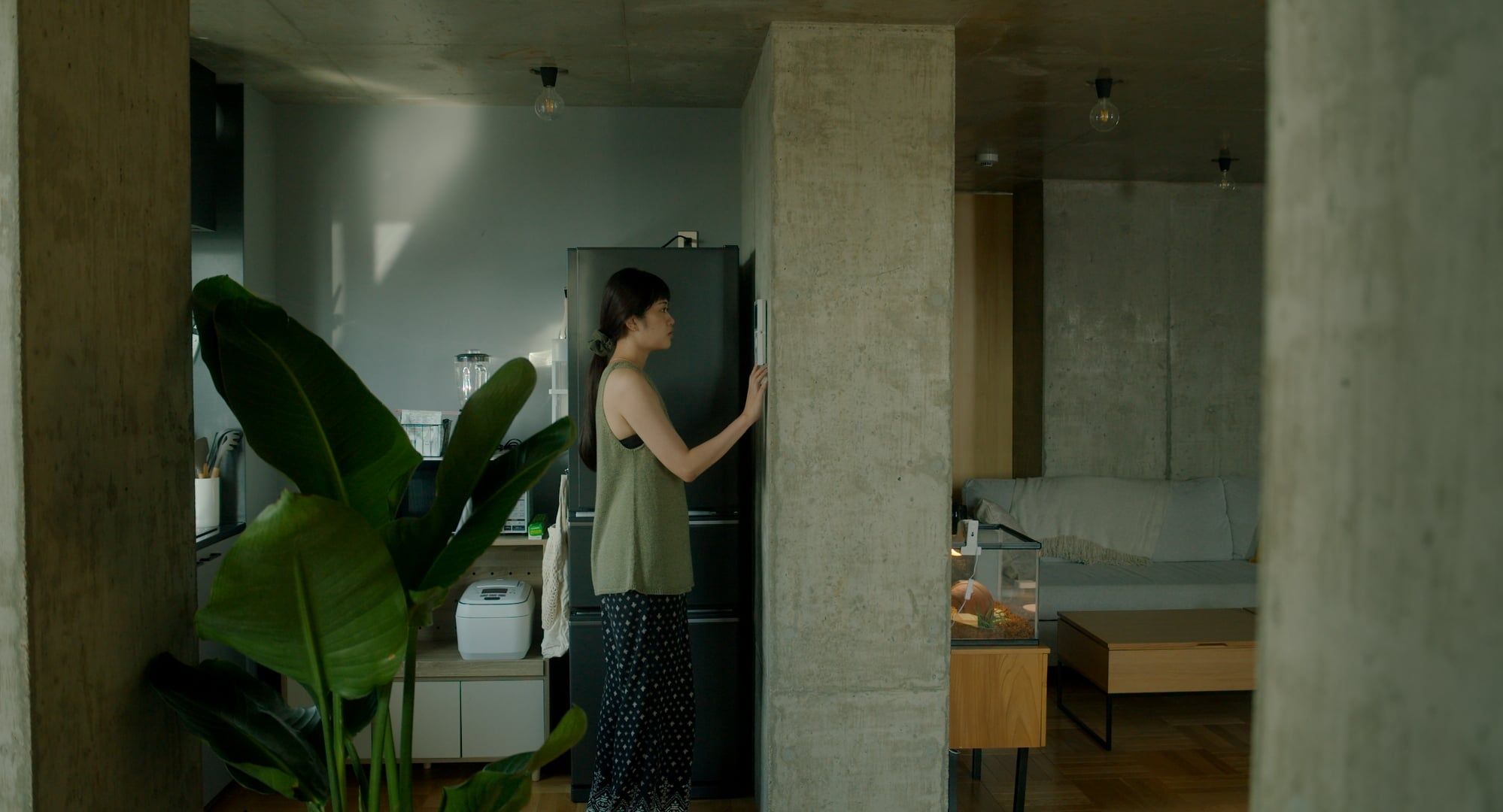
The 30-minutes-long The Temptation I Had also blends present-day reality and fantasy. Most of the action takes place in the apartment in which Kaori (Risa Asanuma) and Takao (Tomomitsu Adachi) live and is anything but futuristic. The outside takes are of ordinary settings: a road intersection filmed from a bird’s eye view, a modern apartment building, an empty plot of land … At first glance, all seems absolutely trivial. However, there is a lingering uneasiness that is created by the voice-over. While the camera captures moments in the couple’s daily life in their private space, Kaori’s voice reveals her concerns about changes in her husband’s behaviour. His habits are not the same as they used to be. The Italian-style noodles he normally prepares so well are suddenly tasteless, whereas the Japanese dishes – usually not his forte – are excellent. The way he uses the vacuum cleaner to clean the floor is also different. And even his physical shape seems to have undergone some strange transformation.
The voice-over reveals the young woman’s inner feelings. She also shares her thoughts with a female friend – Rika (Rio Kanno) – with whom she exchanges text messages. The voice-over and the messages, which are superimposed on images of Kaori, express her misgivings, which are at the core of the narration. Both the voice-over and the text messages add meaning to the images.
The questions Kaori asks herself imbue the film with latent tension, creating moments of suspense. The separation of image and sound together with the text messages, which appear as on the screen of a smartphone, heighten the film’s appeal and create emotional distance. They also contribute to the feeling of mystery that permeates The Temptation I Had. As in Penalty Loop, in which the uncanny pervades the protagonist’s daily life, no special effects are needed to create the realm of fantasy. In Penalty Loop, the futuristic-looking hydroponic plant factory creates an eerie feeling of unfamiliarity. In The Temptation I Had, the bare concrete walls of the apartment or even the bird’s eye’s view of the intersection or the fact that the streets are devoid of cars and pedestrians contribute to the suspense.
Although Rika finds rational answers to her friend’s concerns, the story evolves towards the fantastic. It is in the last part of the film that the uncanny is fully revealed. A dialogue sequence allows the viewers to conclude that despite the overall visual design, which is clearly realistic, they are watching a mystery film.
I will try to avoid spoilers by not providing further clues, but one other key motif, namely desire, can be mentioned without revealing the explanations for Kaori’s worries. In the disguise of the fantastic, Araki deals with questions of sexuality and gender, homosexual desire and sexual identity, and in fact, hidden desires are at the core of his short film. In Penalty Loop, the time-loop narrative is the frame for reflections on guilt and revenge, murder and grief. In The Temptation I Had, the clash between everyday life and fantasy is linked to an unexpected story about desire and hidden feelings.
As in Penalty Loop, there are frequent shots of a tree, its leaves whipped by the wind. Nature is shown as a realm beyond the private space of the apartment in which most of the action takes place. It also alludes to spirituality and inner life and to the magic of nature, so different from the concrete buildings and the tarmac dominating the urban environment. And, as often in Japanese, films, these isolated shots may well not be in any way related to the narration but function instead as a break in the story. Some of the images are beautifully arranged, such as the symmetrical shot of a concrete wall in front of which is a table with a flower in a vase and a glass of wine, evoking a still life. This shot is a clear indication of Araki’s undeniable interest in painting. There is not much music on the sound track except for a few sequences, in particular the one of Kaori and Takao’s passionate lovemaking (3). In general, silence prevails and thereby heightens the feeling of mystery. The slow pace of the narration also invites reflection and at the same time intensifies the latent tension. The atmospheric density that Araki succeeds in creating makes The Temptation I Had a film that is both stimulating and entertaining.

(1)  Interview with Filmmaker Shinji Araki

(2) Penalty Loop

(3) The music was written by Ayane Kondō.


by Andrea Grunert

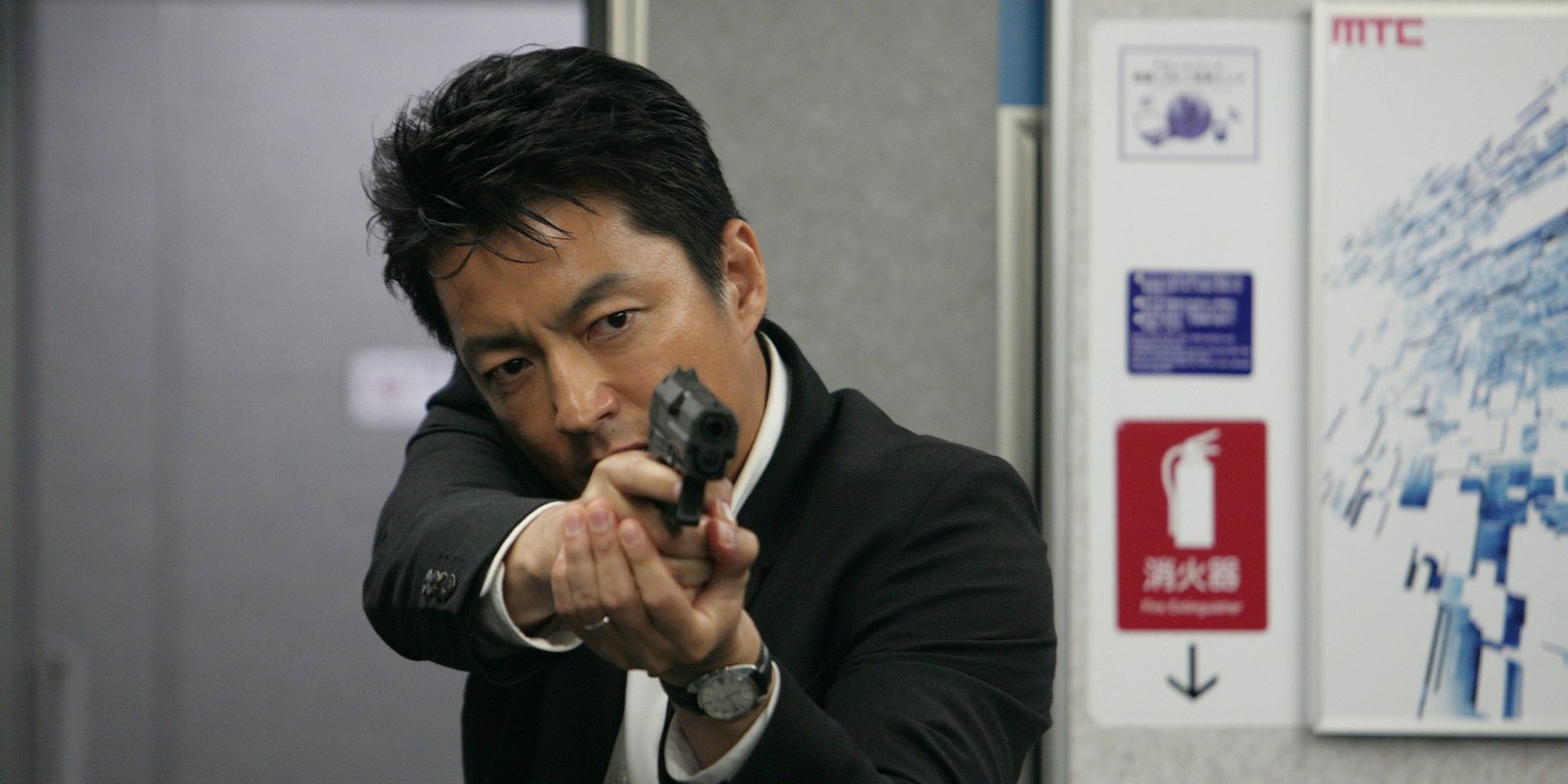
A murder is commissioned: that is the starting point of Takashi Miike’s Shield of Straw (Wara no tate, Japan, 2013). The billionaire Ninagawa (Tsutomo Yamazaki), whose 7-year-old granddaughter has been raped and murdered, offers a reward of one billion yen to anyone who kills the suspected murderer Kunihide Kiyomaru (Tatsuya Fujiwara). When Kiyomaru, on the run, narrowly escapes an attempt on his life, he turns himself in to the police. Inspector Kazuki Mekari (Takao Ōsawa) of the Security Police and his subordinate Atsuko Shiraiwa (Nanako Matsushima) are assigned the task of escorting him from Fukuoka on the island of Kyushu to Tokyo. They are joined by two colleagues from the Tokyo Metropolitan Police and a police officer from Fukuoka Prefecture. The journey of 1,200 kilometres becomes a life-threatening undertaking that not all the members of this team will survive. With the whole of Japan eager to get their hands on the bounty, the police officers themselves are in the role of the hunted.
Shield of Straw is the adaptation of the mangaka Kazuhiro Kiuchi’s eponymous first novel, published in 2004 (1). Takashi Miike, one of the most prolific Japanese filmmakers of the last thirty years, has made use of a great variety of topics and genres including jidai geki (13 Assassins/Jūsannin no shikaku, 2010 and Hara-kiri: Death of a Samurai/Ichimei, 2011), fantasy films rooted in Japanese mythology (The Great Yokai War/Yōkai Daisensō, 2005) as well as directing the Western-inspired Sukiyaki Western Django (Sukiyaki Uesutan Jango, 2007), and Ichi, the Killer (Koroshiya Ichi, 2001), a mixture of crime film and comedy. Many of these works include graphic violence and feature a flamboyant style. At first glance, Shield of Straw might appear to be a straightforward thriller, but, both entertaining and thought-provoking, it is an original work on the rule of law and revenge, duty and trauma that also offers reflections on human nature. As in 13 Assassins and Hara-kiri: Death of a Samurai, Miike approaches moral questions that arise in an extreme situation.

The law called into question
Shield of Straw contains numerous action sequences – wild shootings and spectacular mass scenes – and is full of unexpected turns and moments of great suspense. A huge contingent of police escort Kiyomaru and his five guards. However, the first incidents occur on the motorway in the metropolitan area of Fukuoka, where an intimidating battalion of several hundred policemen are massed to manage the transfer and line the route (2).
The five police officers whose task is to conduct Kiyomaru safely to Tokyo all have different views on their mission. Kamihashi (Kento Nagayama), the youngest of them, expresses most openly his hatred of the murderer. Shiraiwa says, jokingly, that the team is the closest to the one billion yen. However, she threatens Kiyomaru twice with her pistol and seems eager to kill him. Okumura (Gorō Nagayama) says that he would not mind if someone killed Kiyomaru. Sekiya (Masatō Ibu), the police officer from Fukuoka, is a reserved man and shows less contempt. However, he makes no secret of the fact that he understands Ninagawa’s hatred of Kiyomaru and his desire for revenge. It is Mekari, the main protagonist, who is the one almost obsessively single-minded in his determination to protect Kiyomaru at all costs. His sense of duty sometimes collides with that of the three other men, who are not security officers. Each of the five officers having their own idea of the law and justice, the delicate balance between good and evil is continually threatened (3). Repeatedly challenged by people who want to get their hands on the bounty – fellow policemen, yakuza and civilians – the suspicion that one of the five could be a traitor complicates their mission.
The five police officers are required to risk their lives for a murderer – a situation at the core of the moral dilemma addressed in Shield of Straw. There is no doubt about Kiyomaru’s guilt. Portrayed as a completely detestable little man who revels in violence as long as he is not the target himself, he commits another hideous crime in the course of the action, killing Shiraiwa. He is clearly a psychopath who even enjoys the journey, observing his guards closely and provoking them incessantly. Before the murder of Ninagawa’s granddaughter, Kiyomaru had already been sentenced for the rape and murder of a child, and the film emphasizes his pathological interest in young girls when at one point he escapes from his guards. Trying to hide in a small village, his attention is caught by a little girl sleeping on a veranda and it is only the sudden appearance of Mekari that stops him sexually abusing her. Tatsuya Fujiwara’s performance – his malicious grin and obvious enjoyment when witnessing a man being shot – contribute to the portrayal of a criminal who arouses only revulsion.
That Kiyomaru is guilty of murder and highly dangerous are undisputed facts. However, the legal situation is complicated by Ninagawa’s appeal for his murder. By intriguing against Kiyomaru, he reveals his mistrust of the police and the legal system in general. The novel makes it clear that, according to Japanese law, Kiyomaru will not face the death penalty (4), but in Miike’s film, one of the characters states that the murderer will definitely be sentenced to death. However, Ninagawa has taken the law into his own hands, demanding reciprocal justice. His action is not simply a matter of revenge – if someone kills Kiyomaru, that person will face trial for this offence.
Kamihashi’s feeling of disgust for the murderer leads him to threaten Kiyomaru. The father of Kiyomaru’s first victim tries to kill him, but while he acts out of hatred and desperation, greed seems to be the strongest motive for most of those who seek to take Kiyomaru’s life. The hundreds of police officers securing the route for Kiyomaru in Fukuoka and the police units dispatched to the train stations where the train with Kiyomaru and his five guards stops are particularly well-equipped with firearms. They pose a bigger threat than civilians, and high-ranking police officers in Tokyo are even involved in a plan to sabotage the transfer.
In his novel, Kiuchi includes lengthy descriptions of the Japanese security police force to which Mekari and Shiraiwa belong, emphasizing that even if it was established following the American model, it adheres to a policy of non-aggression (5) and it is Ninagawa’s revenge plot that makes it necessary to equip with firearms the five officers travelling with Kiyomaru and also the other police mobilized for the transfer. Miike does not pursue this aspect, leaving it to the viewer to understand the difference between the situation described in the film and the usual practice of the Japanese police. Whereas in the novel Shiraiwa is male, Mekari’s junior and a rather carefree and slightly naïve character, in the film Shiraiwa is not only a woman but also a single mother. Criticism of the difficult role of women in the Japanese police force is hinted at when it emerges that Shiraiwa as a single mother has no prospect of promotion despite her experience and expertise.

Loyalty and obsession
The question why one should protect a villain and risk one’s life for him is frequently posed, and it is Mekari who tirelessly insists on the security officers’ duty to escort Kiyomaru safely to his destination. Giri, which can be translated as loyalty, duty or obedience, was a cardinal value of the samurai-ruled Tokugawa period (1603-1868). In the era of the Tokugawa shogun, collective honour and the protection of both the lord’s and the clan’s honour became more important than seeking personal reward (6). The culture of the warrior class, based on honour, still lingers in Japan’s postwar entrepreneurial culture as well as in institutions such as the police force. His immediate superior says to Mekari that his first and foremost duty is to safeguard the honour of the police, and Japan’s strongly hierarchical system is reflected in the scene in which Mekari, Shiraiwa and the two police officers from Tokyo have to bow to their superiors. Just how much Mekari has internalized the ideal of honour is revealed in the sequence in which Shiraiwa threatens Kiyomaru with her pistol, prepared to kill him. Mekari prevents her from pulling the trigger, appealing to her sense of honour.
Even if questions of loyalty and duty are deeply embedded in Japanese culture, the principled Mekari is also described as a true professional who recalls American counterparts, familiar from cop films. Mekari is an extremely competent security officer, is intelligent, an excellent shot, an attentive observer and a good strategist. He values professional honour and duty and therefore does everything in his power to ensure that the child murderer has a safe journey to Tokyo. Although showing the least revulsion of the perpetrator and his crime, he too is torn between duty and feelings of revenge. However, unlike Ninagawa, who just wants revenge, Mekari consistently defends the rule of law, expressing his disgust at Ninagawa’s interference, which causes chaos and claims lives. Despite sharing with the elderly billionaire a similar experience of loss, Mekari enjoins him to withdraw the bounty offer and face legal consequences.
Contradictions between the law and the notion of justice as well as the topic of revenge are at the core of numerous cop films produced in Hollywood, Donald Siegel’s Dirty Harry (1971) being one of the most famous examples of the genre. In this first of five films with the San Francisco-based detective Harry Callahan played by Clint Eastwood, the legal system is depicted as inefficient and not trustworthy, and in a final showdown, Harry shoots dead the serial killer Scorpio in a situation set up to make it seem a legitimate act of self-defence. Acting as a police officer in the line of duty, Callahan is portrayed as a modern vigilante who defends a system weakened by bureaucracy in which murderers seem to have more rights than victims. Repeatedly disregarding orders, Callahan is notorious for his independent actions, but unlike him, Mekari does not take the law into his own hands or exceed the limits of his power (7). He only once disobeys his immediate superior Ōki (Hirotarō Honda) by not taking Kiyomaru to the nearest police station but instead stubbornly insisting on delivering the prisoner to the headquarters of the Metropolitan Police in Tokyo. He realizes that obeying Ōki’s order would result in Kiyomaru’s death. This determination is a further character trait that Mekari shares with Callahan and other American loner heroes, a determination that borders on obsession.
Keeping strictly within the law and his duty as a security officer who protects his charge – whether politician, VIP or murderer – Mekari saves Kiyomaru from a beating when Kamihashi, incessantly provoked by Kiyomaru, loses his temper. However, when he says: “No hitting, while we’re here”, Mekari suggests that he is not totally against violence and that, at the bottom of his heart, he hates Kiyomaru as much as Kamihashi does. His remark also hints at a wider social context in which police violence is not out of the ordinary, something that is stated more clearly in the novel.
A highly significant similar experience shared by Mekari and Callahan is that fact that both have lost their wives killed by a drunken driver. Without exploring Callahan’s life story, the mention of his tragic loss partially explains his obsessive dedication to his job. This makes the character part of Hollywood’s standard repertoire, but Callahan’s past experience and unresolved grief give him a greater depth and are also a clue to his aggressiveness. Miike explores this aspect of grief, showing Mekari in his flat where he behaves as if his wife were still alive. Numerous references in the novel reveal how much Mekari still lives in the past, unable to overcome his wife’s death. For him, time has stood still since she was killed. Kiuchi also repeatedly refers to Mekari’s death wish, expressed in inner monologues, but Miike only suggests it, Mekari saying that he has only been able to survive the last three years by focusing on his duty as a security guard. He claims that he is following what his wife once said, namely that his job is to protect others. Later, he states that she never said such a thing and that he invented it to be able to cope with his loss. In the world of his imagination, he has often killed the hit-and-run driver, and he admits to being the one of the five police officers who most wants to see Kiyomaru dead (8).
As a security officer, Mekari acts as a living shield for Kiyomaru, protecting him with his body on a number of occasions. However, the motif of the “shield” has a further meaning in Miike’s film – Mekari’s professionalism and determination to see the job through to the end are a shield for his wounded soul, a shield guarding him against his trauma that also prevents him from seeking revenge and breaking the law (9). Fighting their inner demons, both Callahan and Mekari tread the narrow path between good and evil. Their job alone is a means to shield them from turning into murderers.

Action and reflection
Kiuchi uses inner monologue to reveal Mekari’s psychological condition, his death wish and his inability to come to terms with his wife’s death. Miike contents himself with allusions and references in dialogues to reveal Mekari’s past and inner torment. In one sequence, the father of Kiyomaru’s first victim tries to kill the murderer of his daughter. Mekari hits the hysterical man in the stomach, forcing him to collapse. He then bends down to the man lying on the ground and apologizes to him, speaking in a soft, almost tender voice. The look on his face filled with pain shows his understanding for the man. Ōsawa’s restrained but powerful acting reveals how much Mekari is a multifaceted and even mysterious character who loses control only once when, towards the end of the film, he cannot bear Kiyomaru’s cruelty any longer and batters him with his fists while screaming out his pain and anger.
Acting contributes considerably to the portrayal of the characters in the film and clever mise-en-scène supports both the acting and the settings. Many of the scenes take place in narrow spaces – a room in the hospital, the interior of the carriage in the bullet train. Miike makes superb use of depth, with people in the foreground, middle ground and background. Long dialogue scenes are enlivened by the characters changing position within the frame. They give the actors the opportunity to communicate through their gaze, which is as telling as words. Dialogue scenes with close-ups, looking impressive in the widescreen format, alternate with fast-paced action. And shots of the train speeding through the countryside repeatedly create breaks in the action and serve as time jumps, which are numerous in the film. For example, when Mekari offers an alternative to the vehicle convoy that has turned out to be a fiasco, his strategy is not expressed verbally and instead its implementation is shown. First by a single shot of the convoy starting to move again, and then, after another cut, by a shot of Kiyomaru and the five officers boarding a train in a railway station. These two shots are enough to understand Mekari’s plan – the convoy continuing as a decoy whereas Kiyomaru is taken to Tokyo on a bullet train and accompanied only by Mekari and his four colleagues.

In conclusion
In the course of the action, a situation arises in which killing Kiyomaru becomes legal. A rumour spreads that Mekari and Shiraiwa are Kiyomaru’s hostages and killing him would now be considered a legitimate act. Ninagawa’s plan for revenge now seems to be succeeding, as if he had foreseen such a situation. But Mekari stands firm, demonstrating to Ninagawa, that money cannot buy everything and that his attempt to circumvent and bend the law is wrong. Mekari’s determined pursuit of his duty prevents further transgressions of the law as a result of the elderly billionaire’s interventions..
Shield of Straw does not express criticism of the death penalty and gives a rather stereotypical representation of the child murderer as a monster. However, it is also a film that deals with the fragility of the law and with individual and collective responsibility – a topic important to Miike that is also addressed in 13 Assassins and in Hara-kiri: Death of a Samurai. Concerned with human feelings and human behaviour in an extreme situation, Shield of Straw is about the elusive dividing line between good and evil, about the fragility of this simplistic view and about trauma and revenge. The film’s final shot of Mekari and Shiraiwa’s young son reveals that the main protagonist’s physical and mental recovery from his ordeal has not been achieved by his relentless endeavours but is rather the result of a profound change in his life that embraces the fulfilment of duty but also human concern.

Notes
(1) Kiuchi is best known for his manga Be-Bop High School (Bi Bappu Hai Sukūru, 1983-2003).
(2) In the press conference at the Cannes Film Festival in 2013, where Shield of Straw was presented in competition, Miike explained that the scenes taking place in the bullet train were shot in Taiwan because the Japanese railway did not allow shooting in Japan for security reasons. The fact that Taiwan and Japan have the same high-speed train system was also helpful. The scenes on the motorway, requiring a great number of extras, were also shot in Taiwan because it was not possible to close motorways in Japan and feature such a large number of police vehicles. https://www.festival-cannes.com/f/wara-no-tate/
(3) See also Takao Ōsawa talking about this topic in the film’s press conference at the Cannes Film Festival in 2013. https://www.festival-cannes.com/f/wara-no-tate/
(4) Capital punishment is still a possible sentence in Japan and is still enforced. However, this is often after more than two killings or after a particularly horrendous crime.
(5) In the film, this topic is touched on by Shiraiwa wondering whether security officers will use firearms for the first time in Japan’s history.
(6) As Eiko Ikegami writes, “The collective honor of the samurai class was in fact the symbolic architectural foundation of the Tokugawa bakuhan state.” (The Taming of the Samurai: Honorific Individualism and the Making of Modern Japan, Cambridge, Mass., Harvard University Press, 1995, p. 212)

(7) See Ikegami, ibid., p. 212-213.
(8) In the novel, Mekari’s wife has died of cancer. The film implies a desire for revenge because of the fact that Mekari’s wife was the victim of a hit-and-run accident. Her violent death is, moreover, all the more tragic because she was pregnant.
(9) Unlike Callahan, who has killed in the past and at the end of the film shoots the murderer Scorpio, Mekari, who is practising shooting when he first appears in the film, has never killed, nor does he kill Kiyomaru.


Grunert-Image-01

by Andrea Grunert

Okamoto Kihachi (1) started his career as an assistant to several famous directors of Japanese cinema, including Makino Masahiro, Naruse Mikio and Honda Ishirō. He made his directorial debut in 1958 with All About Marriage (Kekkon no subete), a romantic comedy. But he very soon turned to other genres and in 1959, he made his first war film, the satire Desperado Outpost (Dokuritsu gurentai), followed two years later by the sequel Westward Desperado (Dokuritsu gurentai nishi-e). Okamoto also directed several crime genre films. His spy film The Age of Assassins (Satsujinkyō jidai, 1967) once again contains satirical elements as does his jidai geki film Kill! (Kiru, 1968). Jidai geki films are set in the Tokugawa period from 1603 to 1868, and Okamoto’s original approach in this film left an undeniable mark on the genre. Other jidai geki masterpieces that he directed undoubtedly include Sword of Doom (Dai-bosatsu tōge, 1966) and Samurai Assassin (Samurai), the latter being the focus of this article.
Produced by Tōhō Studios and Mifune Productions (2), the film stars Mifune Toshirō, who was already cast in a supporting role in All About Marriage. The film from 1958 marked the beginning of a long period of collaboration of the two men, who worked together on ten films. The script of Samurai Assassin was written by Hashimoto Shinobu, one of Kurosawa Akira’s usual collaborators, and is based on a novel by Gunji Jirōmasa.

The historical context
The action is set in February and early March 1860 in Edo (present-day Tokyo) and focuses on the attempt by a group of rebels to assassinate Ii Naosuke (Matsumoto Kōshirō VIII), the Great Elder, a high ranking official during the shogunate whose status could roughly be compared to that of a modern-day prime minister (3). The period depicted in the film is known as Bakumatsu (“end of the Bakufu”; the Bakufu denoting government by the shogun), a period of great turmoil sparked off by the arrival of American ships in Edo Bay in 1853. The threatening attitude of the Americans put an end to the isolationist policy that Japan had maintained since the 17th century. Bakumatsu ended in 1868 with the abolition of the shogunate and the restoration of imperial rule. Ii, the most powerful official of his time, was a supporter of the Tokugawa shogunate and favoured opening the country up to international trade. However, his policy encountered strong opposition from imperialist loyalists, mainly from those in the provinces Mito, Chōshū and Satsuma, to which Ii responded with violence by ordering the “Ansei Purge” (1858-1860), during which a large number of individuals suspected being disloyal to the Tokugawa shogunate were imprisoned, exiled or even executed. His merciless policy against his opponents made him a most hated figure.
The film’s plot culminates in the assassination of Ii by seventeen imperial loyalists from Mito and one from Satsuma at the Sakurada Gate, one of the entrances to Edo Castle, the shogun’s palace (today`s Imperial Palace) in Edo on 24th March 1860. In the film, Ii has only a few appearances and in one sequence he expresses his regret about the Ansei Purge, considering it too harsh. He is therefore reluctant to take action against the men from Mito who are suspected of planning an attempt on his life purely on the basis of suspicion. He is, moreover, arrogant enough to find it absurd that someone should try to kill him in broad daylight.
The film centres on the group of assassins plotting and scheming, starting with their first failed attempt to kill Ii. During a meeting at an inn, they discuss the reasons for this failure and the possibility that they were betrayed. While they consider who the traitor could be, the camera moves from one face to another until it settles on a figure sitting in the background. Camera movement and framing emphasize that this is the presumed culprit – the film’s main protagonist Niiro Tsuruchiyo (Mifune). While the opening credits run, Tsuruchiyo is shown unabashedly plucking a hair from his nose. In these very first shots of the protagonist, his attitude already differs from that of the other conspirators. He seems uninterested in their discussion and leans against a wall as if he is asleep. His unkempt appearance also distinguishes him clearly from the other members of the group.
Later, it is said that he is a ronin from Bishuu who lives in a shack and has the reputation of being a ruffian, stealing and killing and earning his living as a bodyguard and blackmailer. Numerous scenes show his penchant for violence and alcohol. In fact, Tsuruchiyo is a drunkard and an impetuous and short-tempered man, but he is also one of the two best swordsmen in the group of conspirators. It is because of his great skill with the sword that a man with such a bad reputation could become a member of the Mito group.

Portrait of an outcast
In Samurai Assassin, Mifune Toshirō again plays an outcast and a character guided by his emotions. Because Okiku (Aratama Michiyo), the woman who runs the inn where the meeting of the Mito samurai takes place, bears a striking resemblance to the woman he was once in love with, Tsuruchiyo stubbornly refuses to leave the place for days and becomes obsessed with Okiku. Dialogues and flashbacks reveal Tsuruchiyo’s origins and his decline. Born the illegitimate son of a high-ranking samurai and his concubine, he was adopted by a Doctor of Medicine, a man closely associated with samurai. Supported financially by the merchant Kisoya (Tōno Eijirō), a friend of Tsuruchiyo’s mother, he was given an excellent education as a young man and became the best student in a famous dōjō (a place of immersive learning, especially in the martial arts) in Bishuu. His unrequited love for Princess Kiku (also played by Aratama Michiyo) has turned him into an outcast. Rejected by the young woman’s father (Shimura Takashi) because of his low status, he lost all self-control and started drinking and quarrelling. Expelled from the dōjō, he became a ronin and the depraved individual he is portrayed as in the film. Haunted by the wish to discover the truth about his biological father, he seeks social recognition. His decision to join the conspirators from Mito is not based on ideology but on the hope that he will be rewarded following Ii’s death, and he dreams of becoming a samurai with a steady income.
Mifune’s performance is flawless as ever, his acting being in perfect accord with the portrayal of Tsuruchiyo as a brute, a man whose behaviour, in particular in the film’s final sequence, is close to madness. Despite the many scenes focusing on Tsuruchiyo’s outbursts, there are some moments in which he reveals a different and gentler side of his personality. When Tsuruchiyo plays with his friend Kurihara’s (Kobayashi Keijū) young son, he looks happy and relaxed. But the mention of his dead mother puts an end to this idyllic moment. Tsuruchiyo’s smile fades and his features darken into an expression of sadness.
Mifune’s energetic performance is an important contribution to the film in the way it deals with Tsuruchiyo’s inner torment. The loss of the love of his life and the desperate search for his biological father’s identity are the reasons for his decline and his subsequent struggle for dignity. He tells his friend Kurihara – who is not only an excellent swordman but also a renowned scholar – that his only aim is to live as a human being again. Unable to understand Kurihara’s remark that he has the same dream but extends this aim to other people, he simply says: “I don’t understand. All I know is that you are a good man.” This humble remark implies that Tsuruchiyo is not an intellectual like his friend, but it reveals that he is a caring and sympathetic human being.
However, he is the one who kills Kurihara, suspected by the Mito group’s leader Hoshino (Itō Yūnosuke) of being a traitor. Despite his doubts about Kurihara’s guilt, Tsuruchiyo agrees to the deed after being threatened with expulsion from the group. The prospect of being rewarded by being chosen for the murder of Ii is stronger than his friendship with Kurihara. When the identity of the group’s real traitor is revealed a little later, Tsuruchiyo is desperate, but for the cynical Hoshino, Kurihara’s death is merely collateral damage. In this sequence, which takes place at night in a dimly lit interior, Hoshino’s haughty expression and his pale face, stand out in the darkness, giving him a diabolical aura as the film’s embodiment of evil.
Tsuruchiyo, by contrast, is a character of contradictions. Called a “monster” by some, he is mainly a tormented soul and still capable of deep feelings. His counterpart on a symbolic level can be found in the Noh play Kurozuka (Black Mound), a play that Ii attends a performance of in the film. In this play, the female character who becomes a demon due to obsession wears the hannya mask of a vengeful spirit. However, this mask has a dual significance, the person who wears it being not only a demon but, like Tsuruchiyo, also grief-stricken and tormented, thereby displaying the complexity of the human being.

A cinematic style of contrasts and fragmentation
Samurai Assassin is a film about the end of an era – that of the shogunate – and about darkness pervading a man’s soul. The many nocturnal scenes and the magnificent use of black-and-white photography with its subtle interplay of light and shadow, strongly support these central themes. This is also true for the use of meteorological phenomena such as rain and snow. Many of the scenes take place in pouring rain, underlining the misery of the film’s protagonist as he staggers drunkenly through the muddy streets. The assassination of Ii takes place during a heavy fall of snow, the white blanket on the ground being not a symbol of innocence or purity but referring to death. Also significant is the fact that Ii’s is assassinated on Peach Observance Day, or Girls’ Day/Doll’s Day (hinamatsuri), a festival with its religious origins in Shintoism on which the health and happiness of girls and young women are celebrated (4). On this day, dolls representing the emperor and empress and their entourage dressed in court costumes of the Heian period (784-1185) are put on display. In the film, Okiku has brought such dolls to Tsuruchiyo’s shack and arranged them according to the custom of hinamatsuri. The contrast between the symbols of youth, joy and innocence and Tsuruchiyo’s depravation, represented in this sequence by his dilapidated hut, revealsonce again the complexity of his personality and the tragedy of his life. Talking about his dream of social ascendency. Tsuruchiyo’s smiling face has something childlike, another reminder that this ruthless killer is nevertheless a human being. However, Okiku’s attempt to save Tsuruchiyo from himself fails. Returning to the shack the next morning, she finds on the dirty floor only the dead bodies of the ten killers that Hoshino has ordered Tsuruchiyo to liquidate and also the dolls. Later, the assassination of Ii takes place off-screen, beheaded by Tsuruchiyo, and the film shows the head of the emperor-doll earlier seen as a bridegroom falling down as if it has been cut off – an aesthetic device that also suggests the end of all happiness for Tsuruchiyo and Okiku.
As in other films directed by Okamoto, extravagant framing abounds, such as series of close-ups of faces or objects and an insistence on body parts. In the duel scene between Tsuruchiyo and Kurihara at their first meeting, the camera shot remains on the feet of the two opponents. Only at the moment when the two swords clash are Tsuruchiyo’s face and upper body framed. Very often in this scene, a face, a part of a body or an object are foregrounded. Another frequent device is the use of a frame within a frame, for example when the bamboo screens create a frame in one of the shots. Okamoto employs the technique of depth of field in a particularly ingenious manner, using bodies or parts of bodies as framing devices for a human figure in the background. Satō Masaru’s film score makes use of drums and flutes borrowed from Noh theatre to produce hammering or plaintive but always insistent sounds that are sources of strong tension.
Music, lighting, framing and sudden camera movements destroy any sense of harmony and therefore contribute to a feeling of insecurity and disorientation. The action in the film culminates in the attack on Ii and his retinue, which is filmed in virtuoso fashion and leads to scenes of pure carnage in which the conspirators kill the samurai and servants accompanying Ii and themselves die in the bloodbath. Writhing bodies, severed limbs and screams of the dying contribute gruesome effects to the sequence.

The individual in history
A picture of the assassination of Ii at the Sakurada Gate shows a samurai running away rejoicing with a severed head impaled on his sword (5). In the film, Tsuruchiyo is shown in a similar manner, running away with Ii’s severed head on his sword and shouting in triumph. In the film’s final shot, Tsuruchiyo is an ever-shrinking figure in the falling snow the individual depicted as meaningless in the expanse of the snow-covered square at the Sakurada Gate.
Tsuruchiyo may be a violent man who has been led astray by circumstances, but in the group of Mito revolutionaries, he is a prisoner in a web of violence and intrigue. After being told Tsuruchiyo’s tragic life story, Okiku falls in love with him. Both she and Kisoya try to help him, and even Ii, who is, as it turns out, Tsuruchiyo’s father, is concerned about his unknown son, having asked one of his councillors three times about his whereabouts. However, when Kisoya finally decides to tell Tsuruchiyo who his father is, it is already too late.
Once again, Mifune plays an outstanding swordsman, although not a heroic figure but the victim of manipulation whose longing for honour and social recognition turns out to be an illusion. Tsuruchiyo is unaware of his self-destructive behaviour and of the collapse of a whole system, which is the consequence of Ii’s murder. Facing death, Ii makes a prophecy about Japan’s future, saying that his death means that Japan holds no future for the samurai. And indeed, the abolition of the samurai class came only a few years after Ii’s assassination (6).
However, the conventions of the rigid class system of the Tokugawa period with the samurai as the highest caste have plunged Tsuruchiyo into misfortune. The concept of honour that is associated with the samurai is absent in Okamoto’s film. And as in Kobayashi Masaki’s Harakiri (Seppuku, 1962), Okamoto’s view on the place of the individual in a corrupt society as well as in history is utterly pessimistic, with the individual just a small cog in the huge machinery of history. The names of Kurihara and the real traitor have been erased from the clan’s records, and Tsuruchiyo’s name was erased by Hoshino the night before Ii’s assassination, leaving no trace of the assassin in the history of the Mito clan and, by extension, in Japanese history. Tsuruchiyo’s triumph is a mere illusion, imbuing the end of the film with a feeling of overwhelming sadness, just as the cold of the wintry weather is pervasive on the screen and even palpable for the viewer.

Notes
(1) Names are written according to Japanese conventions: the family name before the given name.
(2) Actor Mifune Toshirō founded his production company in 1962.
(3) Ii Naosuke (1815-1860) presided over the Council of Elders from 1858 until his death in 1860.
(4) After the introduction of the Gregorian calendar, the date of hinamatsuri was fixed on 3rd March. However, before that time, it was on the third day of the third month. The use of different calendars explains the discrepancy between the day on which

hinamatsuri is celebrated today and the day of Ii’s assassination, given as 24th March in the Gregorian calendar.
(5) I refer here to a silk painting dating from 1860 and the work of an unknown artist.
(6) The feudal system and the privileges of the samurai class were officially abolished in 1871.