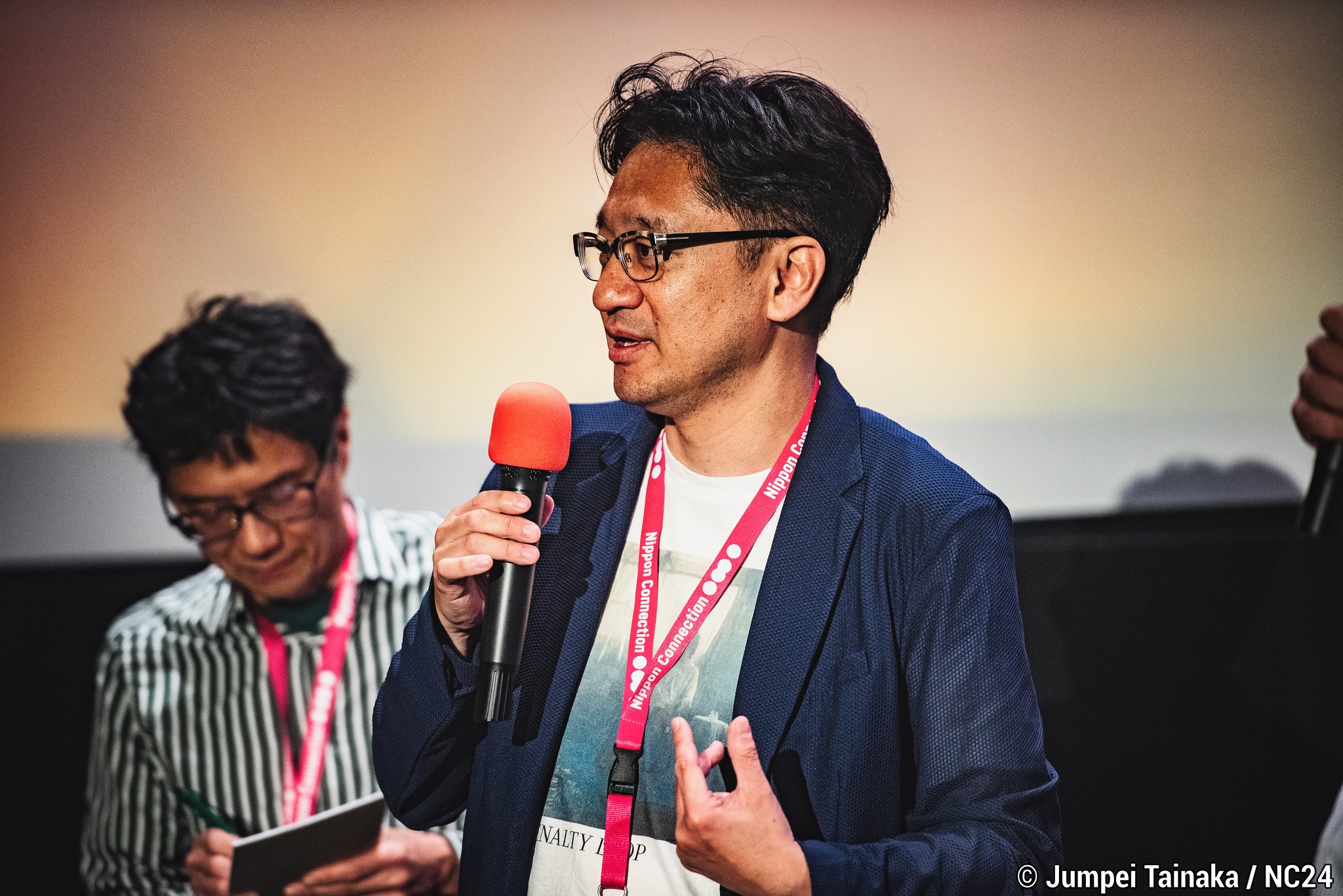
In late March 2024, Shinji Araki’s second feature film Penalty Loop (Peneruti rupu) was released in Japan. Mr. Araki was kind enough to answer a variety of questions put by our author Andrea Grunert when they met at this year’s Nippon Connection Festival in Frankfurt.
Andrea Grunert – Penalty Loop is your second film. What did you do before you started making films? (1)
Shinji Araki – I was a student of Interdisciplinary Cultural Studies at the University of Tokyo but moved to France because I wanted to study at La Fémis (2) in Paris. I was not accepted and returned to Japan, where I began working in the advertising industry.
I worked as a TV advertising planner and creative director for an agency. My job included designing scripts for publicity spots.
In Japan, film directors sometimes shoot commercials. I therefore had the opportunity to work with the director Shinji Somai.
I worked in the advertising industry for 20, nearly 30 years but was getting more and more bored with the job. The year 2011 was marked by the triple disaster in the Tōhoku area. My father also died that year. These events made me think about what I really wanted to do, because life does not go on forever.
I started studying at a screenwriting school. But I was more particularly interested in the Nouvelle Vague. However, in the end, I continued with screenwriting. There are various screenplay competitions in Japan that also offer small cash prizes. I sent in my scripts to earn money. There are only two major institutions that enable screenwriters to have their work screened. One of them is the Kinoshita Group, to which I sent a script, and I won the prize there.
The typical career path would be to make a film and then win an award for it. However, I won the screenplay prize and was able to make my first film – The Town of Headcounts (3) – afterwards.
Andrea Grunert – In Penalty Loop, death is a major topic. Yesterday evening, in the Q&A session following the screening of your film, you said that you cannot accept death.
Shinji Araki – In my childhood, I went to a Catholic kindergarten. I was also baptised – my baptismal name is Johannes. I know that in the Christian church, death is mitigated by the idea of resurrection. But for me, death still has something final about it.
Andrea Grunert – Both of your films have a social as well as a moral dimension. Penalty Loop hints at the topic of the death penalty.
Shinji Araki – My first film depicts a dystopian society and involves a large group of people. The second concentrates on a few characters and focuses on moral issues. Above all, I wanted to make a completely different film from The Town of Headcounts. I wanted to prove that I am a versatile filmmaker.
When I decided to make Penalty Loop, the producer asked me whether the focus would be on the death penalty. There are, of course, many films on this topic. However, I didn’t want it to take centre stage. In Penalty Loop, I am more interested in the question why people want the death penalty or seek revenge or take the law into their own hands.
One of the actors [Jin Dae-yeon] is Korean. The death penalty is still a possible sentence in South Korea but it is no longer carried out (4). It seemed important to me that he should play a key character in the film.
Andrea Grunert – Jun – Penalty Loop’s main character – is introduced as a person who cares for other people and creatures. There is for example the moment in which he sets a ladybird free.
Shinji Araki – There is a Japanese saying: a very gentle person is one who can’t even kill an insect. That is the starting point for the scene with the ladybird. Jun is a gentle person, but he changes after experiencing violence. In one scene, he is supposed to fire his semi-automatic pistol three times, but instead he cannot stop and shoots until the entire magazine is empty.
Andrea Grunert – How did you develop the characters?
Shinji Araki – I discussed Jun’s character a lot with the lead actor. How does a normal and actually gentle person develop into a violent person? I wanted to portray this change.
My career as a director started late. I don’t find it difficult to write a screenplay. i.e. to conceptualise a story. The more difficult part for me is developing the characters.
The main character Jun is played by Ryūya Wakaba. He is an actor but has also directed films himself. He is very much interested in character development. And that’s why I chose him for the role, so that he could give me some advice on this task.
There is a scene in which Jun washes blood off his hands at the sink in his kitchen. In the script, I had only written that he was washing his hands. In the film, he shakes the sink in anger and frustration, almost ripping it out of the wall. That was Mr Wakaba’s idea. That’s an example of the way he got involved. But filmmaking is teamwork, of course, and many people helped me to make the film.
Andrea Grunert – I can well imagine that Mr Iseya, who plays the main character’s antagonist, is a similarly creative actor.
Shinji Araki – Mr Yūsuke Iseya was convicted for drug possession in 2020. Penalty Loop was his first film after his conviction. It seemed to me at the beginning that he had forgotten a little about how to act. At first we read the script together. Iseya wasn’t really involved (he laughs). I was a little worried.
Mr Wakaba and I then tried to cheer Mr Iseya up a bit. After three days, he seemed to have got the hang of it again. On the fourth or fifth day, he seemed to be having fun. It was a great pleasure for us to see his development. When we shot the scene in which his character is drawing, he obviously had a lot of fun. We shot for much longer than originally planned.
Andrea Grunert – Didn’t Mr Iseya study art?
Shinji Araki – Yes, he studied art. But I asked him not to draw too perfectly. So his development during the filming was a very important aspect for all the team. Mr Iseya is a very good actor. In a scene in which the camera shoots him from behind, he folds his arms behind his head (Mr Araki demonstrates it). That was his idea. Not every actor would think of that. He really has great talent.
Andrea Grunert – He sometimes reminds me of Toshirō Mifune.
Shinji Araki – Yes, Toshirō Mifune had a similar gift. In Japan, Mifune is said to have had ōra, a person who has an aura. Mifune and Iseya are actors with an aura.
Andrea Grunert – How much influence did the actors have on the dialogues? Did you allow improvisation?
Shinji Araki – The dialogues are not improvised. I have no experience with improvisation and didn’t want to put more pressure on myself during filming. In this respect, I stuck to what was discussed beforehand, to what was planned. Wakaba and others thought that I should develop more confidence in myself. Perhaps they would have liked to improvise. I would like to try it out in another film.
Andrea Grunert – You told me before that you are interested in the arts yourself. There are many beautiful shots in the film. Some of them are closely linked to Japanese traditions. For instance, the single shot of the bamboo grove, the wind blowing through the bamboo plants, a shot that captivates the viewer in terms of atmosphere. Was that already in the script? Or is it a shot that came about by chance?
Shinji Araki – While I was searching for locations, I discovered the bamboo grove by chance and then integrated it into the film because I found the place so beautiful. I associate the wind blowing through the bamboo plants with death. It was as if someone from the realm of the dead was giving me a sign. It may be very Japanese to associate nature with spirituality, and this kind of shot might look a bit stereotypical. As I said, it was not intentional to include that shot.
We mainly filmed in an industrial area without much natural environment. But there is also the lake into which the corpse [of the killer killed by Jun] is thrown. We found another lake with a willow tree on the bank. A very beautiful spot. Very Japanese. In Japanese culture, the willow tree is often associated with the spirits of the dead. It was not easy to decide which of the two locations to choose. But finally we took the other one.
For my generation, it is rather unusual to make films with willow trees, kimonos, tea ceremonies. We grew up differently. I now feel almost a little embarrassed about having used such a shot, which seems somewhat stereotypical. Nevertheless, I think that the shot with the bamboo grove still seems realistic. I just wanted to include it. I would like to shoot scenes in shrines or temples. But I don’t yet know how I should do that. How much distance I will be able to keep from such settings from this culture. I feel connected to it. But if I shoot a scene like that now, I want to do it differently from Kurosawa, Ozu or Mizoguchi. But how? I don’t know yet.
Andrea Grunert – Despite being a convention in Japanese cinema, I found the shot of the bamboo grove well integrated into the film and still powerful.
Shinji Araki – I hope that the shot of the bamboo grove looks natural. Nevertheless, I would like to include more Japan-specific elements in future films. If I were smarter, I would be able to shoot more scenes that are typically Japanese and would earn a lot of money. But I’m not that smart and don’t think that strategically. I am very impressed by the way Seijun Suzuki portrays Japan, for example, in his yakuza films (Mr Araki points to his arms, suggesting tattoos on them). One day I would like to make films like that about Japan.
Andrea Grunert – I was very inspired by your choice of colours as an aesthetic and symbolic means. For instance, the yellow iris as a symbol for revenge, the fact that Jun, seeking revenge, drives a yellow car …
Shinji Araki – Blue and yellow are my favourite colours. If I were to name a colour for this film, it would be green. Yellow and blue mixed together also make green. The film deals with death, but it’s also a film in which you see a lot of green – in the landscape scenes, in the hydroponic factory etc. It is a very lively colour. For me, the film is green and yellow.
If there is too much dialogue in the film, you can no longer feel the emotions. I’m glad that you asked a question about the colours.
Andrea Grunert – Other elements appealing to the emotions are music and sound, which are obviously very important in Penalty Loop, too. How do you work with the people concerned with the soundtrack?
Shinji Araki – Indeed, music plays a very important role for me. Takuma Watanabe wrote the music for my first film. But unfortunately, he fell ill. When I learnt that he couldn’t work with me on Penalty Loop, I panicked. That shows how important music is to me.
So I had to find another composer. His name is also Watanabe, namely Takashi Watanabe. I was able to get him to write the music for Penalty Loop. He composed pieces for the film that have become my favourites.
For me, it’s not only important in which scene which music is used but it is also important which instruments are used. The piano is a dangerous instrument for me. It’s easy to feel comfortable with piano music. I find that dangerous.
Takashi Watanabe often uses unusual musical instruments such as the tuba and ethnic instruments that are not so well-known.
The sounds other than the music are created by Mr Kō. He also works for Ryūsuke Hamaguchi, among others.
Mr Kō seems a bit crazy to me. He wants to do everything himself. He wants to record and mix everything himself (Mr Araki puts a lot of emphasis on this sentence). In such a big production, he should have one or more assistants. When I asked him about that, he replied: “An assistant, what’s that?” I asked him to hire assistants. He then brought a few people with him, but they left after the sound recordings were finished. He did everything else alone at home. I often discussed with him whether everything was fine or whether something needed to be changed. A very interesting man. As he does almost everything on his own, he has a great responsibility. He and Mr Watanabe were very important for the film. I would love to work with both of them again.
*Interview conducted on 30 May 2024 in Frankfurt/Main and kindly translated from Japanese
into German by Ms Tachibana Yukari. This English version was translated by the interviewer.
Notes
(1) Araki’s first feature film The Town of Headcounts was released in 2020.
(2) École nationale supérieure des métiers de l’image et du son (European Foundation for the Professions of Image and Sound), based at the PSL Research Centre in Paris.
(3) Ninzū no machi, 2020.
(4) In contrast to South Korea, the death penalty is not only legal in Japan but is still caried out.
Gefällt mir Wird geladen …
 shomingeki - Filmzeitschrift