By Andrea Grunert
I am writing these lines after attending the internationally acclaimed short film festival in Oberhausen, a city in the Ruhr-area, once a major industrial heartland of Europe, known for its coal mining and steel production. The somewhat clinical charm of the hotel’s large, empty floors, devoid of decoration except for two modest flower pots, felt like the perfect setting for a film about loneliness, a stage waiting to be filled with imagination. This is by no means a criticism of the hotel, which I found to be a comfortable and enjoyable place to stay. On the contrary, its atmosphere aligned well with the programme I was engaged in and proved conductive to creative thought.
The gnarled, leafless branches of the trees lining the two avenues close to the festival locations lent the area a bizarre air. Uninspiring pedestrianised streets with a few vacant premises bear witness to a lack of purchasing power in a region that had been grappling with social problems for decades. Nevertheless, the Ruhr region is a culturally thriving landscape that continually invites new discoveries. The conclusion, however, is that old factory buildings are being converted into cultural centres without distracting the gaze from everyday problems. Perhaps it is this discrepancy between a dull reality and creative richness on screen that adds to the festival’s vibrancy.
One festival and many facets
The Short Film Festival in Oberhausen is one of the region’s cultural highlights, attended by filmmakers from around the world. This year’s programme, as always extremely varied, demonstrated once again just how inspiring the event – now in its 72nd year – continues to be. And that the short film is alive and well.
In addition to the international competition, there was a German competition and a smaller competition with contributions from North Rhine-Westphalia, the federal state in which Oberhausen is located. Another section was dedicated to films for children and adolescents. Retrospectives, a competition for music videos from Germany, exhibitions and seminars contributed to the festival’s great diversity. One of the main topics was a series of events dealing with the relationship between reality and fiction. Starting with films by James Mitchell and Sagar Kenyon, produced in the early days of cinema, between 1899 and 1912, the programmes embraced short films directed by Werner Herzog from the late 1960s to the 1980s and extended to recent productions made with the help of artificial intelligence.
The thematic exploration of the relationship between fiction and reality has its origins in the early days of cinema. It is also at the core of a number of films that are participating in the international competition, the section emphasised in my article. Across the fifty films presented in the international competition, several themes resonate strongly: a desire to make the invisible visible – bringing hidden secrets to light as well as drawing attention to people (and animals) at risk of disappearing – and, with that, an exploration of loss, grief and memory. The ongoing war in Ukraine casts a shadow over several of the works, while conflicts in other parts of the world, along with past wars whose wounds remain unhealed, also surface or resurface on screen. Yet violence is not portrayed solely through national or ethnic conflict; filmmakers also confront violence against nature and gender-based violence, offering powerful and often unsettling cinematic perspectives. It is clear that the dominant trend in this most prestigious festival section leans towards experimentation, with short films serving as a kind of refuge for it.
Reality and perception
Igor Zelić’s Opera (Croatia, 2026, 19 minutes) is one of these films dealing with perception. Shots of a group of buildings close to a forest are altered through the multi-layered manipulation of light sources. The appearance and/or disappearance of people in the frame also contributes to these changes, as does the feeling of time slipping away. Above all, however, it is the shifting lighting conditions that influence our perception of space and time. Daylight transforms what we see once more, leading to a surprising and dramatic turn.
Perception and representation are at the core of Adebukola Bodunrin’s Leaks in the Lines (USA/Canada, 2025, 4 minutes) which deals with the conflict between nature and organic growth and nature tamed by humans as in baroque garden architecture. The controlled nature, shaped by the principles Jacques Boyceau de la Baraudière outlined in his Traité du jardinage (1638), is exemplified in images of the gardens at Versailles castle. Through alternative editing of these images and fast moving laser engravings, and the superimposition of realist landscape architecture photographs with animated visuals, this imposed order is continually called into question.
Personal stories
The interplay with perception runs like a common thread through most films – both as theme and as means of cinematic expression. Some of these works are also deeply personal in nature. In You Are Seen (Morocco, 2025, 9 minutes), Zakaria Dinia takes a highly poetic approach. The film opens with images of a chameleon searching for water in the desert sand. These shots of the struggling creature repeatedly interrupt those showing an elderly man in a hospital, where he is undergoing dialysis. Images of patients patiently waiting for their treatment and then receiving it alongside shots of medical devices – tubes and monitors – stand in stark contrast to the almost archaic imagery of the solitary reptile. Yet both depict matters of life and death, pain and loneliness, and the struggle for survival.
Matthew Lancit’s Autobiography of My Diabetes (France/Canada, 2025, 30 minutes) recounts the discovery of the disease during the filmmaker’s childhood and provides detailed insights into its symptoms and consequences. However, the film goes beyond a straightforward personal documentary. Lancit closely intertwines his autobiographical narrative with cinema itself. The effects of diabetes on the body are evoked through film sequences, particularly drawn from the horror genre, featuring dissolving and melting bodies. The film also incorporates other references to cinema history, including a scene from The Godfather Part III (USA, 1990) in which Michael Corleone (Al Pacino) experiences a moment close to insulin shock – a rare depiction of this kind of physical vulnerability in a genre film. Diabetes leaves a lasting mark on the filmmaker’s life, just as cinema does. In Autobiography of My Diabetes, Lancit forges a connection between the two, using film as a means to engage with the disease both intellectually and emotionally.
Filming becomes a way of approaching trauma and grief in Teboho Edkins’ An Open Field (France/Germany/South Africa, 2025, 38 minutes). In the film, the director visits the site in Ethiopia where his brother Max died in an aeroplane crash in 2019. It opens with images of mourning villagers who live near the crash site. Members of the community explain their rituals to him and his father. Edkins remarks that he finds some comfort in knowing his brother died in a place where people have deeply rooted practices of mourning. An Open Field also gives space to the voices of the local men and women who recall the horror of the crash. A sequence of still images presents some of the victims – adults and children – underscoring the scale of the loss. Visiting the site for the first time, Edkins is shown recording with his microphone, capturing both the testimonies of the villagers and the ambient sounds of the landscape, as if trying to reach or preserve the voices of the dead. While many images resemble those of a conventional reportage, the filmmaker’s personal involvement transforms his work into a poetic reflection shaped by grief and memory and charged with deep emotion. It also includes critical comments on the accident. In a striking scene, Edkins’ father speaks with the father of the pilot – the pilot being held responsible for the crash by Boeing – raising questions about the company’s accountability. Both plane crashes (the other one having occurred a year earlier) were apparently caused by errors in the control software of the Boeing-developed 737 Max aeroplane. Edkins’ father is less fatalistic than his counterpart and is convinced that if many voices speak out against Boeing, they will not go unheard. The criticism of the American aeroplane manufacturer is reinforced by a Boeing advertisement claiming that the 737 Max offers “maximum safety”. The designation “Max” on the belly of a plane appears like an ironic reference to the filmmaker’s dead brother – an irony filled with much bitterness.
The invisible leaving traces
In Hulum (France, 2025, 22 minutes), Miguel Miceli gives a voice to someone who has none in today’s society: an undocumented worker from North Africa. Hulum (a word from the Arab language) means “the dream”, “the hidden”. The dream of a better life, the desire to escape misery has brought the nameless narrator to southern Spain, to Almeria. Here, like many of his compatriots and other illegal workers, he toils in the region’s greenhouses, known as the “Garden of Europe”, where fruit and vegetables are produced for the European market. The voice of the man, heard off-screen, describes the harsh working conditions and the system of exploitation that leaves little room for a normal life. Images show the shacks where the workers are housed. Repeatedly, we see footage of a person hidden beneath the chassis of a car driving through a barren landscape. The images and sounds resemble a dream that has turned into a nightmare. In the end, the narrator advises his brother not to follow the path he has chosen.
Ece Era’s Dogs and Dust (Turkey/Belgium, 2025, 14 minutes) is another work about invisibility and disappearance. The stray dogs and people living on a landfill site in a Turkish border region are about to vanish. The bulldozers have already arrived to clear the dump and to make way for the construction of a prison. The film needs no dialogue, commentary, or text to evoke strong thoughts and emotions about the erasure of life. Yet the mere indication that the prison landscape in Turkey is expanding adds another layer of meaning to Dogs and Dust.
Anna Heisterkamp’s Daylight (Ireland/USA, 2025, 21 minutes) deals openly with prisons. Her approach to the subject has a reportage-like quality, yet goes beyond conventional reportage. The focus is on the fourth new design for the Manhattan Detention Centre in New York’s Chinatown, which has been established in 1838. Time and again, it had come under harsh criticism for inhumane conditions and was reconstructed by reform-minded representatives of the judicial system in the spirit of their respective eras. Heisterkamp presents footage of the demolition of the most recent building, floor plans of the various structures built since the early nineteenth century, scenes from symposia on justice and architecture, and interviews with architects who work or have worked on prison design. But do these men and women really understand what they are building? Heisterkamp’s film exposes their perspective as little more than well-intentioned rhetoric from people far removed from those who typically end up in prison. Efforts at reform do not change the system. People disappear behind prison walls. Those walls are torn down by excavators, as if memories themselves were being buried under rubble.
The voiceless are also at the centre of Bhavya Karthikeyan’s Tea Powder (India, 2026, 23 minutes). However, Zuhra and Nila – two young women – are eager to find ways of resistance and try to be heard by secretly publishing the magazine Tea Powder in the South Indian city of Kozhikode during the 1970s. The black-and-white film tells, in fragments and through suggestion, a story of oppression and exploitation within Kozhikode’s Muslim community, where women are the primary victims. Because they are women, Zuhra and Nila cannot raise their voices publicly. And in the absence of formal educational institutions for girls and women, the neighbour’s daughter can only attend lessons with Nila in secret. Nila’s refusal to follow her fiancé to one of the Gulf countries is met with violence from her family. And yet, there is solidarity among women and there are moments of tenderness between the two female protagonists – a relation that itself represents a taboo.
Jerónimo Rincón Diaz’s El Salto (Colombia, 2025, 12 minutes) also relies very much on allusions, dispensing with text. The film’s description in the festival programme mentions an indigenous myth in which a god carved a path for rivers through a mountain range in order to protect the Bogotá plain from being flooded. At the centre of El Salto is a powerful waterfall plunging into the depths. But the images show not only the foaming waterfall and rushing rivers. Alongside realistic cinematography, there are distorted images that evoke associations with environmental pollution or the forced eviction of slums. The myth meets a complex present, pointing continuously to the power of nature and the fragility of human existence.
Memories
Memory and trauma are central themes in Flow (Rwanda, 2025, 22 minutes), directed by Kagoma Ya Twahirwa. A young woman, whose face is repeatedly shown in long takes, is still searching for a way to express the trauma following the 1994 genocide in Rwanda. In what resembles a therapy session, young people recount their experiences and the horrors they endured as children. Others took revenge and are now in prison. Flow does not show graphic violence. Instead, it is a work in which silence and the persistent focus on faces convey as much as words that describe memories and express grief.
Personal memories and political context are also interwoven in Alina Titorenko’s Women on fire (France, 2025, 20 minutes). The director portrays herself: a Russian woman studying at the FEMIS film school in Paris, where her festival entry was also produced. Titorenko hails from the Bryansk region, where belief in witchcraft has a long tradition. In Paris, she seeks out three female mediums and fortune-tellers, always in search of love and relief from her loneliness. Titorenko’s film depicts a way of dealing with life in an unknown environment, far from her roots. However, the ongoing war in Ukraine and its effects on people in Russia is not eclipsed. In a phone call with a young men in Russia, allusions to war and death are made, as well as the mention of homosexuality alludes to the oppression homosexuals undergo in present-day Russia.
The war in his country has driven the protagonist of Roman Khimei’s and Yarema Malashchuk’s Open World (Ukraine, 2026, 19 minutes) to Poland. From his room, the young Ukrainian man controls a mechanical avatar – a robot dog – as it moves through the countryside near his hometown and into his mother’s flat. At first, only the robot dog is shown, from within the voice of the man controlling it from a great distance can be heard. The robot, whose shape resembles a chest of drawers, may seem bizarre. Its encounters with people, who react to it with surprising calm (here you might realise that you are watching a film), create some moments of strangeness and also a sense of light-heartedness when the machine meets a little girl near a river. Yet the connection to home is also marked by dependence on an unstable video stream, a hint to the situation people in Ukraine and those who have left their country have to face.
In August and the War (Sweden, 2026, 14 minutes) by Leandro Netzell Cerón and Samori Tovatt, young August finds himself wondering whether he is ready to go to war for his country. The film is not lacking in humorous moments, such as when August who would rather make music, has a machine gun delivered to his home and struggles to get it out of the packing. There is no shortage of witty dialogues either. For instance, August’s mother asks him why he does not take on more responsibility by doing some housework or washing the laundry, instead of wanting to go off to war.
The fragility of nature
In Slow Dissolve (Germany/USA, 2026, 27 minutes), Andreas Bunte combines documentary material with reflections on transience. The film presents two different archives. In one, prehistoric ice is stored, which can be used to construct climate models that provide reliable information about the melting of the polar ice caps. In the Arctic, film reels are preserved to protect them from destruction and for “a post-apocalyptic future”. Memory, ecology and human catastrophes such as war are central themes of the short film Bunte made in collaboration with Library Stack. Scientific findings are conveyed through text panels, while long takes create a latent tension and emphasise a sense of vulnerability. The idea of transience is underlined by the fact that both the ice and the film material made of celluloid are as fragile as human memory itself.
The animated film Green Noise (Sweden, 2026, 8 minutes) by Jeuno Kim and Ewa Einhorn also deals with ecological patterns. In the fictitious city of Krabstadt, humans and houseplants are fighting against climate change and rising temperatures – until the day the plants go on strike. They no longer want to support their own exploitation in the name of saving the ecosystem. Using playful, humorous imagery and cheeky dialogue, Green Noise addresses highly topical issues. Like Bunte in Slow Dissolve, Kim and Einhorn also touch on the melting of the polar ice caps. However, they do so through satire, in an entertaining yet equally urgent way.
In conclusion
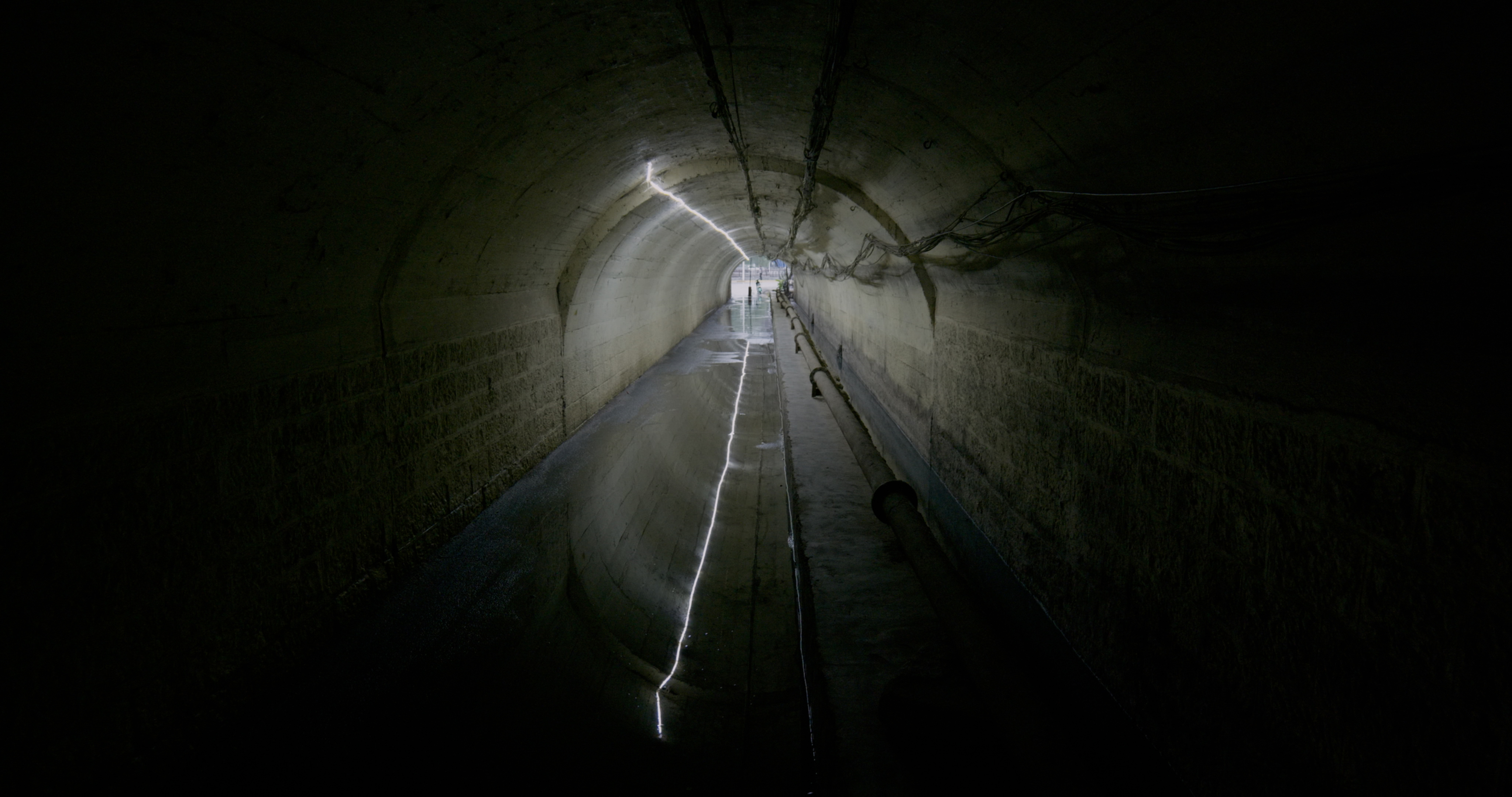
What remains of the festival? Some powerful images that will linger in memory. And not only the contributions with a clearly political, socially critical or philosophical dimension. Films like Opera (the International Jury Prize winner) or the also award-winning Dark Channel (China, 2025, 11 minutes) by Yu Zhe challenge our perception. The only setting of Yu Zhe’s film is a small channel, first filmed in the evening and then in daylight, as can be seen from the channel’s openings. The water level rises in the night and recedes again by daytime. A few people on two-wheeled vehicles occasionally pass through the narrow passage. A large spider remains motionless in its web on the ceiling. Nothing particularly unusual. Nor is it unusual for the everyday to be elevated into an object of art – we have known that since the Dada movement. But then, there is also this green frog, swimming through the water. And the next morning sitting more or less on a dry ground. An image that invites a great deal of reflection.
There is also the animation Slow, fast, slow by Jagoda Czarnek (Poland, 2025, 1 minute). A sleeping woman is rudely jolted awake by the noise of her alarm clock – and something unexpected happens. Czarnek’s film is a very short but refreshing cinematic experience.
The same applies to Nela Gluhak’s Toast (Croatia, 2025, 2 minutes). A female voice narrates that she has been given a toaster as a gift, and immediately the screen fills with countless variations of toasts: toasts filled, topped with cheese, decorated with mayonnaise … all accompanied by the word “toast”. And there are surprises here too. The humour lies in the rhythm and in the fact that nothing really happens. And this “nothing” is presented in a most enjoyable manner.
However, nothing speaks against a little joy. Because when you stepped outside the bubble of the cheerful international cinema crowd that had gathered for the festival, you immediately found yourself in a reality that was not quite as cheerful – though one where you can meet amazing people if you keep your eyes, your ears and your mind open.

