Araki-Photo

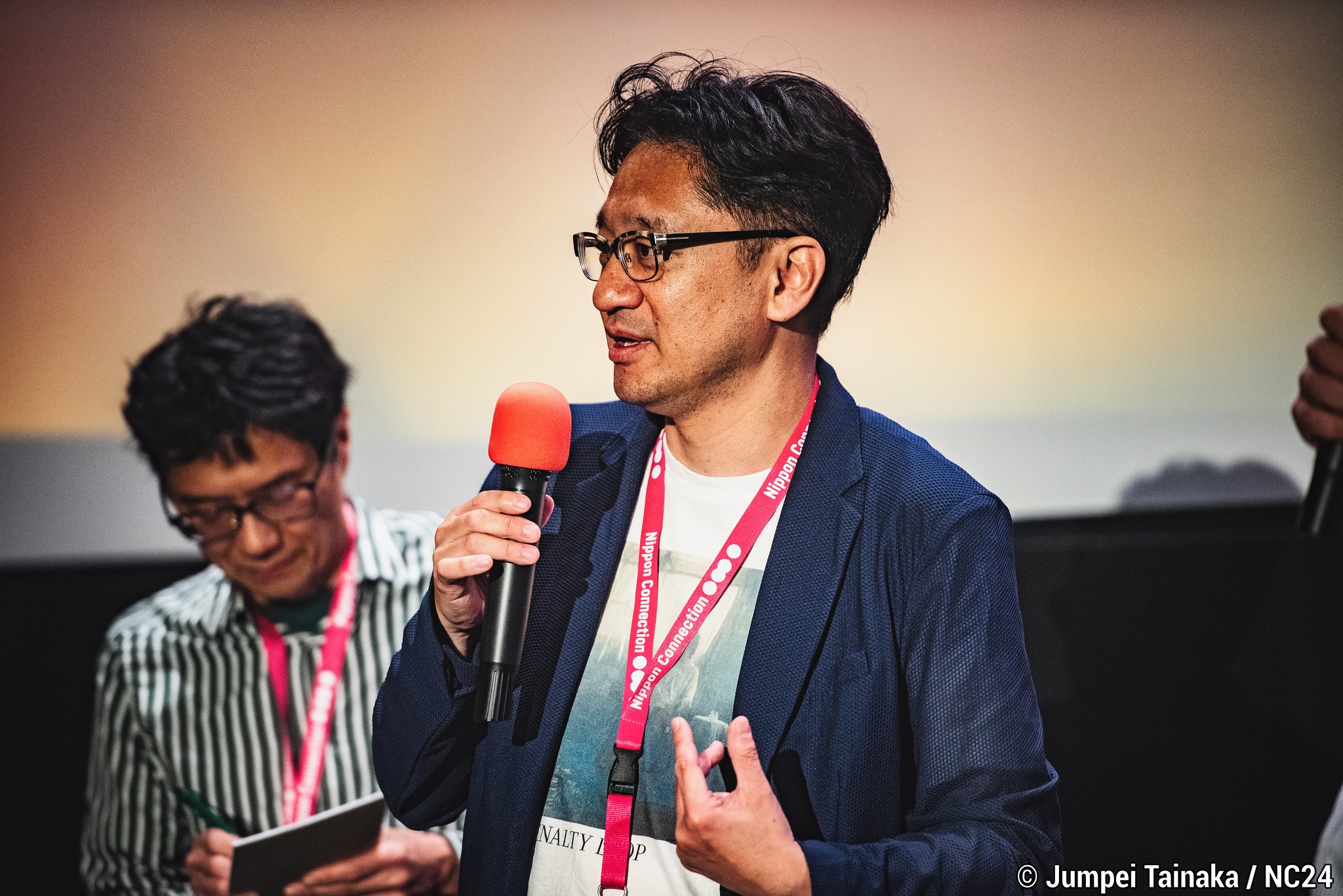
In late March 2024, Shinji Araki’s second feature film Penalty Loop (Peneruti rupu) was released in Japan. Mr. Araki was kind enough to answer a variety of questions put by our author Andrea Grunert when they met at this year’s Nippon Connection Festival in Frankfurt.

Andrea GrunertPenalty Loop is your second film. What did you do before you started making films? (1)
Shinji Araki – I was a student of Interdisciplinary Cultural Studies at the University of Tokyo but moved to France because I wanted to study at La Fémis (2) in Paris. I was not accepted and returned to Japan, where I began working in the advertising industry.
I worked as a TV advertising planner and creative director for an agency. My job included designing scripts for publicity spots.
In Japan, film directors sometimes shoot commercials. I therefore had the opportunity to work with the director Shinji Somai.
I worked in the advertising industry for 20, nearly 30 years but was getting more and more bored with the job. The year 2011 was marked by the triple disaster in the Tōhoku area. My father also died that year. These events made me think about what I really wanted to do, because life does not go on forever.
I started studying at a screenwriting school. But I was more particularly interested in the Nouvelle Vague. However, in the end, I continued with screenwriting. There are various screenplay competitions in Japan that also offer small cash prizes. I sent in my scripts to earn money. There are only two major institutions that enable screenwriters to have their work screened. One of them is the Kinoshita Group, to which I sent a script, and I won the prize there.
The typical career path would be to make a film and then win an award for it. However, I won the screenplay prize and was able to make my first film – The Town of Headcounts (3) – afterwards.
Andrea Grunert – In Penalty Loop, death is a major topic. Yesterday evening, in the Q&A session following the screening of your film, you said that you cannot accept death.
Shinji Araki – In my childhood, I went to a Catholic kindergarten. I was also baptised – my baptismal name is Johannes. I know that in the Christian church, death is mitigated by the idea of resurrection. But for me, death still has something final about it.
Andrea Grunert – Both of your films have a social as well as a moral dimension. Penalty Loop hints at the topic of the death penalty.
Shinji Araki – My first film depicts a dystopian society and involves a large group of people. The second concentrates on a few characters and focuses on moral issues. Above all, I wanted to make a completely different film from The Town of Headcounts. I wanted to prove that I am a versatile filmmaker.
When I decided to make Penalty Loop, the producer asked me whether the focus would be on the death penalty. There are, of course, many films on this topic. However, I didn’t want it to take centre stage. In Penalty Loop, I am more interested in the question why people want the death penalty or seek revenge or take the law into their own hands.
One of the actors [Jin Dae-yeon] is Korean. The death penalty is still a possible sentence in South Korea but it is no longer carried out (4). It seemed important to me that he should play a key character in the film.
Andrea Grunert – Jun – Penalty Loop’s main character – is introduced as a person who cares for other people and creatures. There is for example the moment in which he sets a ladybird free.
Shinji Araki – There is a Japanese saying: a very gentle person is one who can’t even kill an insect. That is the starting point for the scene with the ladybird. Jun is a gentle person, but he changes after experiencing violence. In one scene, he is supposed to fire his semi-automatic pistol three times, but instead he cannot stop and shoots until the entire magazine is empty.
Andrea Grunert – How did you develop the characters?
Shinji Araki – I discussed Jun’s character a lot with the lead actor. How does a normal and actually gentle person develop into a violent person? I wanted to portray this change.
My career as a director started late. I don’t find it difficult to write a screenplay. i.e. to conceptualise a story. The more difficult part for me is developing the characters.
The main character Jun is played by Ryūya Wakaba. He is an actor but has also directed films himself. He is very much interested in character development. And that’s why I chose him for the role, so that he could give me some advice on this task.
There is a scene in which Jun washes blood off his hands at the sink in his kitchen. In the script, I had only written that he was washing his hands. In the film, he shakes the sink in anger and frustration, almost ripping it out of the wall. That was Mr Wakaba’s idea. That’s an example of the way he got involved. But filmmaking is teamwork, of course, and many people helped me to make the film.
Andrea Grunert – I can well imagine that Mr Iseya, who plays the main character’s antagonist, is a similarly creative actor.
Shinji Araki – Mr Yūsuke Iseya was convicted for drug possession in 2020. Penalty Loop was his first film after his conviction. It seemed to me at the beginning that he had forgotten a little about how to act. At first we read the script together. Iseya wasn’t really involved (he laughs). I was a little worried.
Mr Wakaba and I then tried to cheer Mr Iseya up a bit. After three days, he seemed to have got the hang of it again. On the fourth or fifth day, he seemed to be having fun. It was a great pleasure for us to see his development. When we shot the scene in which his character is drawing, he obviously had a lot of fun. We shot for much longer than originally planned.
Andrea Grunert – Didn’t Mr Iseya study art?
Shinji Araki – Yes, he studied art. But I asked him not to draw too perfectly. So his development during the filming was a very important aspect for all the team. Mr Iseya is a very good actor. In a scene in which the camera shoots him from behind, he folds his arms behind his head (Mr Araki demonstrates it). That was his idea. Not every actor would think of that. He really has great talent.
Andrea Grunert – He sometimes reminds me of Toshirō Mifune.
Shinji Araki – Yes, Toshirō Mifune had a similar gift. In Japan, Mifune is said to have had ōra, a person who has an aura. Mifune and Iseya are actors with an aura.
Andrea Grunert – How much influence did the actors have on the dialogues? Did you allow improvisation?
Shinji Araki – The dialogues are not improvised. I have no experience with improvisation and didn’t want to put more pressure on myself during filming. In this respect, I stuck to what was discussed beforehand, to what was planned. Wakaba and others thought that I should develop more confidence in myself. Perhaps they would have liked to improvise. I would like to try it out in another film.
Andrea Grunert – You told me before that you are interested in the arts yourself. There are many beautiful shots in the film. Some of them are closely linked to Japanese traditions. For instance, the single shot of the bamboo grove, the wind blowing through the bamboo plants, a shot that captivates the viewer in terms of atmosphere. Was that already in the script? Or is it a shot that came about by chance?
Shinji Araki – While I was searching for locations, I discovered the bamboo grove by chance and then integrated it into the film because I found the place so beautiful. I associate the wind blowing through the bamboo plants with death. It was as if someone from the realm of the dead was giving me a sign. It may be very Japanese to associate nature with spirituality, and this kind of shot might look a bit stereotypical. As I said, it was not intentional to include that shot.
We mainly filmed in an industrial area without much natural environment. But there is also the lake into which the corpse [of the killer killed by Jun] is thrown. We found another lake with a willow tree on the bank. A very beautiful spot. Very Japanese. In Japanese culture, the willow tree is often associated with the spirits of the dead. It was not easy to decide which of the two locations to choose. But finally we took the other one.
For my generation, it is rather unusual to make films with willow trees, kimonos, tea ceremonies. We grew up differently. I now feel almost a little embarrassed about having used such a shot, which seems somewhat stereotypical. Nevertheless, I think that the shot with the bamboo grove still seems realistic. I just wanted to include it. I would like to shoot scenes in shrines or temples. But I don’t yet know how I should do that. How much distance I will be able to keep from such settings from this culture. I feel connected to it. But if I shoot a scene like that now, I want to do it differently from Kurosawa, Ozu or Mizoguchi. But how? I don’t know yet.

Andrea Grunert – Despite being a convention in Japanese cinema, I found the shot of the bamboo grove well integrated into the film and still powerful.

Shinji Araki – I hope that the shot of the bamboo grove looks natural. Nevertheless, I would like to include more Japan-specific elements in future films. If I were smarter, I would be able to shoot more scenes that are typically Japanese and would earn a lot of money. But I’m not that smart and don’t think that strategically. I am very impressed by the way Seijun Suzuki portrays Japan, for example, in his yakuza films (Mr Araki points to his arms, suggesting tattoos on them). One day I would like to make films like that about Japan.

Andrea Grunert – I was very inspired by your choice of colours as an aesthetic and symbolic means. For instance, the yellow iris as a symbol for revenge, the fact that Jun, seeking revenge, drives a yellow car …

Shinji Araki – Blue and yellow are my favourite colours. If I were to name a colour for this film, it would be green. Yellow and blue mixed together also make green. The film deals with death, but it’s also a film in which you see a lot of green – in the landscape scenes, in the hydroponic factory etc. It is a very lively colour. For me, the film is green and yellow.
If there is too much dialogue in the film, you can no longer feel the emotions. I’m glad that you asked a question about the colours.
Andrea Grunert – Other elements appealing to the emotions are music and sound, which are obviously very important in Penalty Loop, too. How do you work with the people concerned with the soundtrack?
Shinji Araki – Indeed, music plays a very important role for me. Takuma Watanabe wrote the music for my first film. But unfortunately, he fell ill. When I learnt that he couldn’t work with me on Penalty Loop, I panicked. That shows how important music is to me.
So I had to find another composer. His name is also Watanabe, namely Takashi Watanabe. I was able to get him to write the music for Penalty Loop. He composed pieces for the film that have become my favourites.
For me, it’s not only important in which scene which music is used but it is also important which instruments are used. The piano is a dangerous instrument for me. It’s easy to feel comfortable with piano music. I find that dangerous.
Takashi Watanabe often uses unusual musical instruments such as the tuba and ethnic instruments that are not so well-known.
The sounds other than the music are created by Mr Kō. He also works for Ryūsuke Hamaguchi, among others.
Mr Kō seems a bit crazy to me. He wants to do everything himself. He wants to record and mix everything himself (Mr Araki puts a lot of emphasis on this sentence). In such a big production, he should have one or more assistants. When I asked him about that, he replied: “An assistant, what’s that?” I asked him to hire assistants. He then brought a few people with him, but they left after the sound recordings were finished. He did everything else alone at home. I often discussed with him whether everything was fine or whether something needed to be changed. A very interesting man. As he does almost everything on his own, he has a great responsibility. He and Mr Watanabe were very important for the film. I would love to work with both of them again.

*Interview conducted on 30 May 2024 in Frankfurt/Main and kindly translated from Japanese
into German by Ms Tachibana Yukari. This English version was translated by the interviewer.

Notes
(1) Araki’s first feature film The Town of Headcounts was released in 2020.
(2) École nationale supérieure des métiers de l’image et du son (European Foundation for the Professions of Image and Sound), based at the PSL Research Centre in Paris.
(3) Ninzū no machi, 2020.
(4) In contrast to South Korea, the death penalty is not only legal in Japan but is still caried out.

Grunert-Image-Saitama-01

by Andrea Grunert

A hot day in Kumagaya, a city in Saitama, the prefecture adjacent to Tokyo (1), and at more than 40° Celsius it is hot enough to fry an egg on the pavement. And that is taken literally in Takeuchi Hideki’s (2) Fly Me to the Saitama (Tonde Saitama, Japan, 2019). Mr. Sugawara (Brother Tom) is frying an egg, not on the hob of a cooker but on the concrete outside his home. This comical moment is part of the story that forms the framework to the main plot. Its focus is on the Sugawara family – Yoshimi, the father, Maki, the mother (Asō Kumiko) and Aimi, the daughter (Shimazaki Haruka), who are leaving their home town for Tokyo, where Aimi’s engagement ceremony will take place.
The young woman dreams of life in the capital after her marriage, and what she is looking forward to most is escaping from provincial Saitama, geographically so close to Tokyo but at the same time so far from it. There is a stigma attached to Saitama, which is despised by the Tokyoites as a rustic, uncivilized place, and the film, based on a manga by Maya Mineo (3), depicts the rivalries between city and countryside, a conflict that is universal. Aimi’s desire to move to Tokyo is a reflection of the city’s attraction for the young woman. During the journey by car with her parents, she continually speaks disparagingly of provincial Saitama as a boring place, an attitude that upsets her parents. The scenes with the Sugawara family also reveal the inferiority complex that people from provincial towns and/or the countryside sometimes have towards big cities. Her father shamefully recalls a moment when this deep-rooted feeling of inferiority made him deny his origins – when he first met his future parents-in-law, a couple from Chiba Prefecture, he pretended to be from Tokyo.
Takeuchi also includes in his film information about Saitama that a Japanese person might know. The sequence with the egg refers to the fact that in August 2007 the highest temperatures ever recorded in Japan – 40.9° Celsius – was measured in Kumagaya (4). The comical scenes with the Sugawaras are the framework for the main plot, an urban legend that is broadcast on the radio during their journey by car to Tokyo. While the father is completely absorbed listening to the tale, the film projects the viewer into the narrative – a wild fantasy in which the rivalry between city and province is taken to extremes.
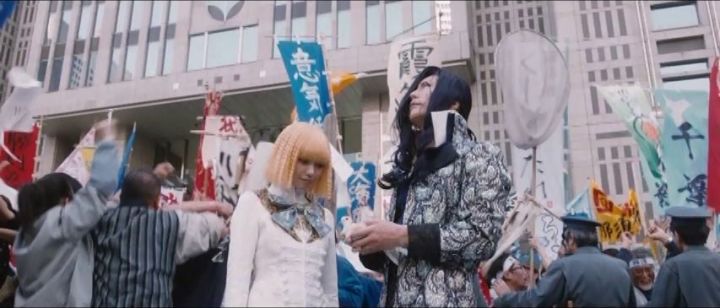
The urban legend is set in an imaginary time, a steampunk-like mix of past and present, of European and Japanese culture. Japan is a divided country with Tokyo on the one hand and the despised prefectures Saitama, Chiba and Gunma on the other. Japan’s capital city is depicted as a modern metropolis, a glittering high-tech world that contrasts strongly with its impoverished and undeveloped neighbouring provinces. At the élite school attended by the film’s two main protagonists Asami Rei (Gackt) and Dannoura Momomi (Nikaido Fumi) – the latter being the girlish-looking son of Tokyo’s governor (Nakao Akira) – there is a strict hierarchy that depends on the social status of the student and the part of Tokyo or Japan that they come from. Students from Saitama are treated as outcasts and required to live in a shack outside the school premises. Social difference is reflected not only in this dilapidated shack, which contrasts with the ostentatious school building, but also in the students’ clothes. Momomi and the female students from Tokyo wear elegant dresses or a uniform similar to that typically worn at Japanese schools. The costumes of the young Saitamites, however, are a random mixture of clothes similar to those worn by many Japanese during and immediately after World War II. The brownish jacket of the male student from Saitama is reminiscent of the uniform worn by low-ranking soldiers during World War II; the female students from Saitama wear blouses with sailor collars, but instead of blue or black skirts they wear patched monpe – another reminder of the war and wartime hardship (6).
Social exclusion and poverty are the result of the oppressive system imposed by the capital, and the film includes many examples of discrimination. The mere mention of the word “Saitama” leads to hysteria among the arrogant Tokyoites, even causing some of the female students to faint, and people from Saitama are avoided as if they were carriers of some contagious disease. They are the dehumanized Other known from racist discourses, and the government responds to Tokyoite fear of this Other from Saitama with a policy of strict segregation. The students from Saitama are denied medical care at the school, and residents of Saitama even need a pass to cross the border into the metropolis. They are hounded by a special branch of the Tokyo police, who detect Saitamites by means of an electronic device and arrest anyone suspected of being from that prefecture. The brutality is typical of a terror regime, with people from Saitama kept outside the city in a wasteland behind a fence while the governor of Tokyo resides in a magnificent palace.
This ruler of Tokyo behaves like a dictator, but Rei, who has recently returned from the United States, is the long-awaited saviour of Saitama. He finds a staunch supporter in Momomi, who has fallen in love with him. It turns out that Rei is the son of the mysterious Duke of Saitama (Kyomoto Masaki), a hero of the Saitama independence movement and leader of the Saitama Liberation Front. Together, father and son are fighting for the abolition of the pass system, for freedom and equality.
The portrayal of the conflict between capital city and countryside evokes situations and behaviour familiar to viewers from historical and present-day dictatorships, and it smacks of racism and discrimination. However, the film is not a sociological study but presents this serious topic in a playful manner. Costumes and set design constantly remind the viewer of the fiction he or she is watching. The architecture seen in the film combines modern skyscrapers with buildings inspired by European classicism. The rooms in the governor’s palace are filled with European-style furniture from the eighteenth and nineteenth centuries – golden candelabras, sparkling chandeliers, magnificent four-poster beds, a great deal of silk and furniture made of expensive kinds of wood. The governor’s wife wears a rococo-inspired dress with an ostrich feather in her opulent hairstyle and her husband is dressed like a daimyō (7) in an elegant kimono, formal haori (8) and hakama (9) – all reminiscent of Japan’s samurai heritage. This connection is also suggested by the governor’s family name, which is Dannoura and is a reference to a famous battle fought by samurai in the twelfth century (10). Many details in the film refer to Japanese history, for example the capes, hats, sandals and calf pads made of straw and worn by some of the characters in one scene (11). There is no medical doctor in backward Saitama, and instead there is a healer who is dressed like a yamabushi, an ascetic mountain monk of long ago.
References to Japanese history abound. The pass system recalls the strict rules in Tokugawa Japan (1603-1868), when travel permits were needed to leave one’s home province and control posts were established all over the country. Rei, suspected of being from Saitama, is forced to stamp on a giant rice cracker. Saitama is known as an important producer of rice crackers, and the Eurasian Collared Dove portrayed on the cracker is found chiefly in Saitama and is therefore used as the prefecture’s emblem. This scene in the film recalls a practice to which people who were suspected of being Christians were subjected at various times in Japanese history. They were forced to stamp on a cross in order to demonstrate their rejection of the Christian faith. In the film, the rice cracker symbolizes Saitama and is accorded the same significance for the Saitamites as the cross has for Christians.
Many of these thematic and visual references have been perpetuated in film, including the jidai geki, the historical films set in the Tokugawa period. It is noteworthy that Toei, the film’s distributor, was in the 1950s the studio that produced whole series of jidai geki. The portrayal of Gunma Prefecture as a jungle in which scientists have discovered giant footprints is another of the film’s cinematic references, this time to Godzilla – Gojira in Japanese – the monster accidentally created by nuclear tests (12). In Fly Me to the Saitama, the characters watch a television report on the discovery of the footprints, recalling a similar scene in Roland Emmerich’s Godzilla (USA, 1998). In the jungle of Gunma Prefecture, Momomi is confronted by a monster emerging from a river, and in a later sequence, it seems that Momomi is about to be sacrificed to it. The image of Momomi, tied up in front of the gigantic statue of the creature, recalls a plethora of films from Cabiria (Italy, 1913, Giovanni Pastrone) to King Kong (USA, 1933, Merian C. Cooper and Ernest B. Schoedsack). The monster even looks like one created by the French film pioneer Georges Méliès (1861-1939). However, it is only a paper-mâché monster in an entertainment park, and Momomi is reprieved at the park’s daily closing time.
Everything is fake, everything is illusion, and the cast contribute to this artful play in their appearance. The girlish boy Momomi, whose name is a girl’s name, is played by the actress Nikaido Fumi. This character – the governor’s son – develops from an authoritarian and somewhat callous young man into a caring person who changes his views on Saitama after being kissed by Rei. The androgynous appearance of the pop and fashion icon Gackt (13) heightens the way the film deals with gender in a clever and amusing ways. This playing with sexual identity also figures in Momomi’s dream with his fears for the man he loves and his jealousy. In this dream, Rei is in chains and Akutsu Shō (Iseya Yūsuke), the leader of the Chiba Liberation Front, gives his prisoner a very long, very sensual kiss. This kind of kissing scene between two men is still a rarity in mainstream cinema. The mixture of European and Japanese cultures in the film is a reflection of taste in Japanese culture since the Meiji era (1868-1912), and playing with fluid sexual identity challenges the views on gender and sexuality of the ruling authorities (14).
The film suggests that such divisions can be overcome. Before the battle against Tokyo, the Saitama rebels have to face their rivals from Chiba, a prefecture similarly oppressed by Tokyo. The Chiba Liberation Front led by Akutsu employs an odd form of torture that involves filling the orifices of their prisoners with peanuts, recalling another clichéd view of a particular region (15). The two rivalling prefectures try to outdo each other in a birthplace contest to see who has produced the greatest number of celebrities – singers, actors, actresses. The opposing crowds then clash in a mass brawl, but without any bloodshed. Their leaders, Rei and Akutsu, decide to combine their forces in order to put an end to Tokyo’s pass system and oppression. When they reach Tokyo, the once hostile groups face the brutality of the police that confront them in the streets. Footage of police operations at demonstrations and images of the Tokyo Marathon are incorporated into these scenes, and although the borderlines between archive material and footage shot for the film are blurred, they are nevertheless clear enough to reveal the illusion that is at the core of film as a medium.
Meanwhile, Momomi has exposed the corrupt system over which his father presides, and in the frame story set in present-day Japan, father and mother Sugawara proudly celebrate being Saitamites. A series of publicity-like shots from the present-day prefecture presents Saitama as a definitely habitable and economically successful prefecture.
In his film, Takeuchi toys with stereotypes, but he does so with great virtuosity in a colourful mix of visual and musical elements. Some of the comic elements may seem crude, but great attention is paid to detail, requiring the viewers’ full attention and captivating their imagination with a cast who visibly enjoy their roles. Nikaido, Gackt and Iseya manage to keep the balance between naturalist acting and theatricality, between seriousness and humour. In the opening sequence, Maya Mineo himself appears, telling the viewers: “This is a work of fiction.“ Fly Me to the Saitama is indeed a work of fiction and it does not take itself seriously, nor should it be taken seriously by viewers. However, the exaggerated style and visual flamboyance also point to the irrationality behind all racism and the origins of fear of the Other. Fiction is always rooted in reality, and Fly Me to the Saitama invites the viewer to grasp a deeper meaning behind its gaudy images.

Notes
(1) Saitama Prefecture is located north of Tokyo.
(2) Names are written according to Japanese conventions: family name before the given name.
(3) The manga was serialized in the manga magazine Hana to Yume in the early 1980s.
(4) In July 2018, a new record was set, with 41.1° Celsius, also measured, in Kumagaya.
(5) Chiba does not figure in the manga and was added because the director is from that prefecture.
(6) Monpe were loose trousers often worn by agricultural workers. During World War II, they became a standard garment for women and were turned into a symbol of wartime deprivation.
(7) Territorial lords in pre-modern Japan.
(8) A kimono jacket.
(9) A type of traditional Japanese skirt-like trousers
(10) The Battle of Dan-no-ura was a sea battle fought on 25th April 1185 between the Taira and the Minamoto, the latter emerging as victors. It marked the end of the Genpei War (1180-1185) and the beginning of two hundred years of Minamoto rule.
(11) People from the lower classes and travellers wore these clothes and accessories made of straw as protection against rain.
(12) Gojira first appeared in Honda Ishirō’s eponymous film, released in 1954.
(13) Gackt is the stage name of Ōshiro Gakuto, a singer-songwriter, J-pop/J-rock superstar, record producer and actor. Emphasizing an androgynous appearance, he is an important figure in the v-kei (visual kei) movement, which originated during the 1980s in Japan as a style of music with a strong focus on extravagant stage costumes.
(14) The manga is a yaoi, a boys’ love manga. It is a homoerotic subgenre of shōjō or girls’ comics featuring male/male relationships and intended primarily for young women.
(15) Chiba, the neighbouring prefecture to the east of Tokyo, accounts for 85% of Japan’s peanut production.

IMG_1064

Siegfried Kracauers „Straßen in Berlin und anderswo“ wurde 2009 neu herausgegeben, 1964 ziemlich unbeachtet erschienen, lässt uns die Sammlung von Feuilletons (entstanden zwischen 1926 und 1933) Kracauer als wachen und auch wahr-träumenden Beobachter des Vorkriegsalltags kennen lernen. Es ist faszinierend, wie wir in diesem Buch auch kommendes Unheil, hinein oder herauslesen können, alles verdichtet im Text über die Kaiser-Wilhelm-Gedächtniskirche, betitelt „Ansichtspostkarte“. Die noch unzerstörte neoromanische Kirche war eines der beliebtesten Berlin-Motive auf Karten, so beliebt wie heute das Foto von der Ruine und dem Kirchenneubau. Es ist ein geradezu prophetischer Text, der doch mit Vorurteilen beginnt, mit Architekturkritik und religiöser Überheblichkeit. Kracauer meint zu wissen, dass in diesem Haus Gott nicht wohnen und nicht angebetet werden kann. Wie in einer Vision ihrer Zerstörung wird aber die verachtete Kirche am Abend durch das Licht der benachbarten Kinos fast aufgelöst. Dieses Licht und seine profane Herkunft wird – quasi soziologisch – genauso kritisiert und verachtet wie der Kirchenbau. Doch spricht Kracauer diesem Lichtspiel eine Kraft der Verwandlung zu: den Ort zu einem „Hort des Vergossenen und Vergessenen“ gleichsam umzuschaffen. Es ist die Vision der Umwandlung in eine andere Art der Gedenkkirche, nicht zur Erinnerung an einen Kaiser, – obwohl sie seinen Namen weiterhin trägt – sondern in ein Mahnmal, die Vision einer da noch unbekannten Zukunft von Schuld, Zerstörung und Bewältigung. Ein Ort, an den Menschen heute wirklich auch kommen, um Tränen zu vergießen. Die Kerzenleuchter in der Gedenkhalle, dem ursprünglichen Eingangsbereich der alten Kirche, sind umlagert und füllen sich nach der Öffnung morgens im Nu mit angezündeten Lichtern.
„Die Kaiser-Wilhelm-Gedächtniskirche am Abend: wer sie, vom Bahnhof Zoo herkommend, erblickt – und der Großstädter erblickt sie überhaupt nur abends, da sie ihm tagsüber nichts weiter ist als ein riesenhaftes Verkehrshindernis ist -, dem wird ein merkwürdiges , ein beinahe überirdisches Schauspiel zuteil. Von der religiösen Baumasse strahlt ein sanftes Leuchten aus, das so beruhigend wie unerklärlich ist, eine Helle, die mit dem profanen rötlichen Schimmer der Bogenlampen nichts gemein hat, sondern sich fremd von der Umwelt abhebt und ihren Ursprung in den Kaiser-Wilhelm-Gedächtniswänden selber zu haben scheint.
Dringt der fahle Glanz aus dem Kircheninnern hervor? Aber dieser Kuppelbau, der Schwert und Altar miteinander verkuppelt, hat offensichtlich nur den einen Ehrgeiz: nach außen hin zu repräsentieren. Das trägt eine romanische Uniform und ist inwendig gar nicht zu benutzen. Das könnte mit Steinen ausgefüllt sein. Das beschwört die Erinnerung an Bezirkskommandos, Hofprediger und Kaiserparaden herauf.
Der geheimnisvolle Glanz ist in Wirklichkeit ein Reflex. Reflex der Lichtfassaden , die vom Ufapalast an bis über das Capitol hinaus die Nacht zum Tage machen, um aus dem Arbeitstag ihrer Besucher das Grauen der Nacht zu verscheuchen. Die haushohen gläsernen Lichtsäulen, die bunten überhellen Flächen der Kinoplakate und hinter den Spiegelscheiben der Wirrwarr gleißender Röhren unternehmen gemeinsam einen Angriff gegen die Müdigkeit, die zusammenbrechen will, gegen die Leere, die sich um jeden Preis entrinnen möchte. Sie brüllen, sie trommeln, sie hämmern mit der Brutalität von Irrsinnigen auf die Menge los. Ein hemmungsloses Funkeln, das keineswegs nur der Reklame dient, sondern darüber hinaus sich Selbstzweck ist. Aber es schwingt und kreist nicht selig wie die Lichtreklame in Paris, die ihr Genüge darin findet, aus Rot, Gelb und Lila ihre verschlungenen Muster zu bilden. Es ist viel eher ein flammender Protest gegen die Dunkelheit unseres Daseins, ein Protest der Lebensgier, der wie von selber in das verzweifelte Bekenntnis zum Vergnügungsbetrieb einmündet.
Der milde Glanz, der die Kaiser-Wilhelm-Gedächtniskirche umfließt, ist der unbeabsichtigte Widerschein dieser finsteren Glut. Was vom Lichtspektakel abfällt und vom Betrieb ausgestoßen wird – öde Mauern bewahren es auf. Das Äußere der Kirche, die keine Kirche ist, wird zum Hort des Vergossenen und Vergessenen und strahlt so schön, als sei es das Allerheiligste selber. Heimliche Tränen finden so ihren Gedächtnisort. Nicht im verborgenen Innern – mitten auf der Straße wird das Unbeachtete, Unscheinbare gesammelt und verwandelt, bis es zu scheinen beginnt, für jeden ein Trost.“
Tatsächlich ertappe ich mich dabei, dass ich mich in diese Perspektive der Zwischenkriegszeit vor der großen Zerstörung gut versetzen kann. Als Zeitgenossin hätte ich wohl den neoromanischen Bau, der den Geist dieser Epoche nicht einzufangen vermag, – anders als die Turmruine! – auch geringschätzig betrachtet, Und einfach deshalb, weil die Kirche noch da war! Aber der Anblick einer alten Postkarte von 1925 „Berlin: Kurfürstendamm und Kaiser-Wilhelm-Gedächtniskirche“ löst in mir tiefes Bedauern, Erinnerung an die Kriegszerstörung und den Wunsch nach Wiederherstellung aus. Es freut mich immer wieder, dass die Berliner sich den Plänen eines kompletten Abrisses widersetzten. So wurde das Fragment der Turmruine die überzeugende äußere Gestalt der Mahnung. Und in der Gedenkhalle „mitten unter uns“ steht der kriegsbeschädigte Christus, der früher auf dem Altar im Kirchenraum seinen Platz hatte, und heute in seiner versehrten einarmigen Gestalt gütig auch diejenigen begrüßt, die nur zufällig hereinstolpern. Manche Touristen , so erzählte mir eine Ehrenamtliche, fragen sie irritiert, ob sie sich in einer ehemals katholischen oder evangelischen Kirche befinden, da die Halle innen mit byzantinisch anmutenden Deckenmosaiken ausgestattet ist, auf denen man nicht sogleich die weltlichen Herrscher erkennt, die Hohenzollern. Vielleicht erst wenn eine Führung darauf hinweist, geht der Blick nach oben zum zentralen Christus Pantokrator, / Weltenherrscher an der Decke, auch beschädigt, oder – noch übersehbarer – zum Boden, wo ein den Drachen besiegender Erzengel Michael streitet.
Freitagmittag aber beim Coventrygebet, das 1959 formuliert wurde, und jede Bitte mit „Vater vergib“ beschließt, wird die Mahnung greifbar, denn die Gedächtniskirche hat das unglaubliche Privileg, eines der Nagelkreuze aus dieser von Nazideutschland 1940 bombardierten englischen Stadt erhalten zu haben, was mit der Verpflichtung zum Versöhnungsgebet verbunden ist.
So hat sich erfüllt, was in Kracauers Text in einer prophetischen Doppelbelichtung vorweggenommen wurde. Reimar Klein schreibt im Nachwort zu „Straßen in Berlin und anderswo“, die Kirche erinnere nicht mehr an die „Allianz von Thron und Altar“, sondern mahne „auf einmal zur Trauer über vergangenes Leiden.“

Bettina Klix