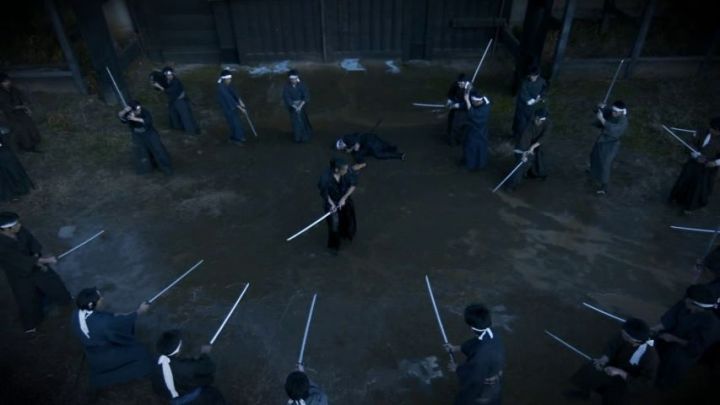
The Pass-Image-01

by Andrea Grunert

Koizumi Takashi’s (1) jidai geki (period film) The Pass: Last Days of the Samurai (Tōge: Saigō no samurai) is the adaptation of the novel Tōge written by Shiba Ryōtarō and published in 1968. Koizumi, a longtime assistant of Kurosawa Akira, directed After the Rain (Ame ageru, 1999), based on a screenplay written by Kurosawa who died in 1998. Recently, Koizumi has directed two other jidai geki: A Samurai Chronicle (Higurashi no ki, 2014) and Samurai Promise (Chiri tsubaki, 2018). Yakusho Kōji, who plays the leading role of Kawai Tsugunosuke in The Pass, also starred in A Samurai Chronicle. Several actors who have worked with Kurosawa appear in supporting roles: Nakadai Tatsuya (2), Kagawa Kyōko and Igawa Hisashi.
The action starts in November 1867 with the declaration of shogun Tokugawa Yoshinobu (Higashide Masahiro) to return governmental power to the Emperor (3). However, imperial loyalists from Satsuma, Chōchū and other domains opposed the idea of Yoshinobu’s leading role in a government council of the territorial lords. On 27 January 1868, Yoshinobu and his allies from various domains clashed with pro-imperialist forces at the Battle of Toba-Fushimi marking the beginning of the Boshin War (4). The protagonist of The Pass, Kawai Tsugunosuke (1827-1868) serves as the chamberlain of Makino Tadayuki (Nakadai), the lord of the Nagaoka domain (5). As a Tokugawa loyalist, Tadayuki continues to support Yoshinobu while he also expresses his respect to the emperor. His chamberlain follows a policy of “armed neutrality” and dreams of independence for his domain.
Numerous films and television series depict the final years of the Tokugawa shogunate, known as Bakumatsu, and the early Meiji period (1868-1912). The leading pro-imperialists of Chōshū, Satsuma and Tosa or the shinsengumi, an elite group of swordmen created by the shogunate, continue to inspire Japanese cinema (6). The Bakumatsu period and the first years of the Meiji era were times of great turmoil, making them particularly suitable for literary and cinematic productions seeking action, emotions, and reflections on political and cultural change.
In 1853, the arrival of American ships put an end to Japan’s isolationist policy (7). The Pass does not deal with the arrival of foreigners from America and Europe on the Japanese coast from 1853 onwards, but with internal struggles, specifically the threat posed by the army of Chōshū and Satsuma and their allies to Nagaoka. Kawai’s attempt to prevent war is unsuccessful due to his failure to consider the arrogance of the samurai from Chōshū and Satsuma, who refuse all negotiations (8).
The Pass contains numerous dialogue scenes, including political negotiations, idea exchange, strategy planning and private conversations. The placid rhythm is only interrupted by battle scenes in the final part. The film’s focus is on Kawai’s efforts to maintain peace while preparing his clan for an eventual war. In his first appearance, Kawai observes a shooting training. Later, he expresses his satisfaction with the Gatling gun (9) that he obtained for his clan and is interested in purchasing two or three more of these machine guns to compensate Nagaoka’s shortage of manpower.
Kawai is portrayed as a mild-mannered but strong-minded man who seeks to avoid conflict. In one scene, he confronts a group of young samurai from his clan who ambush him in a dark street. Although there is a brief fight in which Kawai demonstrates his physical strength, the conflict is primarily resolved through dialogue. However, the contradiction within the policy of “armed neutrality” is exposed in a conversation between Kawai and a maid who questions him: “You claim that conflict is wrong, yet you are constantly preparing for it.” The young woman’s remark brings to mind the dilemma often portrayed in jidai geki, where samurai live and die by the sword, yet many of them try – often in vain – not to kill.
The Pass briefly depicts the horror of war, exemplified by a scene in which Kawai encounters an elderly peasant holding his whimpering grandchild, still an infant, in front of his burning home. Yakusho’s exceptional acting conveys Kawai’s helplessness in the face of this atrocity. Kawai seamlessly fits into the lineage of samurai and ronin (masterless samurai) of Koizumi’s jidai geki which inherit Kurosawa Akira’s humanism. Kawai’s primary concern is for the people of his clan and their future. He acknowledges that the future entails change which in turn signifies the end of his own social class. In Samurai Promisse, the protagonist states that a samurai’s duty is to think of the people. Similarly, Kawai expresses a political idea: “The people are the nation. Dignitaries serve the people.”
Kawai is portrayed as a skilled strategist and honourable samurai, devoted to his lord and clan, and kind to the people. Despite this idealisation, he is depicted as a human being with many dimensions. The focus on his personal life, which reveals Kawai as a loving husband and highlights the strong bond between him and his wife Osuga (Matsu Takako), makes the character more relatable for modern audiences. The scenes showing the protagonist at home with his wife or enjoying life in a geisha house, to which he invites Osuga to accompany him, contribute to this rich human portrayal that avoids mere stereotyping.
The film showcases moments of great beauty through carefully composed and lit shots. The attention to detail is evident, particularly in the long shots where human presence is reduced to figurines. The colour palette predominantly features blues, greys, browns, pale greens and gold. The careful composition of each shot aligns with the slow rhythm of the narration and Japanese aesthetics, which also inspires the architecture.
The Pass, as well as Koizumi’s previous jidai geki including After the Rain, emphasises a classic narration and style. This is in contrast to more daring approaches to the genre, as demonstrated in Miike Takashi’s 13 Assassins (Jūsannin no shikaku, 2010) or Shimamura Yūji’s Crazy Samurai Musashi (Kyō samurai Musashi, 2020). The Pass does not criticise samurai ethics. Its protagonist is an example of an honourable loser who fought against an army of 50,000 with only 690 men. However, the film’s portrayal of the ideal samurai based on humanity challenges interpretations which value obedience and masculine strength. Moreover, Kawai’s vision is not restricted by the values of his own social class. He encourages a young man to pursue his desire to become a painter and emphasizes the importance of education in planning the future of his clan.
The Pass teaches us lessons about war and peace and about the importance of dialogue. It also highlights the conflict between the ideal of peace and the reality that war is always a possibility. It is precisely this dilemma that not only the Japanese have to face again today.

Notes

(1) The names are written in accordance with Japanese conventions, with the family name preceding the given name.
(2) Yakusho attended Mumei juku, an actor’s school founded by Nakadai and his late wife Miyazaki Yasuko (1931-1996).
(3) Following two and a half centuries of rule by the shoguns of the Tokugawa family, which gave the period from 1603 to 1868 its name – Tokugawa period (Tokugawa jidai) –, imperial rule was reinstated.
(4) The Boshin War took place from 1868 to 1869 and concluded with the defeat of the pro-Tokugawa forces.
(5) Nagaoka was a small domain located in Echigo province.
(6) See, for example, Ōtomo Keishi’s five Rurouni Kenshin-films (2012, 2014, 2021) and Harada Masato’s Baragaki: Unbroken Samurai (Moeyo Ken, 2021).
(7) During the first half of the 17th century, the Tokugawa regime implemented a policy of isolation, with strongly restricted relations and trade between Japan and foreign countries.
(8) The Nagaoka territory was one of the main battlefields in the Boshin War.
(9) The Gatling gun, an early machine gun with multiple barrels that fired rapidly, was invented in 1861 by the American Richard Jordan Gatling.

Grunert-Image-Musashi-01

by Andrea Grunert

Miyamoto Musashi (1), played by Sakaguchi Tak, is the main character in Shimomura Yūji’s Crazy Samurai Musashi (Kyō samurai Muasahi, Japan, 2020). Based on an idea by filmmaker Sono Sion, the film centres on the famous duel at Ichijōji Temple (2) between Musashi and samurai from the Yoshioka School of swordsmanship. Musashi (c. 1584-1645), a celebrated swordsman in Japanese history, is a blend of fact and fiction, much like d’Artagnan. Yoshikawa Eiji’s novel Musashi (Miyamoto Musashi), serialised between 1935 and 1939 in the newspaper Asahi Shinbun (3), has played a significant role in Musashi’s enduring popularity. Musashi is the protagonist of numerous films, some of which were inspired by Yoshikawa’s novel, such as Inagaki Hiroshi’s Samurai Trilogy (1954-1956; 4) and Tomu Uchida’s five films about Musashi produced between 1961 and 1965 (5). Mizoguchi Kenji also made a film about the famous swordfighter in 1944: Miyamoto Musashi. Mikami Yazuo’s Musashi (2019) is a more recent film. Musashi was also the main protagonist of a taiga drama in 2003 (6).
The duel at the Ichijōji Temple is a crucial episode in Yoshikawa’s novel as well as in the novel’s adaptations by Inagaki and Uchida and in Mikami’s Musashi. In Uchida’s and Mikami’s films, the number of Musashi’s opponents is given as about 70 (7). In Crazy Samurai Musashi, the number is given as 400! As a result, the film focuses heavily on swordfighting. There is almost no plot and only a few dialogues, but a series of fights between Musashi and a seemingly never-ending appearance of opponents he kills one after the other (8).
Before becoming a director, Shimomura worked primarily as an action director, stunt coordinator and stuntman. It is improbable, however, that his interest in fighting scenes and his expertise in the field are the sole reason for his choice. On the contrary, focusing on the fights is an effective means to reveal the very essence of the jidai geki and chanbara (9), as well as Musashi’s personality (10). This essence lies in the act of killing men. Inagaki and Uchida show the transformation of Musashi from a wild, uncontrolled youth to a disciplined swordsman. Musashi, the young peasant samurai (he is sixteen years old at the beginning of Yoshikawa’s novel) must learn how to harness his powers. He is presented with the chance to study and become a more accomplished swordsman, adhering to the samurai ideal of bu (martial valour) and bun (cultural achievement). After spending two and a half years in seclusion, reading and reflecting on his violent past, the protagonist embarks on a long journey to perfect his skills and master the sword and his mind. During his travels in Japan, he encounters several renowned warriors of his time, including Seijurō, the leader of the Yoshioka School whom he defeats, as well as Seijurō’s brother Denshichirō. At Ichijōji Temple, the Yoshiokas, led by thirteen-year-old son Matashichirō (11), attempt to regain their honour.
In Miyamoto Musashi, Mizoguchi already questions the motives of the protagonist. This Musashi (Kawarasaki Chōjūrō) denies fighting for personal reasons such as revenge, but Mizoguchi casts doubts on the purity of his acts. However, he depicts him as a master of the sword who is in full control of his body and mind. In Inagaki’s Sasaki Kojirō trilogy (1950/1951; 12), Musashi, played by Mifune Toshirō, is a wild, ruthless fighter who kills without hesitation. Mifune also plays Musashi in Inagaki’s Samurai Trilogy, where the famous swordsman exhibits more romantic traits (13). However, the three films do not completely obscure the ambiguity behind his violent actions. This ambiguity is further explored in Uchida’s Miyamoto Musashi: Ichijōji no kettō (1964), the fourth film in his series of five in which Musashi (Nakamura Kinnosuke) kills his opponents being in a frenzied state. At the end of the fight at Ichijōji Temple, Musashi, on the brink of madness, runs away as if escaping from his murderous self.
It is the contrast between the pursuit of spiritual enlightenment and the use of deadly force which is often depicted in films about Musashi as well as in other jidai geki. Many jidai geki of the 1960s feature samurai or rōnin who do not wish to kill, yet end up doing it anyway. This is the case in Okamoto Kihachi’s satirical Kill (Kiru, 1968) and in Gosha Hideo’s Goyōkin (1969). Also in Mikami’s Musashi, one of the characters states: “The only purpose of the sword is to kill people.” In this film, Musashi (Hosoda Yoshikiro) is a killing machine, driven by the idea of winning, despite his remorse after having killed a child at Ichijōji Temple.
In Crazy Samurai Musashi no guilt feeling is expressed. Violence is presented as a simple, unavoidable fact without being idealised or masked by notions of duty or honour. Musashi must kill to survive against the superior number of opponents. The film focuses on Musashi’s fighting without providing any explanation about his character or psychological approach. The lack of dialogue emphasises the importance of the action (14).
The film features three distinct locations in close proximity to the temple where the battle one against 400 occurs. The first is a small clearing in a forest, with Musashi facing a large number of opponents. The other two locations are the narrow streets of an abandoned village and the open space at the village entrance. These locations require varying camera positions and framing. Throughout the sword fighting sequences, Musashi is often filmed from behind, which conceals his emotions from the viewer. The fights filmed in the narrow streets of the abandoned village are shorter and more fragmented due to the visual closures created by the space.
Most shots are long shots, with close-ups and medium close-ups being infrequent. However, the fight sequences are presented with a variety of framing, camera movements, and the use of the handheld camera. For instance, in one duel sequence, the combatants are illuminated by lightning while the rolling thunder accompanies the sound of the fighting. The pouring rain blurs the contours of the setting, emphasising its desolation and adding to the sense of tragedy surrounding the violent action. The final moments of the fierce battle at Ichijōji Temple are shot from a bird’s-eye view, revealing Musashi surrounded by a multitude of adversaries.
The fight sequences depict Musashi taking brief breaks to drink water and recover, with his exhaustion palpable at times. Despite heavy panting, he quickly resumes his deadly business and ultimately fights with two swords, a technique attributed to the historical Musashi. The short pauses and infrequent dialogue, along with the soundtrack, contribute to the production’s originality. There are moments in which the only sound are the cries and the panting of the men and the clashing of the swords. The wind can also be heard and, in the aforementioned sequence, rain and thunder. The haunting sound of drums accompanies several moments of the fighting, while melodious tunes played on the piano and violins appear in others. The colour palette is dominated by shades of brown and grey and of blue, the colour of many of the kimonos worn by the combatants. The red of blood is the only vivid colour used in the long fighting scene. Musashi’s face and kimono are stained with blood; blood spurts from ruptured arteries. The limited colour palette and long takes emphasise the repetitive nature of the killings. Despite the abundance of action sequences, the film manages to avoid becoming tedious due to the sufficient visual and acoustic variations. However, repetition is also used to create tension. The numerous killing sequences can have an unsettling effect on the viewer. This feeling of anticipation and discomfort could lead to insight and deeper reflection on the sense or nonsense of violence and the code of honour of the samurai.
The series of fights takes place between two scenes containing comparatively more dialogue. In the film’s second scene, young Matashichirō (Kimura Kōsei) appears. He is a small child of approximately nine or ten years, an innocent boy who apparently does not fully understand the dangerous situation in which he is been placed by the elders of his clan. Matashichirō, smiling happily, is more interested in a white butterfly than the impending fighting, but Musashi’s sudden attack ends both the child’s and the butterfly’s life with a single stroke of his sword. The youthfulness and immature behaviour of the boy accentuate the horror of Musashi’s murderous action.
In Buddhism, white is a symbol of both purity and death. Combined with the delicate butterfly (15), it suggests the transience of life. In the final scene, which takes place seven years after the events at Ichijōji Temple, Musashi, now bearded and with his face covered in scars, is meditating beside a small stream when a white butterfly lands on the pommel of his sword. The butterfly is now associated with the warrior whose life is often short (16). Additionally, the butterfly remembers past events that continue to linger and seem to materialise in this very scene. Suddenly, Chūsuke (Yamazaki Kentō), a former student of the Yoshioka School, appears at the stream with a group of samurai. The short opening scene, which precedes the dialogue scene before the beginning of the battle, focuses on Chūsuke, practising with a wooden sword. Close-ups and medium close-ups of the young man in an interior are alternated with shots of a one-on-one duel taking place in a landscape. The fight is filmed in close-ups and extreme close ups, fragmenting bodies and objects. The combatant’s faces remain indistinct. It can be presumed that these shots are memory images showing Musashi who fights against one of the Yoshioka brothers. The dreamlike quality of these flashbacks is underlined by black-and-white photography. In the following scene, Chūsuke expresses his ardent desire to take revenge for the deaths of Seijurō and Denshichirō, providing an explanation to the previous shots. Seven years after the battle at Ichijōji Temple, Chūsuke challenges Musashi, driven by his desire for revenge fueled by the mass killing. Chūsuke appeals to his opponent’s sense of duty and honour as a samurai. Musashi dismisses these concepts as meaningless and declares that his only goal is to win. He then proceeds to kill Chūsuke’s men one by one, this time using a sickle instead of a sword. Throughout the short fight, Chūsuke is mesmerised by Musashi’s incredible swordsmanship.
Yoshikawa’s novel and the films made about Musashi present his life as a series of fights. However, none of them consist solely on fighting scenes. Crazy Samurai Musashi portrays violence in a concentrated and unadorned form, illustrating Musashi’s bitter realization at the end of Uchida’s Shinken shōbu (1971), the sixth film added to his series of five films on Musashi: “The sword is finally nothing else then violence.” (17)
Crazy Samurai Musashi reveals the ultimate consequences of violence as an inherent element of jidai geki. Shimomura’s film, which goes far beyond the works of his predecessors, presents a radical vision of the violence at the heart of the samurai ethos. The film does not include reflections on ethics, the search for the meaning of life, or honour and nobility. The only question is whether to kill or be killed. Musashi is portrayed as a killing machine who attacks with a frenzy. However, Shimomura also depicts the protagonist as an individual trapped in a cycle of violence that he strives to overcome and survive (18). The film ends with Chūsuke asking: “What are you?” Musahsi’s response is : “I am…”, followed by the words “crazy samurai Musashi” written in red kanji over a black background. Although Musashi’s actions may seem to be driven by obsession and insanity, it is important to note that they are rooted in an ethical system strongly asscoiated with violence. This system has inspired an entire cinematic genre. In a broader sense, Shimomura’s film reveals humanity’s persistent atavism.

Notes
(1) The names are written according to Japanese conventions in the order of family name followed by given name.
(2) The Ichijōji Temple is a Buddhist temple situated in northeastern Kyoto. The duel marked the culmination of a long-standing feud between Musashi’s family and the Yoshioka family.
(3) The novel was serialised in 1013 episodes from 23 August 1935 to 11 July 1939.
(4) Samurai I : Musashi Miyamoto (Miyamoto Musashi, 1954), Samurai II : Duel at Ichijōji Temple (Zoku Miyamoto Musashi : Ichijōji no kettō, 1955) and Samurai III: Duel at Ganryū-jima (Miyamoto Musashi kanketsuhen: Kettō Ganryū-jima, 1956).
(5) Miyamoto Musashi (1961), Miyamoto Musashi : Han’nyazaka no kettō (1962), Miyamoto Musashi : Nitōryu kaigen (1963), Miyamoto Musashi : Ichijōji no kettō (1964) and Miyamoto Musashi : Ganryū-jima no kettō (1965).

(6) Ichikawa Ebizō XI played Musashi in the taiga drama Musashi, broadcast in 2003. Taiga dramas are year-long historical television dramas, produced by NHK (Japan Broadcast Corporation).

(7) According to the novel and films, a great number of students of the Yoshioka School as well as mercenaries hired by the Yoshioka clan were hidden near the temple to kill Musashi in order to save the reputation of the once famous swordsman school, whose existence was in jeopardy after Musashi’s subsequent victories.

(8) The fight scene at Ichijōji Temple lasts for around 118 minutes in the 131-minute film.

(9) The term jidai geki refers to historical films (and other historical narratives), particularly those set in the Tokugawa period (1603-1868), while chanbara is a term for sword fighting films.

(10) However, viewers are free to enjoy the sword fighting.

(11) In Shimomura’s film, the boy involved in the scene is only referred to by name. However, in Yoshikawa’s novel, he is called Genjirō and is identified as the eldest son of Yoshioka Genzaemon, who is an uncle of Seijirō and Denshichirō. Other authors refer to the boy as Seijurō’s son and use the name Matashichirō. See Alexander Bennett, The Complete Musashi: The Book of Five Fings and Other Works, Rutland, Vermont, Tuttle Publishing, 2018, p. 31.

(12) The trilogy comprises of the following films: Sasaki Kojirō (1950), Zoku Sasaki Kojirō (1951) and Kanketsu Sasaki Kojirō: Ganryū-jima no kettō (1951). Sasaki Kojirō (ca. 1575-1612) was a renowned swordsman and Musashi’s rival. He was killed by Musashi in a duel on a small island, which was later named Ganryū-jima after Kojirō’s nickname Ganryū.

(13) In Samurai II: Duel at Ichijōji Temple (1955), Inagaki does not mention the killing of the boy from the Yoshioka clan. The omission aligns with the portrayal of Musashi as a man who does not hesitate to kill but who also exhibits great dignity. For such a character, taking the life of a child seems inconceivable.

(14) There are a few occasions where language is used. The second scene, lasting approximately six minutes, comprises extended dialogue between members of the Yoshioka School. During the long fight scene, two of the Yoshioka students engage in a heated argument. Three or four of Musashi’s opponents introduce themselves by name before facing him in a one-on-one fight. Musashi occasionally speaks to himself, questioning the number of men the Yoshiokas have and making statements such as “It’s getting tough” or “I’ll kill them all.”

(15) Butterflies are mentioned several times in Yoshikawa’s novel. For example, he writes: “To the universe, the death of a man could have any more signification than that of a butterfly, but in the realm of mankind, a single death could affect everything, for the better or worse.” (Yoshikawa Eiji, Musashi, New York, Kodansha USA, 2012, p. 522).

(16) The cherry blossom is traditionally associated with the samurai, symbolising the transience of life.

(17) In Shinken shōbu, Uchida focuses on a famous episode from Yoshikawa’s novel: Musashi’s duel with Baiken, a master with a sickle and notorious robber. Uchida’s film concludes with a lengthy duel scene between Musashi and Baiken, played by Mikuni Rentarō. However, unlike Shimomura, Uchida’s primary focus is on the relationship between the two main characters. He highlights their conversations and emotions, with the duel being just one of many scenes, albeit a very long one. In Crazy Samurai Musashi, Baiken is one of the fighters who has joined the Yoshioka samurai and who faces Musashi in a one-on-one duel.

(18) Despite his pursuit of higher awareness, Musashi cannot be considered a clear-cut hero, as his ardent desire to win conflicts with the values of honour and duty associated with samurai. As Alexander Bennett put it: “As much as Musashi is revered as a supreme warrior by the majority of Japanese, he is also reviled by some as representing the antithesis of the Way of the samurai. A common criticism is his alleged use of cowardly delaying tactics to irritate his opponents and to win by any means possible, however, dishonourable.” (Bennett, op. cit., p. 20). This ambiguity makes Musashi an especially intriguing case for questioning the idealised Way of the samurai.

Radar_City-Sadness-1_Courtesy-of-Curzon-Artificial-Eye

Der Vorspann, helle Schriftzeichen auf dunklem Untergrund. Aus dem Off hört man die Kapitulationsrede des japanischen Kaisers. Eine Aufblende wie das Licht am Ende des Tunnels in Lien Lien Fung Chen (Liebe wie Staub im Wind, 1987). Das erste Bild erscheint wie beim langsamen Sichtbarwerden eines Fotoabzuges im Entwicklerbad. Ein korpulenter Mann Wen Xiong (der älteste von vier Brüdern einer taiwanesischen Familie, der betet und Räucherstäbe anzündet. Diffuses Licht. In einem anderen Teil dieser Wohnung eine Frau, die unter Schmerzensschreien ein Kind zur Welt bringt. Gesprächsfetzen, die Schreie der Frau. das geräuschvolle Schlurfen Wen Xiongs. Irgendwann wird der Strom eingeschaltet, eine Stubenlampe leuchtet auf. Mit fast ritueller Sorgfalt krempelt der untersetzte Mann den Lampenschirm hoch und verläßt den Bildausschnitt. Die Lampe und ein Teil dieses Raumes. Menschenleer. Die menschlichen Stimmen von außerhalb der Kadrage gehen allmählich in ein elektronisches Dröhnen über, welches von weit außerhalb des Raumes und der Zeit herzukommen scheint. Dann der zweite Teil des Vorspanns, symphonische Synthesizermusik, der Bruch zwischen der Zeit, von der Beiqing Chengshi erzählt (die ersten Jahre nach dem Zweiten Weltkrieg) und der Zeit eines Kinos in den Neunziger Jahren. Man könnte auch von dem Geräusch der Zeitmaschine Kino reden, die uns zeitlich und räumlich aus der Gegenwart heraus und wieder zurückführen wird.

Die Familie Lin bei der Vorbereitung eines Festes. Wen Liang, der dritte Bruder wird aus dem beendeten Krieg zurückerwartet. Der Blick in ein Zimmer, verengt durch Interieurs. In der verengten Kadrage das geschäftige Treiben der Personen, der Vater, der Opfergeld verbrennt, die Frauen, die den Haushalt besorgen. Gesprächsfetzen, die sich mosaikartig zu Informationen zusammensetzen. Oft treten die Personen aus dem Bildausschnitt heraus und wieder hinein, aus dem winzigen sichtbaren Teil des Raumes in den imaginären.

In den längsten Einstellungen des Films bleibt die Kamera meistens starr. ein Blick, der aus sicherer Distanz beobachtet. Personen, die essen, trinken oder reden. Szenen, die das dramatisch bewegende Sujet wieder unterwandern. Die Vergänglichkeit der Menschen und der Dinge in bis zu dreiminütigen Plansequences in kleinen Ewigkeiten festgehalten. Zu Beginn des Films treffen sich Intellektuelle in einer Bar. Irgendwann stimmen sie dann in ein nostalgisches Lied ein. Einer von ihnen öffnet das Fenster im Hintergrund der Bildmitte, ein blaues Quadrat, in das der Blick in die Tiefe nach „außen“flüchten kann. Die Befreiung des Blicks aus dem Eingeschlossensein eines begrenzten Raumes. Kein Hinweis, daß einer der Personen, Hinoe, im Laufe des Filmes. eine gewichtige Rolle spielen wird. Ein Schnitt, der die Tonspur aber nicht abbrechen läßt, auf eine gebirgige Landschaft, die von Leitungen wie von Schienennetzen durchzogen ist. Die Montage, die nicht den Sinn baut, sondern Möglichkeiten anbietet im Verlaufe des Films Verknüpfungen im eigenen Kopf vorzunehmen.

Der Gang eines Krankenhauses: Das Bild durch Säulen und Mauern doppelt gerahmt, verkleinert den Raum, in dem sich die Akteure bewegen auf die Hälfte des Filmformates. Der Blick kann wieder flüchten bis zum Eingang des Krankenhauses, wo das Tageslicht und die Grünanlagen die Freiheit versprechen. Diese Einstellung kehrt mehrmals wieder, vermutlich sogar in identischen Einstellungsgrößen. Einmal nach den ersten blutigen Unruhen versammelt sich eine Menschenmenge in dem ohnehin schon verengten Bildausschnitt, Ärzte und Krankenschwestern, die Verletzte behandeln oder durch die Räume tragen. Die ganze Welt scheint sich auf dieses kleine Stückchen Raum reduziert zu haben. Es ist Nacht. Kein Licht am Ende des Tunnels.

Ein Treffen von Oppositionellen in den Wohnung Wenqings, des jüngsten, der vier Brüder. Seit frühester Kindheit ist er staubstumm. Während sich die anderen unterhalten, beschäftigen sich Wenqing und die Krankenschwester Hinomi miteinander. Obwohl im selben Raum mit den anderen, nur Zentimeter von deren Tisch entfernt, dominiert hier für einen Moment die Geschichte zwischen diesen beiden Figuren. Von einem Plattenspieler hört man das Loreley-Lied „Ich weiß nicht, was soll es bedeuten.“ Die Kommunikation zwischen beiden ist beschränkt auf das Austauschen von kleinen Zettelchen, die als ausgedehnte Zwischentitel wie Referenzen an den Stummfilm auf der Leinwand erscheinen. Schriftlich erzählt Hinomi dem Stummen die Geschichte des Loreley-Liedes. Eine intime Szene einer sich entwickelnden Liebesgeschichte, die gleichermaßen Aufmerksamkeit beansprucht, wie die Hinweise von Morden, Unruhen und der Auseinandersetzung zwischen der KMT-Regierung und der Untergrundbewegung. Inmitten einer Zeit der Angst, lange lyrische Sequenzen, wie kleine Inseln, zu denen man gelegentlich flüchten kann.

Die Vielfalt der Sprachen; Mandarin, verschiedene Akzente, unter ihnen der, den die TaiwanesischenUreinwohner sprechen und auch japanisch, die Sprache der ehemaligen Besatzungsmacht ist zugleich auch eine Krise der Verständigung. Die Untertitel versuchen daher nicht nur für Europäer dieses Wirrwarr zu ordnen. Auf der anderen Ebene, Inserts, Zwischentitel, aus dem Off gesprochene Briefe und Tagebuchaufzeichnungen. Die Frauen, fast bar jeder Macht und jeden Einflußes sind denoch die eigentlichen Chronisten. Die propagandistischen Radioansprachen der Regierung werden mit den persönlichen Reflexionen der Frauen konfrontiert. Die offizielle Geschichte und die Stimmen derer, die später in der Geschichtsschreibung verstummen werden. Die gesprochene und geschriebene Sprache als Chaos oder als Versuch zu ordnen, die ihre Grenzen offenbart und auf nichtverbaler Ebene ihre Entsprechung in Blicken und Gesten findet. Die exaktesten historischen Exkurse über dieses Sujet müssen zwangsläufig scheitern. Beiqing Chengshi ist unter anderem auch ein Film über die Sprache, die versucht zu benennen und über die Dinge, die für sich selbst sprechen.

Der stumme Wenqing wird verhaftet. Von außen durch die Gefängnistür und Gitter halb verdeckt, eine kleine schweigende Gruppe von Gefangenen, denen man auf den ersten Blick kaum Todesangst ansieht. Emotionen, die sich allenfalls erkennen lassen in der sorgfältigen Betrachtung der Gesten, die sich manchmal nur auf banale mechanische Funktionen der Gliedmaßen reduzieren. Ein Name wird aufgerufen. Körper, die sich zum Abschied umarmen, von denen manchmal nur die Rümpfe zu erkennen sind. Fragmente einer Tragödie, die sich im Nichtsichtbaren abspielt. Die Tür, die den Blick in die Zelle bricht wird geöffnet, ein Mann abgeführt. Kurze Zeit später fällt ein Schuß. Wenqings Name wird aufgerufen. Ein Blick auf seine Mitinsassen zeigt ihm, daß er gemeint ist. Wieder wird die Tür geöffnet, Wenqing abgeführt. Sie führen ihn durch einen langen Gang, der eine Unendlichkeit in die Tiefe des Bildes zu ragen scheint. Die Kamera bleibt starr, folgt ihnen nicht. Ganz am Ende des Ganges wird eine Tür geöffnet und wieder geschlossen. dann die Leere des unendlichen Ganges. Was bleibt ist die Ahnung der unaussprechlichen Angst, eine namenlose Drohung. Kein Licht am Ende des Tunnels.

Wenqing, durch seine Stummheit mit der Welt nur visuell in Verbindung stehend, ist Fotograf. Wie seine tagebuchschreibende Freundin ist auch er ein Chronist jenseits der offiziellen Geschichte. Mehrmals sieht man ihn bei der Betrachtung oder Retouchierung von Fotografien auf einem Lichtpult. Seltsame, durch das Licht verfremdete winzige Chimären, sepiafarbene Phantomwesen außerhalb der Zeit. Der ganze Film ist weit entfernt von einer spektakulären Familiensaga, eher ein überdimensionales Familienalbum. Jedes Bild ein Zeugnis von der Präsenz der Menschen und der Dinge. Jedes Bild hat seine eigene fragmentierte Geschichte. Beiqing Chengshi ist einem Film wie Ozus Bakushu näher als beispielsweise Xie jins Furong Zhen (Die Stadt Hibiskus, China 1988). Vermutlich völlig unabhängig von Ozu, die gleiche tiefe Suche nach der Bestimmung des Kinos und dessen Basis, das fotografierte Bild. Die Personen erleiden nicht nur Geschichte, sondern sind sogar bestrebt, sie festzuhalten oder aufzuzeichnen, vielleicht sogar in dem Bewußtsein ihrer eigenen Vergänglichkeit. Die Fotografie des ermordeten ältesten Bruders, welches auf der Beerdigung von seinen Angehörigen getragen wird, der Versuch zumindest einen winzigen Teil des Lebens aus der Zeit zu nehmen und über den Tod hinaus zu erhalten. Eine der letzten Szenen, die mir auf merkwürdige Weise Andre Bazins Aufsatz Ontologie des photografischen Bildes ins Gedächtnis ruft: Wenqing vor dem Spiegel beim Einbalsamieren seiner Haare mit nahezu ritueller Feierlichkeit. Hinomi und ihr gemeinsames Kind sitzen bereits in einer Pappdekoration mit gemaltem Kamin, gemaltem Fenster, gemalter Vase. Nichts Lebendiges. Eine künstliche Idylle, der verzweifelte Versuch dem Traum von einem beseren Leben, außerhalb der Wirklichkeit (außerhalb des Diesseits ?) Gestalt zu verleihen. Das Klicken des fotografischen Selbstauslösers. Das Bild friert ein, die Haltung der Personen gleicht fast denen von Mumien. Aus dem Off die Stimme Hinomis, die in einem Brief mitteilt, dieses Foto sei drei Tage vor der Verhaftung Wenqings gemacht worden. Wenqing habe darauf bestanden, seine Arbeit beenden zu können. Seit Tagen hat sie nichts mehr von ihm gehört. Unausgesprochen bleibt die Gewißheit, daß Wenqing inzwischen hingerichtet wurde.

Bilder, Szenen, die sich nicht einfach summieren. Szenen, die manchmal wie streng abgeteilte Räume eines Gebäudes wirken und die von der Montage nicht einfach zu einer Geschichte verbunden werden. Vielmehr eröffnet die Montage zahlreiche Kombinationsmöglichkeiten diese fragmentierten und manchmal nur angedeuteten Episoden mit Hilfe der eigenen Vorstellungskraft zu vervollständigen. Wenige Rückblenden, aus dem Off gesprochene Tagebuchtexte, wie kleine unterirdische Gänge, durch die man sich einen Weg bahnen kann, von einem Stück Geschichte zum nächsten. Die „Geschichte“, die man durch Inhaltsangaben erfährt, zefällt wie bei einer Zellteilung in viele verschiedene, die ihre Souveränität gegenüber dem Hauptplot behalten, auch wenn sie sich dennoch miteinander verknüpfen lassen: Die Geschichte von Wenliang, dem dritten Bruder, der bereits als seelisches Wrack aus dem Krieg zurückkehrt, in den ihn die japanischen Besatzer gezwungen haben, der aufgrund seiner Labilität in Gangsterkreise gerät, als Kollaborateur verhaftet wird und in den KMT-Gefängnissen zum körperlich und geistigen Krüppel geschlagen wird. Der Rest seiner Identiät, das verbotene Naschen von halb verfaulten Opfergaben. Unter anderem geht es auch um die Geschichte Hinomis, Wenqings und ihrer Liebe, die Geschichte einer Familie, welche die KMT-Regierung als Fortsetzung der japanischen Okkupation erleidet. Sogar der zweite Bruder (ein Arzt), der gar nicht erst aus dem Krieg zurückkehrt, ist in kleinen Geschichten präsent. Seine Frau, in der irrationelen Hoffnung, er werde dennoch zurückkehren, desinfiziert regelmäßig seine Instrumente. Es sind die Geschichten der Namenlosen, die in die Geschichtsbücher keinen Zugang haben. Geschichten wie Splitter eines zerbrochenen Glases. Faccetten von Menschenleben, die für einen Moment die Vielschichtigkeit einer Person durchscheinen lassen. Der Tod des ältesten Bruders, ein Häftling, der zur Hinrichtung geführt wird oder eine Messerstecherei mit tödlichen Folgen. Kurze häßliche Szenen, ohne Pathos die banale Ungeheuerlichkeit des Todes. Jede dieser Personen, ein kleines Universum für sich, jeder Tod ein kleiner Weltuntergang.

Das letzte Bild. Wie zu Beginn, ein menschenleerer Raum, ein Fenster und eine Vase. Ein Stilleben. Die Starrheit der leblosen Dinge gegenüber dem bewegten und vergänglichen Leben der Menschen. Das Kino wieder an seinem Ausgangspunkt, der Fotografie. Dann eine Abblende, die den Raum wieder schließt, den die Aufblende am Anfang geöffnet hatte. Der Nachspann, ein traditionelles Kinoritual, die Schriftzeichen wie Hiroglyphen auf dem Tor zu einem Raum, der sich öffnet und wieder schließt, in dem man nr Beobachter ist und in dem doch für 160 Minuten die Menschen und die Dinge auf nahezu unheimliche Weise präsent waren. Es gibt Filme, die kann man nicht so einfach nacherzählen, sie sind wie Räume, in denen man für einige Zeit gewohnt haben muß.

Rüdiger Tomczak (Erstdruck in Journal Film, Freiburg im Breisgau, Sommer 1991)

cityofsadness