NC24_cinema_Penalty Loop
(Copyright: „Penalty Loop“ Film Partners)

by Andrea Grunert

The Town of Headcounts (Ninzū no machi, Japan, 2020), Araki Shinji’s (1) directorial debut is a sombre portrait of Japan at an unspecified time in the future. The film is the dystopian tale of a society that manipulates its citizens and tries to eliminate the undesirable such as the poor and the criminals. If space is an important factor in this first film, the focus in Penalty Loop, Araki’s second film, is on time (2). Yui (Yamashita Riō), the girlfriend of the film’s main protagonist Jun (Wakaba Ryūya), has been murdered. The young man is devastated and takes the law into his own hands, killing her murderer, Mizoguchi (Iseya Yūsuke), who works as a maintenance man at the same factory as Jun. When Jun wakes up, the day after having had his revenge, it is still June 6th – the same as the day before – and his victim is still alive. Jun is caught in a spiralling loop of violence during which he kills Mizoguchi again and again.
Araki varies not only the situations in which the killing takes place, but he also shifts from reality to virtual reality. What makes his film original and particularly appealing is its visual design. Jun and Mizoguchi work at a hydroponic plant factory, a highly automatized place and almost devoid of human presence. Jun, clothed from head to toe in a protective suit, is almost unrecognizable as a human figure. The huge room in which vegetables are grown and where his task is to set in motion a conveyor belt with heads of lettuce looks sterile. Just as in his previous film with its futuristic-looking setting, Araki does not need special effects to create an eerie feeling of unfamiliarity. In addition, the motif of the time loop is a perfect pattern to display a great variety of genre conventions borrowed from fantasy, horror, and crime films.
The hydroponic factory is certainly a significant feature of Araki’s film, but the plot focuses on the two main characters, Jun and his antagonist Mizoguchi, depicting not only the conflict between the two men – reminiscent of two duellists – but also the development of the relationship between them and their personalities. Jun commits his first murder in a frenzy. He first spikes Mizoguchi’s coffee, leaving him writhing with severe stomach cramp. When Jun later kills him, Mizoguchi is no longer able to defend himself and Jun stabs his victim brutally several times, venting his fury at the death of his girlfriend.
When Jun kills Mizoguchi the second time, Mizoguchi sees his assailant’s face, and from then on starts adopting strategies to avoid being killed. The following day, he does not drink the poisoned coffee but offers it to a female employee at the factory and watches almost with glee as the woman writhes in pain. To begin with, there is no dialogue between Jun and his opponent, but language soon becomes an indication of rapprochement as human beings. Jun’s desire for revenge moderates and Mizoguchi, realizing that he is going to die, reacts with sadness.
Despite its emphasis on death and violence, Penalty Loop is not lacking in humour, for example when Jun pushes a trolley on which is Mizoguchi’s dead body, wrapped in a plastic bag and kept in an upright position through the aisles of the factory, a group of employees watching in amazement. In another scene, Jun complains to his victim: “I am going to dump your body. You are so heavy”, to which Mizoguchi replies laconically “I am sorry.” However Mizoguchi also complains about being in constant pain as it hurts being so frequently stabbed or shot.
Araki skilfully mixes tragedy and humour, just as he convincingly combines the social and moral levels. The Town of Headcounts is full of references to present-day Japanese society, and in Penalty Loop too the plot is firmly anchored in reality. The film also has a strong psychological dimension. At the beginning it is reported that the police have arrested Yui’s murderer. That does not seem to be enough for Jun and he wants to see the perpetrator dead. The death penalty is still carried out in Japan but mainly for what are considered aggravated murders. However, for Jun, the law does not seem to be enough. He is depicted as someone who gives unbridled rein to his anger and helplessness over Yui’s death. These are certainly feelings that many viewers could share from their own experience – although probably from other less dramatic scenarios. The death penalty is hinted at in the scene in which Jun and Mizoguchi go bowling. In this scene two kinds of opponents are referred to, namely “executioners” and “death row inmates”. However, it is not the death penalty that is the focus of Araki’s film but how to come to terms with the violent death of a loved one and how to deal with one’s grief.
Jun is depicted as an attentive and caring person, revealed in one early sequence in which he sets a ladybird free. But the brutal death of his girlfriend changes him and the gentle Jun becomes an unscrupulous avenger who plans Mizoguchi’s death carefully and does not kill in the heat of the moment. The film only hints at how such a friendly and ordinary man can become a killer. However, the development of Jun’s personality does not end there, and he becomes himself a prisoner of the spiralling loop of violence that he has triggered. The constant killing sobers him up, and a new process of realization sets in, Jun realizing more and more clearly that revenge will change nothing. Nevertheless, he cannot stop killing.
This awakening of a conscience also means that he can for the first time really come to terms with the past, revealed in flashbacks showing him with his girlfriend. In this way, Araki indicates just how much grief is a slow process. Jun’s girlfriend is presented as a mysterious young woman whom he first met when she was burning documents on a beach. Even when Mizoguchi – who reveals that he is a contract killer – talks to Jun about the murder, much about Yui remains in the dark. For Jun, the brutal loss of his girlfriend also means that he does not get any answers – neither about Yui’s behaviour nor about her true feelings. These many unanswered questions torment him as they do many other bereaved.
The character of Mizoguchi does not perhaps have much depth, but is far more than a mere cliché. Araki, who is also the screenwriter of his film, could easily have portrayed Mizoguchi as an embodiment of evil. Instead, he emerges as a broken figure, which is emphasized by Iseya Yūsuke’s performance, as nuanced and imaginative as ever (3). His acting gives the character profile. Intrigued by Jun who is drawing a picture of a mighty tree close to the factory, he finally tries to draw the tree himself. The camera remains on Mizoguchi for a long time while he concentrates deeply on what is for him an unusual task but enjoys this peaceful moment, a smile lighting up his face. The melancholy but also the joy that he experiences suggest that he too is changing. Artistic creativity is set in contrast to violence and death. By portraying Mizoguchi as a human being rather than a cliché, Araki enriches the film’s moral dimension and critically questions revenge.
In addition to ethical reflections, the questioning of the revenge motif and implicitly of the death penalty, i.e. violence sanctioned by the state, Penalty Loop has a strong spiritual dimension, an aspect mentioned by Araki Shinji in the interview I conducted with him (4). Nature plays a major role in the film’s technological world, which is both realistic and at the same time detached from reality. The factory looks futuristic but is real – Penalty Loop was shot in a hydroponic plant in Fukushima Prefecture. In the factory, nature is domesticized and completely under human control. It is presented as a modern landscape and a human interpretation of nature. But there are also plants in Jun’s apartment and frequent shots of the huge tree that the two protagonists draw. While Mizoguchi is drawing his picture, the wind blows through the tree’s foliage, evoking the idea of a ghostly presence. The same suggestion of a spiritual presence is created by the image of an isolated spot in a bamboo grove, recalling similar images from numerous jidai geki. Nature is central to Shintoism, which holds that restless spirits who have been torn from life unnaturally inhabit trees and howl their suffering to the winds (5). Making use of these conventions, Araki succeeds very convincingly in externalizing inner feelings via pure visual imagination.
Flower symbolism is repeatedly evoked by the radio commentator Jun listens to every morning. According to the voice on the radio, the iris, the flower of the day – i.e. June 6th – is a symbol of hope. However, the yellow iris has a negative connotation, being a symbol of revenge, and thus this symbol combines both the film’s revenge motif and its yearning for hope.
There is no image of a yellow iris in the film, but Jun, the avenger, drives a yellow car. Colours are very important in The Town of Headcounts, and in Penalty Loop too, Araki giving a great deal of emphasis to colours. The film’s main colour is green – the rich green of the salads and vegetables in the hydroponic factory and that of the leaves on the huge tree on the factory’s premises, the green of the bamboo grove and of the plants in Jun’s apartment. This lively colour establishes a significant contrast to the theme of murder and violence. There is also the blue of the water in the sequence in which Jun and Mizoguchi are rowing on a lake. Filmed from bird’s eye view, the bluish-turquoise surface of the water creates an almost idyllic image. This brief moment contrasts with the nocturnal images in which water is linked with death – Yui is murdered near a lake; Jun apparently dumps Mizoguchi’s dead body in the same lake. Even the scene with the two men in the boat ends with a death when Jun shoots Mizoguchi dead. Araki’s use of water as a motif in the film is a reminder that this element is in many cultures strongly associated with both life and death and expresses the very idea of rebirth.
Araki privileges image, music and sound over dialogue. Emphasis is put on the actors and how they communicate using their eyes and their facial and body expressions. Very often, Araki is content to offer allusions. In Penalty Loop, the viewer does not know any more than the characters do, but is it necessary always to explain everything? Making clever use of the time loop narrative, Araki has created a film full of unexpected turns. Despite its violent theme, Penalty Loop is highly entertaining, and the spellbinding combination of drama and comedy leaves enough space for deeper reflection on death, loss and grief. Moreover, Araki succeeds marvellously in combining a great variety of narrative and visual elements without destroying the film’s internal coherence.
Notes
(1) Names are written according to Japanese conventions: the family name before the given name.
(2) It should be noted that the time loop motif figures in two other recent Japanese films: Takebayashi Ryō’s Mondays: See You “This” Week! (Mondays: Kono tainurūpu, jōshi ni kidzuka senai to owaranai, 2022) and Yamaguchi Junta’s River: The Timeloop Hotel (Riba; nagarenaide yo, 2023). The first of these films deals with Japanese white-collar workers, a young salaryman being caught in a time loop. In the second, the characters are caught in a two-minute time loop at an inn in the countryside. Penalty Loop is however very different from these two films, the time-loop factor being the only common element.
(3) See Araki Shinji on working with the actors in the interview that I conducted with him during the Nippon Connection Film Festival in Frankfurt on May 30th, 2024.

(4) ibid.

(5) Links between nature and the spiritual world are also features of Buddhism and other religions.
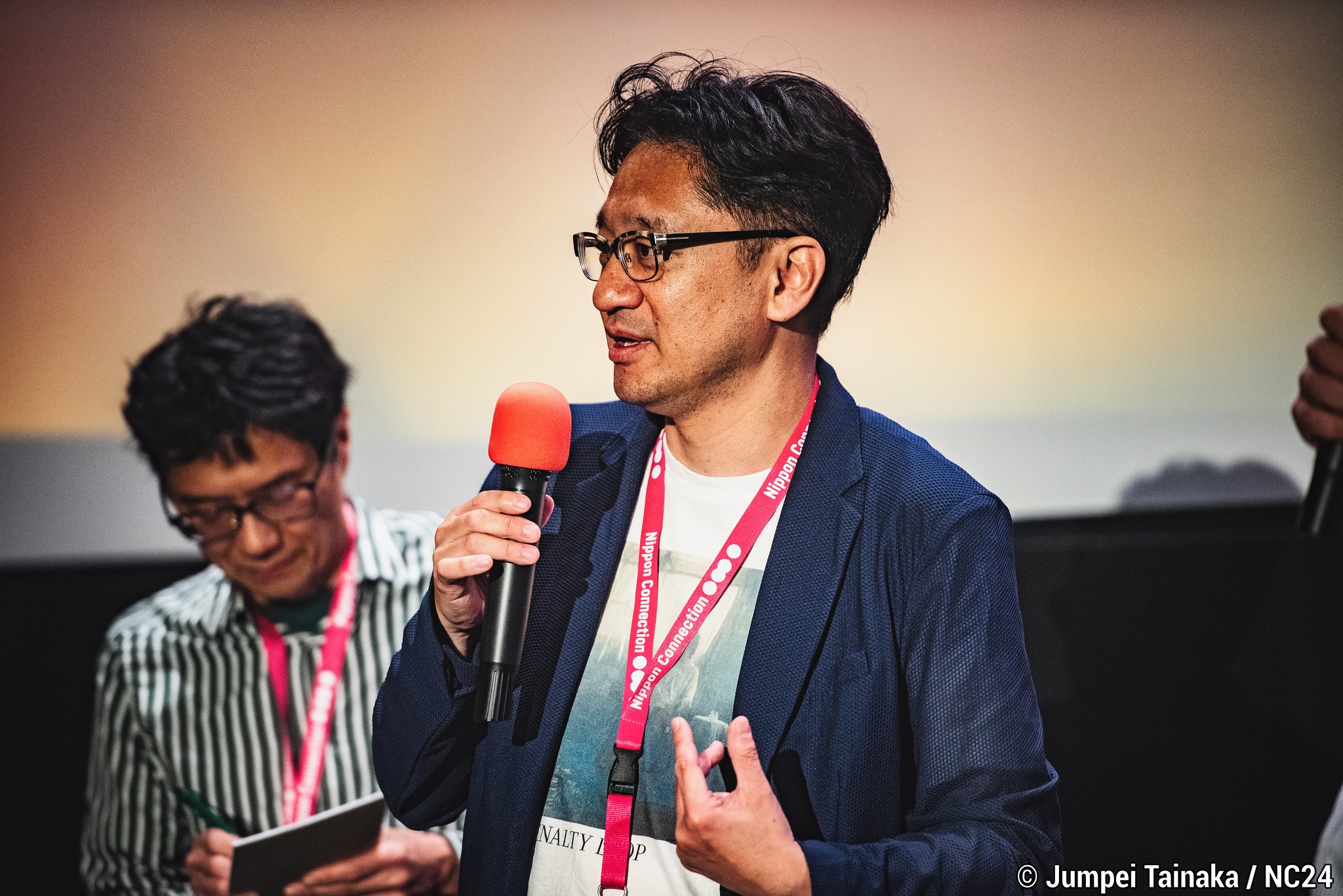
Araki-Photo

In late March 2024, Shinji Araki’s second feature film Penalty Loop (Peneruti rupu) was released in Japan. Mr. Araki was kind enough to answer a variety of questions put by our author Andrea Grunert when they met at this year’s Nippon Connection Festival in Frankfurt.

Andrea GrunertPenalty Loop is your second film. What did you do before you started making films? (1)
Shinji Araki – I was a student of Interdisciplinary Cultural Studies at the University of Tokyo but moved to France because I wanted to study at La Fémis (2) in Paris. I was not accepted and returned to Japan, where I began working in the advertising industry.
I worked as a TV advertising planner and creative director for an agency. My job included designing scripts for publicity spots.
In Japan, film directors sometimes shoot commercials. I therefore had the opportunity to work with the director Shinji Somai.
I worked in the advertising industry for 20, nearly 30 years but was getting more and more bored with the job. The year 2011 was marked by the triple disaster in the Tōhoku area. My father also died that year. These events made me think about what I really wanted to do, because life does not go on forever.
I started studying at a screenwriting school. But I was more particularly interested in the Nouvelle Vague. However, in the end, I continued with screenwriting. There are various screenplay competitions in Japan that also offer small cash prizes. I sent in my scripts to earn money. There are only two major institutions that enable screenwriters to have their work screened. One of them is the Kinoshita Group, to which I sent a script, and I won the prize there.
The typical career path would be to make a film and then win an award for it. However, I won the screenplay prize and was able to make my first film – The Town of Headcounts (3) – afterwards.
Andrea Grunert – In Penalty Loop, death is a major topic. Yesterday evening, in the Q&A session following the screening of your film, you said that you cannot accept death.
Shinji Araki – In my childhood, I went to a Catholic kindergarten. I was also baptised – my baptismal name is Johannes. I know that in the Christian church, death is mitigated by the idea of resurrection. But for me, death still has something final about it.
Andrea Grunert – Both of your films have a social as well as a moral dimension. Penalty Loop hints at the topic of the death penalty.
Shinji Araki – My first film depicts a dystopian society and involves a large group of people. The second concentrates on a few characters and focuses on moral issues. Above all, I wanted to make a completely different film from The Town of Headcounts. I wanted to prove that I am a versatile filmmaker.
When I decided to make Penalty Loop, the producer asked me whether the focus would be on the death penalty. There are, of course, many films on this topic. However, I didn’t want it to take centre stage. In Penalty Loop, I am more interested in the question why people want the death penalty or seek revenge or take the law into their own hands.
One of the actors [Jin Dae-yeon] is Korean. The death penalty is still a possible sentence in South Korea but it is no longer carried out (4). It seemed important to me that he should play a key character in the film.
Andrea Grunert – Jun – Penalty Loop’s main character – is introduced as a person who cares for other people and creatures. There is for example the moment in which he sets a ladybird free.
Shinji Araki – There is a Japanese saying: a very gentle person is one who can’t even kill an insect. That is the starting point for the scene with the ladybird. Jun is a gentle person, but he changes after experiencing violence. In one scene, he is supposed to fire his semi-automatic pistol three times, but instead he cannot stop and shoots until the entire magazine is empty.
Andrea Grunert – How did you develop the characters?
Shinji Araki – I discussed Jun’s character a lot with the lead actor. How does a normal and actually gentle person develop into a violent person? I wanted to portray this change.
My career as a director started late. I don’t find it difficult to write a screenplay. i.e. to conceptualise a story. The more difficult part for me is developing the characters.
The main character Jun is played by Ryūya Wakaba. He is an actor but has also directed films himself. He is very much interested in character development. And that’s why I chose him for the role, so that he could give me some advice on this task.
There is a scene in which Jun washes blood off his hands at the sink in his kitchen. In the script, I had only written that he was washing his hands. In the film, he shakes the sink in anger and frustration, almost ripping it out of the wall. That was Mr Wakaba’s idea. That’s an example of the way he got involved. But filmmaking is teamwork, of course, and many people helped me to make the film.
Andrea Grunert – I can well imagine that Mr Iseya, who plays the main character’s antagonist, is a similarly creative actor.
Shinji Araki – Mr Yūsuke Iseya was convicted for drug possession in 2020. Penalty Loop was his first film after his conviction. It seemed to me at the beginning that he had forgotten a little about how to act. At first we read the script together. Iseya wasn’t really involved (he laughs). I was a little worried.
Mr Wakaba and I then tried to cheer Mr Iseya up a bit. After three days, he seemed to have got the hang of it again. On the fourth or fifth day, he seemed to be having fun. It was a great pleasure for us to see his development. When we shot the scene in which his character is drawing, he obviously had a lot of fun. We shot for much longer than originally planned.
Andrea Grunert – Didn’t Mr Iseya study art?
Shinji Araki – Yes, he studied art. But I asked him not to draw too perfectly. So his development during the filming was a very important aspect for all the team. Mr Iseya is a very good actor. In a scene in which the camera shoots him from behind, he folds his arms behind his head (Mr Araki demonstrates it). That was his idea. Not every actor would think of that. He really has great talent.
Andrea Grunert – He sometimes reminds me of Toshirō Mifune.
Shinji Araki – Yes, Toshirō Mifune had a similar gift. In Japan, Mifune is said to have had ōra, a person who has an aura. Mifune and Iseya are actors with an aura.
Andrea Grunert – How much influence did the actors have on the dialogues? Did you allow improvisation?
Shinji Araki – The dialogues are not improvised. I have no experience with improvisation and didn’t want to put more pressure on myself during filming. In this respect, I stuck to what was discussed beforehand, to what was planned. Wakaba and others thought that I should develop more confidence in myself. Perhaps they would have liked to improvise. I would like to try it out in another film.
Andrea Grunert – You told me before that you are interested in the arts yourself. There are many beautiful shots in the film. Some of them are closely linked to Japanese traditions. For instance, the single shot of the bamboo grove, the wind blowing through the bamboo plants, a shot that captivates the viewer in terms of atmosphere. Was that already in the script? Or is it a shot that came about by chance?
Shinji Araki – While I was searching for locations, I discovered the bamboo grove by chance and then integrated it into the film because I found the place so beautiful. I associate the wind blowing through the bamboo plants with death. It was as if someone from the realm of the dead was giving me a sign. It may be very Japanese to associate nature with spirituality, and this kind of shot might look a bit stereotypical. As I said, it was not intentional to include that shot.
We mainly filmed in an industrial area without much natural environment. But there is also the lake into which the corpse [of the killer killed by Jun] is thrown. We found another lake with a willow tree on the bank. A very beautiful spot. Very Japanese. In Japanese culture, the willow tree is often associated with the spirits of the dead. It was not easy to decide which of the two locations to choose. But finally we took the other one.
For my generation, it is rather unusual to make films with willow trees, kimonos, tea ceremonies. We grew up differently. I now feel almost a little embarrassed about having used such a shot, which seems somewhat stereotypical. Nevertheless, I think that the shot with the bamboo grove still seems realistic. I just wanted to include it. I would like to shoot scenes in shrines or temples. But I don’t yet know how I should do that. How much distance I will be able to keep from such settings from this culture. I feel connected to it. But if I shoot a scene like that now, I want to do it differently from Kurosawa, Ozu or Mizoguchi. But how? I don’t know yet.

Andrea Grunert – Despite being a convention in Japanese cinema, I found the shot of the bamboo grove well integrated into the film and still powerful.

Shinji Araki – I hope that the shot of the bamboo grove looks natural. Nevertheless, I would like to include more Japan-specific elements in future films. If I were smarter, I would be able to shoot more scenes that are typically Japanese and would earn a lot of money. But I’m not that smart and don’t think that strategically. I am very impressed by the way Seijun Suzuki portrays Japan, for example, in his yakuza films (Mr Araki points to his arms, suggesting tattoos on them). One day I would like to make films like that about Japan.

Andrea Grunert – I was very inspired by your choice of colours as an aesthetic and symbolic means. For instance, the yellow iris as a symbol for revenge, the fact that Jun, seeking revenge, drives a yellow car …

Shinji Araki – Blue and yellow are my favourite colours. If I were to name a colour for this film, it would be green. Yellow and blue mixed together also make green. The film deals with death, but it’s also a film in which you see a lot of green – in the landscape scenes, in the hydroponic factory etc. It is a very lively colour. For me, the film is green and yellow.
If there is too much dialogue in the film, you can no longer feel the emotions. I’m glad that you asked a question about the colours.
Andrea Grunert – Other elements appealing to the emotions are music and sound, which are obviously very important in Penalty Loop, too. How do you work with the people concerned with the soundtrack?
Shinji Araki – Indeed, music plays a very important role for me. Takuma Watanabe wrote the music for my first film. But unfortunately, he fell ill. When I learnt that he couldn’t work with me on Penalty Loop, I panicked. That shows how important music is to me.
So I had to find another composer. His name is also Watanabe, namely Takashi Watanabe. I was able to get him to write the music for Penalty Loop. He composed pieces for the film that have become my favourites.
For me, it’s not only important in which scene which music is used but it is also important which instruments are used. The piano is a dangerous instrument for me. It’s easy to feel comfortable with piano music. I find that dangerous.
Takashi Watanabe often uses unusual musical instruments such as the tuba and ethnic instruments that are not so well-known.
The sounds other than the music are created by Mr Kō. He also works for Ryūsuke Hamaguchi, among others.
Mr Kō seems a bit crazy to me. He wants to do everything himself. He wants to record and mix everything himself (Mr Araki puts a lot of emphasis on this sentence). In such a big production, he should have one or more assistants. When I asked him about that, he replied: “An assistant, what’s that?” I asked him to hire assistants. He then brought a few people with him, but they left after the sound recordings were finished. He did everything else alone at home. I often discussed with him whether everything was fine or whether something needed to be changed. A very interesting man. As he does almost everything on his own, he has a great responsibility. He and Mr Watanabe were very important for the film. I would love to work with both of them again.

*Interview conducted on 30 May 2024 in Frankfurt/Main and kindly translated from Japanese
into German by Ms Tachibana Yukari. This English version was translated by the interviewer.

Notes
(1) Araki’s first feature film The Town of Headcounts was released in 2020.
(2) École nationale supérieure des métiers de l’image et du son (European Foundation for the Professions of Image and Sound), based at the PSL Research Centre in Paris.
(3) Ninzū no machi, 2020.
(4) In contrast to South Korea, the death penalty is not only legal in Japan but is still caried out.

under-the-open-sky
Subarashiki sekai (Under the Open Sky) von Nishikawa Miwa

von Andrea Grunert

Bedingt durch die Pandemie fand in diesem Jahr das japanische Filmfestival Nippon Connection erneut online statt. Neben den Filmreihen – Spielfilmen, Anime, Dokumentarfilmen, Kurzfilmen – gab es wieder ein interessantes Begleitprogramm mit Interviews und Vorträgen. Angesichts des vielfältigen Angebots hatte der Zuschauer die Qual der Wahl. Die meine fiel auf fünf Filme: Zeze Takahisas Rakuen (The Promised Land, 2019). Fukada Kōjis Yokagao (A Girl Missing, Japan/Frankreich, 2019), Nishikawa Miwas Subarashiki sekai (Under the Open Sky, 2020), Sono Sions Escher dori no akai posuto (Red Post on Escher Street, 2020) und Toyoda Toshiakas Hakai no hi (The Day of Distribution, 2020).
Erinnerung und Trauma sind die Themen, die sich wie ein roter Faden durch die Filme ziehen. In Rakuen, Yokagao und Subarashiki sekai liegt die Vergangenheit wie ein dunkler Schatten über den Charakteren. In Rakuen leidet die junge Tsumugi (Sugisaka Hana) auch zwölf Jahre nach den Ereignissen noch unter dem Verschwinden ihrer Schulfreundin. Die mysteriöse Entführung eines jungen Mädchens zerstört das Leben der Tante des Tatverdächtigen (Yokagao). In Subarashiki sekai versucht ein alternder Yakuza sich nach einer langen Haftstrafe verzweifelt in die Gesellschaft zu integrieren.
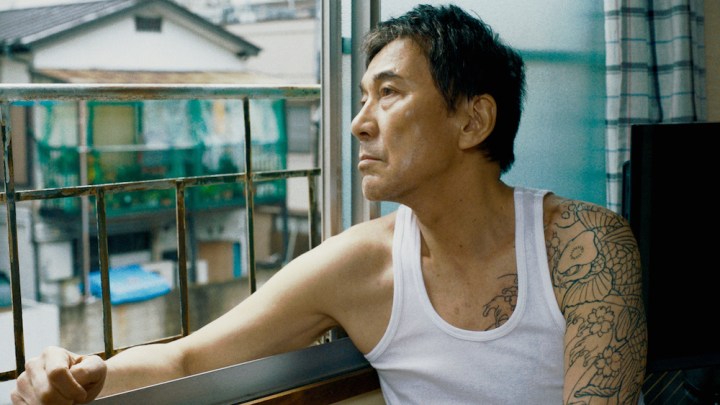
Nishikawas Film beginnt mit der Einstellung eines vergitterten Fensters, bevor die grauen Mauern eines Gefängnisses in einer Schneelandschaft gezeigt werden. Das Gefühl der Trauer und des Eingeschlossen seins, das diese Bilder ausstrahlen, durchzieht den gesamten Film, in dem der von Yakusho Kōji gespielte Ex-Gangster nicht nur versucht, wieder Fuß im Alltag zu fassen, sondern sich auch auf die Suche nach seiner Mutter macht, die ihn als Kleinkind verlassen hat. Die Vergangenheit lauert überall. Mikami hat die Gefängnisregeln verinnerlicht, marschiert in einigen Szenen im Stechschritt, was an Yakushos Rolle in Imamura Shoheis Unagi (The Eel, 1997) erinnert, in dem der aus dem Gefängnis entlassene Protagonist die gleiche Attitüde zeigt.
Mikami hat nicht nur Schwierigkeiten, im Gefängnis antrainierte Verhaltensmuster abzulegen, sondern muss sich einer Reihe von Hindernissen stellen. Der Alltag ist voller Tücken mit Neuerungen, wie der Mülltrennung, die ihm fremd sind. Dabei ist er nicht völlig auf sich gestellt. Sein Anwalt und dessen Frau versuchen ihm zu helfen, ebenso ein junger Sozialarbeiter und ein Journalist. Er findet sogar einen Freund in einem Supermarktfilialleiter. Doch der leicht erregbare Mikami hat sich nicht unter Kontrolle und fällt immer wieder in sein altes, von Gewalt geprägtes Gehabe zurück. Die mehrfach auftauchenden Totalen, die ihn nachts im Bildhintergrund in einer Telefonzelle zeigen, sind visueller Ausdruck seiner Isolation.
Während Mikami versucht, die Vergangenheit hinter sich zu lassen und ein anderer Mensch zu werden, jedoch immer wieder von ihr eingeholt wird, leben die Charaktere von Rakuen in der Vergangenheit. Zwölf Jahre zuvor hatte sich die Freundin an einer Wegkreuzung von Tsumugi getrennt. Kurz danach war sie verschwunden. Ihre Familie und vor allem der Großvater (Emoto Akira) leiden ebenso wie die nun Anfang Zwanzigjährige Tsumugi unter dem nach wie vor ungeklärten Schicksal des Mädchens. Der eigenbrötlerische Bienenzüchter Zenjirō (Satō Kōichi) kann den Tod seiner Frau nicht verwinden und klammert sich an die Vergangenheit. Tsumugi allerdings versucht, sich aus ihrem Trauma zu befreien, verlässt ihr Heimatdorf und findet Arbeit in Tokio.
Yokagao rekonstruiert in Rückblenden die Geschehnisse um die Krankenschwester Ichiko (Tsutsui Mariko), die nach der Entführung und möglichen Vergewaltigung des Teenagers Saki, der Tochter der Familie, deren bettlägerige Mutter eine von Ichikos Patientinnen ist, ihre Arbeit verloren hat. Von Rache besessen schmiedet sie eine Intrige und ändert dafür ihre Identität. Doch nicht nur sie wird von dem Verbrechen geplagt, sondern auch Motoko (Ichikawa Mikako), Sakis ältere Schwester, die Ichiko bei ihren Eltern denunziert, die nicht wissen, dass der Tatverdächtige ihr Neffe ist. Dabei war es Motoko, die Ichiko geraten hatte, die Verwandtschaft zu verheimlichen. Motoko zerstört mit weiteren Lügen Ichikos Leben. Diese verliert ihre Arbeit bei der Schwesternagentur; der Arzt, mit dem sie verlobt war, trennt sich von ihr. Während Saki nach ihrem Wiederauftauchen unbeschadet wirkt, wird Motoko als gestörte Persönlichkeit dargestellt, die sich der jüngeren Schwester gegenüber zurückgesetzt fühlt und starke Gefühle auf Ichiko projiziert. Als diese es ablehnt, mit ihr zusammenzuziehen, da sie vor hat den Arzt zu heiraten, verleumdet Motoko sie vor der Presse.
Die Vergangenheit, der sich die Charaktere stellen müssen, spielt auch in Escher dori no akai posuto eine große Rolle. Der Regisseur Kobayashi (Yamaoka Tatsuhiro) begegnet immer wieder dem Geist seiner verstorbenen Frau, die seine Ideen in Frage stellt und ihn inspiriert. Kiniko (Kohira Matsuri), eine der jungen Frauen, die sich zum Casting für Kobayashis neuen Film angemeldet haben, lebt in der Erinnerung an ihren bei einem Unfall verstorbenen Mann. Und auch in Hakai no hi hat die Vergangenheit Einfluss auf die Gegenwart: Das Monster, das in einer alten Kohlemine gefangengehalten wird, hat ein tödliches Virus in die Welt gesetzt, während der Film über traditionelle Gegenstände wie das katana (das Langschwert der Samurai) und Nohmasken Erinnerungen an die Ära der Samurai heraufbeschwört.
Wenngleich auf unterschiedliche Weise sind in allen Filmen Vergangenheit und Gegenwart von Gewalt geprägt, von Verbrechen (Rakuen, Yokagao, Subarashiki sekai, Escher dori no akai posuto) oder einer tödlichen Krankheit (Hakai no hi). Blut und Tod sind omnipräsente Motive aller fünf Spielfilme, die um Schuld und Sühne, Unschuld und Rache kreisen. In Rakuen fragt der verbitterte Großvater, warum Tsumugi lebe und seine Enkelin verschwunden und sehr wahrscheinlich tot sei. In Yokagao macht Mokoto Ichiko gegenüber eine ähnliche Bemerkung, als sie die Krankenschwester fragt, wie diese glücklich sein könne, nachdem deren Neffe Saki entführt habe. Dieses Glück, auf das sie neidisch ist, wird sie systematisch zerstören. In Sonos Film werden Themen wie Sünde und Reinigung von Schuld angesprochen, während in Rakuen eine der Personen sagt, dass der Selbstmord des Tatverdächtigen Befreiung von Schuld sei. Der junge Mann verbrennt sich selbst. Feuer und Wasser als reinigende Elemente : Ichiko wird, nachdem ihre mühevoll inszenierte Intrige fehlgeschlagen ist, ins Meer waten – nicht um zu sterben, wie die Szene zuerst vermuten lässt, sondern in einem Moment der Erneuerung, selbst wenn es keine Rückkehr zur vorher gelebten Normalität und keine vollständige Heilung geben wird.
Die spirituelle Dimension trifft auf die Beschreibung menschlicher Schicksale, Symbolik auf Psychologie. Alle Filme entwerfen kritische Porträts der Gegenwartsgesellschaft. Sie beschäftigen sich mit Vorurteilen und Diskriminierung, deren Opfer der ehemalige Yakuza Mikami ebenso wird wie der junge aus Korea stammende Einwanderer Takeshi (Ayano Gō), der in Japan nicht das gelobte Land findet, sondern vom Mob in den Tod gehetzt wird (Rakuen). Zezes Film verweist auf tiefverwurzelten japanischen Rassismus gegen Koreaner und Rassismus, der sich gegen eine neue Gruppe von Migranten – in diesem Falle Afrikaner –wendet, die von den Dorfbewohnern als erste verdächtigt werden, nachdem erneut ein Mädchen vermisst wird. Tsumugi stellt sich nicht nur ihrem Trauma, sondern reißt auch das Plakat ab, auf dem die Dörfler zur Wachsamkeit aufgefordert werden. Sie stellt sich gegen diesen Appell zur Denunziation, der nur Misstrauen schüre. Ichiko wird Opfer dieses Misstrauens, dass durch die Medienhetze, die sie mehr und mehr ausgrenzt, befeuert wird. Kritik an sensationslüsternen Medien findet sich auch in Nishikawas Film. Eine Redakteurin plant einen Film über Mikami zu drehen, doch ihr Interesse gilt nicht den Problemen des ehemaligen Yakuza, sondern spektakulärer Gewalt.
Nach Jigoku de naze warui (Why Don’t You Pay in Hell?, 2013) ist Escher dori no akai posuto ein weiterer Film Sonos über das Filmemachen. Über den Mikrokosmos der Filmwelt werden psychosoziale Probleme aufgezeigt wie der Wunsch des Einzelnen nach Beachtung und Individualität. Kobayashi will zu seinen Wurzeln als Indie Filmemacher zurückkehren, wird dabei aber mit vielen Hindernissen konfrontiert. Sein Name erinnert an Kobayashi Masaki, einen Regisseur, der ebenfalls Konflikte mit seinem Studio ausgetragen hat. Die Korruption innerhalb des Studiossystems findet ihren Widerhall auf der politischen Ebene. Die auf den ersten Blick künstlich erscheinende Filmwelt wird in der Realität verankert, wenn im Radio Nachrichten über Demonstrationen in Hongkong zu hören sind. Der experimentelle Hakai no hi ist ganz eindeutig eine Reaktion auf aktuelle Zustände: Das Leben mit dem Virus.
Allen Filmen sind ihre verschachtelten Strukturen gemein, die manchmal überraschende Wendungen zulassen. Alle arbeiten sie auf mehreren Zeitebenen mit Flashbacks und Flashforwards. Bereits im Titel von Sonos Film findet sich die Referenz an den niederländischen Künstler M.C. Escher (1898-1972), der sich in seinem Werk mit optischen Täuschungen, unmöglich erscheinenden Perspektiven und multistabiler Wahrnehmung beschäftigt. Sonos Film kreist um Wahrnehmung und Illusion, was durch die verschiedenen Zeitebenen, durch Perspektivwechsel auf ein und dieselbe Handlung und Variationen von Themen erzählerisch und visuell verstärkt wird. Außerdem greift Sono auf die Geisterfigur zurück und spielt auf vielen Ebenen mit Täuschung: von der Selbsttäuschung, in der sich Stars ebenso wie Statisten verlieren, bis hin zur Halluzination. Auch in Hakai no hi findet sich die Geistergeschichte wieder ebenso wie das Horrorelement, die das Monster verkörpert. Um Täuschungen geht es auch in Yokagao, in dem Sakis kurzzeitiges Verschwinden ein Rätsel bleibt, Ichiko eine andere Identität annimmt und in dem Malerei und die unterschiedliche Bedeutung ein und desselben Motivs bei verschiedenen Malern ein Thema ist. In Rakuen verbirgt sich hinter der Maske des freundlichen Bienenzüchters ein Misanthrop und Mörder, der aber selbst Opfer einer eingeschworenen Dorfgemeinschaft ist, während das Schicksal des verschwundenen Mädchens ein Geheimnis bleibt.
Am Ende von Escher dori no akai posuto scheint die Filmhandlung in die Realität zu münden, als auf einer belebten Straße mitten in Tokio gedreht wird und ein Polizist die Aufnahme stoppt, indem er die Hand auf die Kameralinse legt. Fiktion oder Realität? Kino ist Illusion und doch unabdingbarer Teil gelebter Wirklichkeit ist. Das zeigen die fünf Filme in komplexen Geschichten und Bildkompositionen. Über jeden dieser Filme wäre noch viel zu schreiben. Und dennoch – mir fehlte wie so häufig in den letzten Jahren – die Kraft der Filme der großen Meister der japanischen Kinos der Vergangenheit.