by Andrea Grunert
Right from the opening credits, a direct link is established between Fumihiko Sori’s Ichi (2008) and Kan Shimozawa’s short story “The Tale of Zatoichi” (“Zatōichi monogatari”, published in 1948), informing the viewer that the film is based on Shimozawa’s work of literature. Moreover, Ichi is a spin-off of a whole series of jidai geki films starring Shintarō Katsu in the role of Zatōichi (1), the itinerant blind masseur and master with the sword. In Sori’s film, Ichi is a woman, a blind wandering musician, and is played by Haruka Ayase. Her name is a direct play on “ichi” in “zatōichi” (2). And like the hero in the film series, Sori’s Ichi excels at swordfighting.
Ichi starts with an image of snowflakes against a night sky. In the next shot, a blind figure is making slow progress across a wintry landscape. Shots of snow-covered landscapes appear repeatedly in the film, and snow is also a reminder of two films featuring a female swordfighter: Lady Snowblood (Shurayuki-hime, Japan, 1973) and Lady Snowblood 2: Love Song of Vengeance (Shurayuki-hime: urami renga, Japan, 1974), both directed by Toshiya Fujita (3). Not unlike Yuki (Meiko Kaji), the heroine in Fujita’s films, Ichi kills efficiently. However, Yuki – whose name means “snow” – is trained to be a cold-blooded killer. She hacks and slashes her way through the narrative, driven solely by the desire for vengeance. Her aim is to fulfil her late mother’s wish and take revenge on the men who had murdered her husband and young child and had raped her, Yuki being the child resulting from this act of rape.
Ichi, after being expelled from a group of blind female itinerant musicians has her own motive for her pilgrimage round Japan. A flashback reveals that a blind swordfighter (Tetta Sugimoto) had placed her in the care of the wandering musicians when she was still a child. Now an adult, she is driven by the desire to find and reunite with this unnamed man who had once rescued her and whom she regards as her father. The film deliberately plays with the identity of her mentor, suggesting that he may even be the legendary blind swordsman Zatōichi. This connection is implied by their similar lightning-fast fighting style, reminiscent of the technique for which Zatōichi is renowned. Ichi herself has been taught this distinctive fighting style by her surrogate father, who visited her periodically when she was an adolescent, as a flashback reveals. Like Zatōichi in the film series, both Ichi and the unnamed swordfighter from her past wield a cane sword (shikomizue).
Sori’s female protagonist is depicted as exacting retribution for harm inflicted upon her, including the rape perpetrated by a male character. In contrast to Yuki, who has undergone a rigorous training regime turning her into a true killing machine, Ichi has primarily been taught by her mentor so that she can defend herself. However, both women are highly skilled combatants.
History and genre conventions
Ichi relies on the tradition of jidai geki (period films) and its subcategory the chanbara, swordfighting films. Quick midair drawing of the sword, slashing blades and acrobatic somersaults are part of the swordfighting choreography. Action is set in the 1830s/1840s, a period in which samurai were still the political rulers of Japan although the merchant class had accumulated the economic power to assume authority. In the social order established during the Tokugawa period, merchants belonged to the lowest rank (4), a status that was viewed with profound disdain by the samurai. Nevertheless, over the course of several centuries, their importance in Japanese society had increased exponentially.
Most of the narrative in Ichi takes place in the fictitious town of Bito. Once a vibrant post station (shukuba), it is now terrorized by a yakuza gang led by the brutal Banki (Shidō Nakamura). The Shirakawa clan, a group of chivalrous gamblers who are firmly integrated into the town’s social life is at risk of being eliminated by the bandits. The narrative of two rival gangs bears a striking resemblance to Akira Kurosawa’s renowned masterpiece Yojimbo (Yōjinbō, 1961). In Kurosawa’s jidai geki, a town is terrorized by yakuza gangs, who have been hired by two merchants in a bid to gain control of the region. In Yojimbo, the merchants are shown as exercising a dominant influence in social life of the town, this being an allusion to historical reality in the early nineteenth century and at the same time pointing to the importance of those with economic power in the context of post-war Japan.
In both films, the town that serves as a social microcosm is infested with corruption and crime. However, as in the first film in the Zatoichi series, the focus of Ichi is the conflict between two opposing yakuza gangs. Chōbei (Akira Emoto), the head of the Shirakawa clan who openly demonstrates his yakuza identity, is portrayed as a respectable and socially influential figure whose activities contribute positively to the town’s fortunes. His status within the community is further underscored by his formal attire when he welcomes an inspector from the shogunate, a scene that reinforces his position as a legitimate and respected member of the social order. In contrast, their hotchpotch clothes in garish colours and eye-catching patterns and wild hairstyles immediately identify the Banki gang as yakuza, the way they dress setting them apart from mainstream society.
The blue and grey kimonos worn by the men of the Shirakawa clan demonstrate the new social standing of these yakuza as fully integrated into the community. They are very clearly the “good” ones, defending a rightful cause against the “bad” Banki and his bandits. This portrayal of the Shirakawa clan follows the romanticized view of yakuza as honourable outlaws that is familiar from literature and cinema and also corresponds to the self-image of traditional yakuza (5). This romanticized image of the criminals in Ichi contrasts strongly with that in Kurosawa’s Yojimbo, where the two rival groups are both depicted as villainous.
While adhering to a conventional “good” versus “bad” narrative structure, Sori nevertheless emphasizes the hapless situation of outcasts such as Ichi and Banki. Banki was once a samurai but his face was disfigured by a burn, and this led to his expulsion from his clan and subsequent descent into criminality. Banki’s and also Ichi’s experiences are indicative of the widespread fear of physical disability in Japanese society. The ragged clothes worn by Ichi, in conjunction with the frequent shots of her and other visually-impaired musicians in the cold of winter, serve as a constant reminder of their impoverished existence on the margins of society.
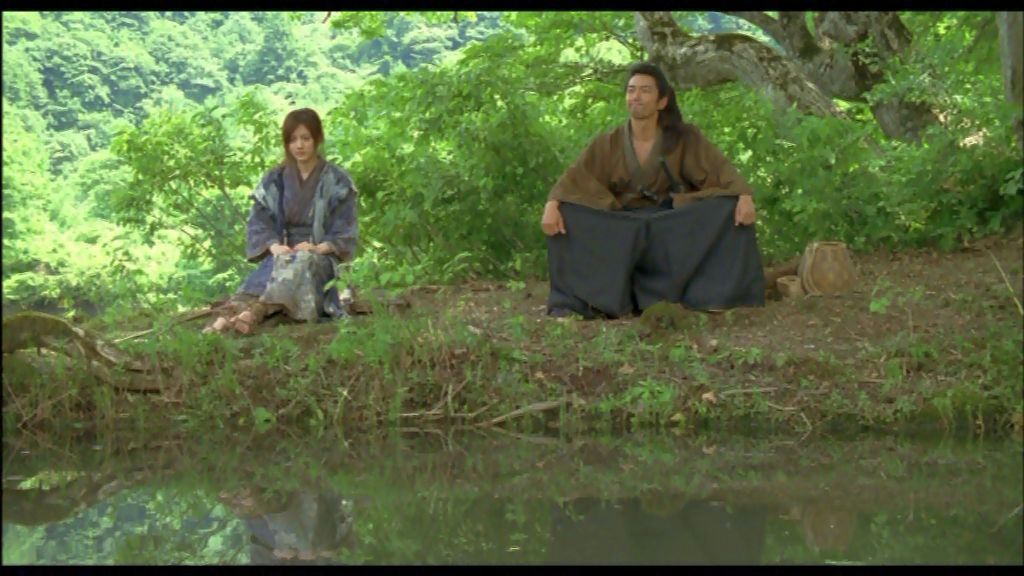
However, the disabled in Ichi are presented as resourceful and particularly strong fighters. It is the inspector sent by the shogun who trembles with fear when threatened by one of Banki’s men. The samurai’s political impotence hints at the changing socio-political conditions in these last decades of the shogunate. It is, however, the character of Toma Fujihira (Takao Ōsawa), a samurai who meets Ichi by chance and remains by her side, who challenges and redefines conventional representations of masculinity and the warrior class. Although a formidable fighter with a wooden stick, Toma is unable to draw his sword. Hired by the Shirakawa as their yōjinbō, or bodyguard, he is unable to perform this task because of his inability. After their boss’s death, which he was not able to prevent, the vengeful Shirakawa brutally humiliate him, beating and kicking him.
Toma’s characterization contrasts sharply with the conventional image of the heroic samurai. He is a “fake hero” – a pretender whose reputation is built on a lie. The Shirakawa hired him because they believed that he had killed five of Banki’s men. In fact, it was Ichi who killed them to rescue Toma from death at the hands of the bandits. However, he does not set the record straight and although he feels remorse about taking credit for Ichi’s achievements, he does not reveal the truth. His silence on this therefore reinforces the film’s critique of masculine heroism. Toma’s behaviour exposes the discrepancy between the image of the invincible samurai and the vulnerability of the man behind that image.
De- and reconstructing traditional gender roles
Haruka Ayase plays the demanding role of the blind woman in a highly convincing manner with restrained expressions and gestures. This sober portrayal of the female protagonist follows jidai geki conventions in their representation of stoic, self-controlled swordsmen. She is a superheroine with the sword, refuting the commonly held belief that a woman’s role is that of the victim. The insistence on her fighting skills may, at first glance, seem simply a reversal of gender roles and genre conventions, with Ichi portrayed as a woman in a role traditionally associated with men. Her reluctance to engage in fights that do not concern her recalls numerous heroes in American westerns. She advises Toma against fighting for the Shirakawa clan because becoming involved in matters that concern only other people bears risks. However, her pilgrimage is determined not only by the search for her fatherly mentor and is also portrayed as the painful quest for a sense in life. Snow becomes a symbol of a world lacking the human warmth that Ichi – perhaps unconsciously – is looking for.
The portrayal of the male protagonist, Toma, and the deconstruction of masculinity contribute to the establishment of a central female figure, and here too, external motifs are brought to the fore. Toma’s repeated desperate attempts to draw his sword from its sheath allude to Freudian theories of castration anxiety. Just as Ichi is traumatized by her experience of loss, Toma’s inability to fight with a sword is similarly explained as the result of a childhood trauma.
The character Toma can be read as a deliberate subversion of the conventional ideal of samurai masculinity, traditionally associated with physical strength and emotional restraint. Rather than conforming to this archetype, Toma is characterized by a need to express himself verbally, by animated gestures, and by visible emotionalism. This is particularly evident in the scene following his first encounter with Ichi, in which his loquacious and expressive behaviour contrasts sharply with Ichi’s reserved demeanour. His frequent moments of comic relief, at times approaching slapstick, further destabilize the image of the samurai as a figure exhibiting serious and controlled masculine authority.
However, Toma’s lack of conventional masculinity in the film does not diminish his status. His emotional openness coexists with qualities traditionally coded as masculine such as courage, chivalry and a willingness to protect and care for others. In this sense, Toma represents a more differentiated model of masculinity in which emotional expressiveness and vulnerability are compatible with strength and honour. As a character, he therefore challenges the assumption that masculine identity must be grounded in stoicism and the suppression of emotions. This emerges as particularly significant in his relationship with Ichi. While Ichi exhibits a more conventional form of restrained and emotionally opaque behaviour that is strongly influenced by traditional representations of masculinity, Toma’s openness reveals the limitations of this kind of emotional detachment.
East meets West
In the last part of the film, Ichi has exchanged the rags she has so far worn for an elegant kimono and outer garments with highly symbolic meaning. Over the kimono she wears Toma’s green coat as an expression of honour for the man who has devoted his life to her and a light, black overcoat reminiscent of the kind worn by Zen Buddhist monks in a reference to their ideals of harmony and inner peace. In Bito, Ichi has found the path leading to enlightenment. She says to the boy Kotarō (Ryōsuke Shima), another character besides Toma whose kindness has touched her, that he has brought light into her life. This is a reference back to a sequence earlier in the film when the boy mistakenly brings Ichi a lantern which she clearly does not need. Here too, the focus is on an object that has a second, spiritual meaning. Ichi is now able to see the “inner light” and find the sense of humanity she has been longing for.
Conclusion
Ichi does not delve into the psychology of its protagonists, and its references to elements in other cinematic works (6) are often only superficial. However, its nuanced portrayal of the two main protagonists succeeds in reconstructing and redefining gender roles. The juxtaposition of seemingly contradictory attitudes such as strength and vulnerability allows the film to present gender roles not as a fixed identities but as something that is constructed, performed and can potentially be reconfigured.
Notes
(1) The first of the 26 films with Shintarō Katsu was released in 1962 and the last in 1989. In 2003, Takeshi Kitano directed Zatoichi: The Blind Swordsman (Zatōichi), a reboot of the popular franchise, in which he also starred.
(2) In the name Zatōichi, the part “zatō” refers to a blind masseur or musician in historical Japan. “Ichi” is the given name of both protagonists. “Zatō” was the lowest of four ranks in the Tōdōza, a guild created for blind persons during the Tokugawa or Edo period (1603-1868). Because blind people were subject to strict social stratification and had only limited employment options, they often worked as musicians or massage therapists (anma). Over time, “zatō” became synonymous with “blind person”.
(3) Fujita’s Lady Snowblood inspired Quentin Tarantino’s two Kill Bill films (USA, 2003/2004).
(4) In the Tokugawa period, the social order comprised four distinct classes: samurai, peasants, artisans and merchants.
(5) Traditional yakuza like to refer to themselves as ninkyō dantai (chivalrous organization). The Shirakawa clan is modelled on this idealized image of community-focused yakuza who act as protectors of a town.
(6) In the showdown scene between the two gangs, the dusty main street of the small town resembles very closely the street in Yojimbo. The setting in both films also clearly evokes the western, with a shop sign rattling in the wind in Ichi a further reminder of this Hollywood genre. And the film’s final sequence, in which the boy Kotarō calls after Ichi, asking if they will see each other again, is very similar to the final shots in George Stevens’s western Shane (USA, 1953).In a further parallel, the use of close-ups of Toma’s eyes in the duel scene with Banki recalls Sergio Leone’s framing and editing techniques in his spaghetti westerns.

