by Andrea Grunert
In Mitsutoshi Tanaka’s Ask This of Rikyu (Rikyū ni tazuneyō, Japan, 2013), the viewer is prepared for the main protagonist’s tragic fate right from the beginning. The opening sequence shows the arrest of Sen non Rikyū, the famous sixteenth-century tea master, who is ordered to commit suicide by disembowelment. The reasons for this sentence, imposed by Hideyoshi Toyotomi, Japan’s de facto ruler at that time, remain unknown, but what is clear is that Rikyū lost his life in a struggle for power and influence. However, Tanaka’s film reveals that there is no clear-cut distinction between winning and losing but that these terms are part of a highly complex reality.
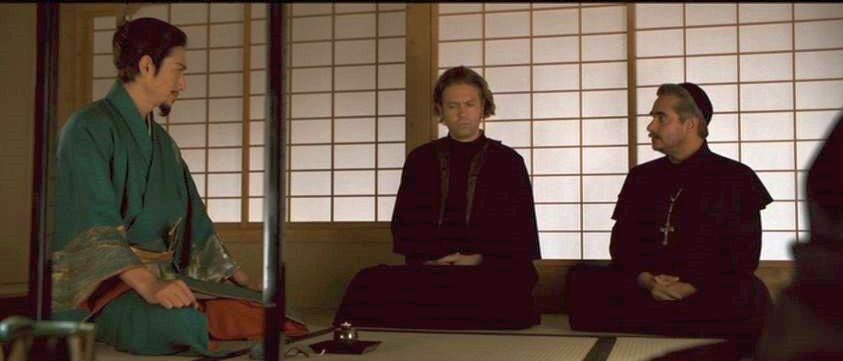
Considering this topic of “winning or losing” immediately brought one particular scene in Ask This of Rikyu to my mind – the scene in which, twelve years before his death in 1591, Rikyū (Danjūrō Ichikawa XIII) conducts a tea ceremony for his lord Nobunaga Oda (Yūsuke Iseya) and two Jesuit priests. It is a long dialogue scene lasting about 5 minutes and in which contrasting world views clash. The value of a tea caddy made of clay is first discussed by the Japanese tea master and the two Europeans, for whom this small, dark-coloured receptacle simply has no particular value at all. Their monetary-oriented perception is in conflict with Rikyū’s, for whom its beauty and spiritual significance are more important than what it is worth financially. For him, tea is something that delights both body and soul.
Two brief previous scenes have already revealed the difference between European and Japanese taste and definitions of beauty. The younger of the two Jesuits, Alessandro Valignano (Everton Strottmann), still unfamiliar with the country in which he has only recently arrived, has only contempt for the Japanese culture, using the word “junk” to refer to objects revered by the Japanese such as the utensils used in a tea ceremony. His companion Luis Frōis (Eduardo Mira Battista), a Japanophile who admires the country and its culture, contradicts him. There are other subtle visual hints that demonstrate Valignano’s lack of knowledge. In contrast with the delicate colouring and fragility of a flower bud in a vase made of a bamboo cane, the contents of the storeroom full of presents from Europe – including armour and elephant tusks – look like just a collection of bric-a-brac. These contrasting images imply strong criticism of the European feeling of superiority, with Valignano’s behaviour representing sheer ignorance.
In the tea room sequence, the focus quickly shifts to Nobunaga and Rikyū and from a clash of cultures to the confrontation between master and servant, both of whom have strength of character. Today, Rikyū is considered one of the most influential tea masters in Japanese history. In the film, his lord, Nobunaga, is presented as a connoisseur who can appreciate the artistic value of an object but is less interested in the spiritual aspect than in the political dimension of the “Way of Tea” (chadō), which he tries to use to his own advantage. He is an obsessive collector, as shown in an earlier sequence in which, still in his riding dress, he casts only a fleeting glance at the tea utensils offered to him and quickly decides which he will buy.
In the intimacy of the tea room, the dialogue between Nobunaga and Rikyū does not unfold as an open dispute, and their disagreements are revealed in a more subtle way and conveyed primarily through the performance of the two actors. Nobunaga watches with amusement the discussion between the Jesuits and the tea master on the value of the tea caddy, a topic that he has introduced. He then challenges Rikyū in a mocking tone, clearly emphasizing that he is the master and Rikyū his servant. The provocation behind his words is fully revealed by the expression on his face and in his voice – a smug smile, an ironic undertone. However, Rikyū does not allow himself to be provoked, and he responds calmly but firmly. While Nobunaga’s facial expression and body language convey pride and passion, Rikyū is a man at peace with himself, offering resistance but without using grand words or actions. Confident and unafraid of his lord, he states: “Beauty is what I say it is. Legends will grow from the objects I choose.”
Ichikawa’s performance is in perfect accord with the sobriety of the tea room, a flower bud in a bamboo tube being the only decoration. This tea-room scene is reminiscent of Rikyū’s tea-ceremony style with its emphasis on simplicity. However, the mise-en-scène is not rigid but highly varied, alternating between medium-long shots and close-ups, and positioning the human figures either in isolation or within foreground-background constellations. The composition of the images, marked by visual clarity, are echoed in restrained, deliberate gestures. Close-ups of individual objects – the flower bud, the tea caddy, a tea bowl filled with frothing matcha – generate moments of contemplative tranquillity.
In the tea room, the positioning of the participants accords them equal status. However, Nobunaga is prominent visually – while Rikyū and the two Jesuits wear simple garments of dark colours, the lord is dressed in a green kimono adorned with delicate gold embroidery and a golden brocade obi (kimono sash), introducing an element of luxury into the room’s restrained simplicity. Moreover, his golden fan contrasts sharply with the earthenware tea caddy. At the end of this scene, Nobunaga asserts his power when he suddenly orders his vassal Tōkichirō, the future Hideyoshi Toyotomi (Nao Ōmori) who is on guard outside the tea room, to come in and take away the tea caddy. However, this worldly power based on a desire for possession and on objects of material value, is transient. Nobunaga was assassinated only a few years after the scene portrayed in the film. Considered the first unifier of Japan after a long period of unrest, he remains one of the most important figures in Japanese history. But it was Hideyoshi who became his successor, and the Oda clan’s power declined after Nobunaga’s assassination. In the tea-room sequence, Nobunaga clearly puts Rikyū in his place; and years later the tea master is condemned to death by Hideyoshi, Japan’s second unifier. However, despite seeming to be the loser both in the film and in history, Rikyū wins a moral victory in the tea-ceremony scene and he also has a place in history as the person who left his indelible mark on the “Way of Tea”.
Andrea Grunert is an independent scholar (Ph.D. University Paris X with a dissertation on the films of Clint Eastwood and the American frontier) and freelance writer. She is the editor of four books published by Charles Corlet (France): Le corps filmé (2006), L’écran des frontières (2010), De la pauvreté (2013) and Et les jeunes … (2016).
Instagram: @angru2016
Facebook: @andreagrunert.98
Website: http://www.a-grunert.de

